
Three Abandoned-Cart Emails, No Order: What to Check
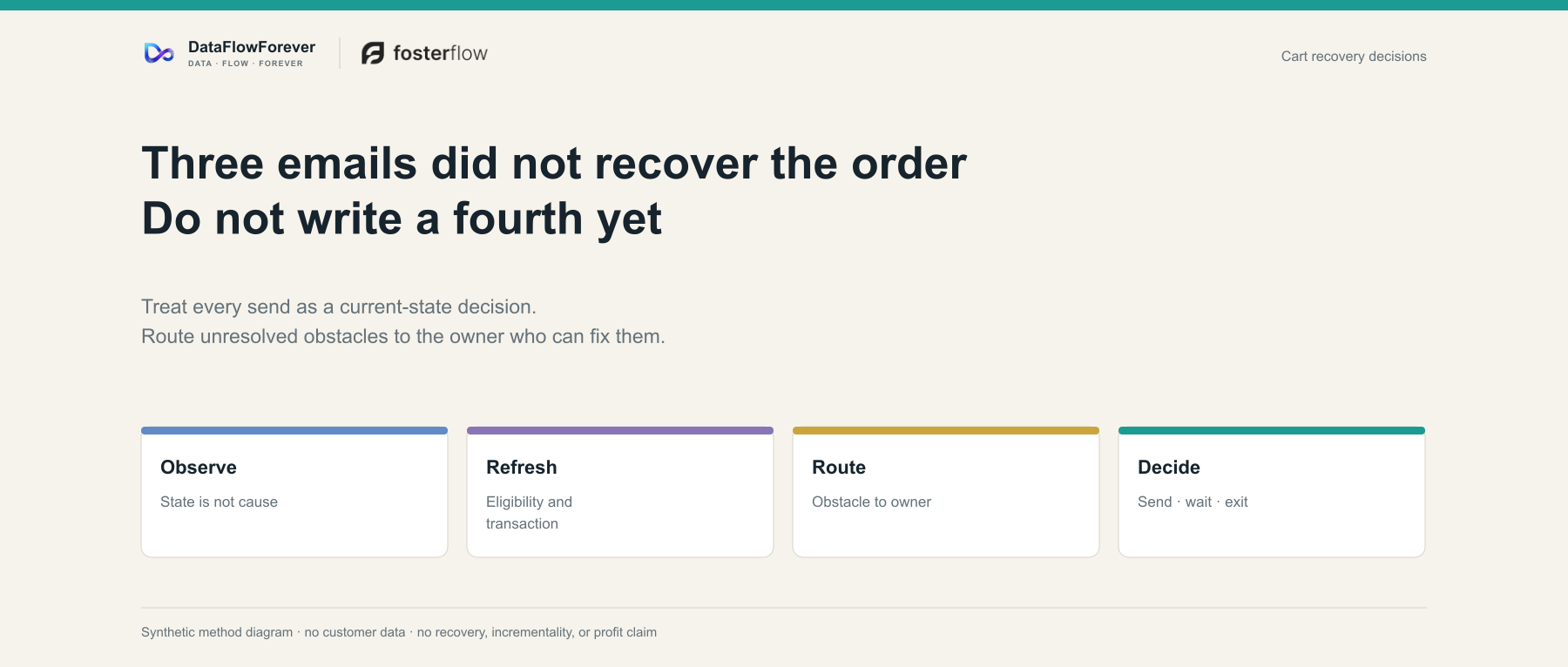
Three sends are a message count, not three useful recovery jobs. Refresh current eligibility and commerce state before deciding to send, wait, exit, or hand off.
Consider a hypothetical store.
A shopper adds an item, reaches checkout, and leaves. The recovery sequence sends its first message, follows with product information, then offers an incentive. No connected order appears.
The next discussion often starts with copy: a stronger subject line, more urgency, a larger discount, or another channel. Yet the evidence has not changed. The team has observed a cart or checkout state and no corresponding completed order within a defined data scope. It has not established whether the shopper still wants the item, bought through another path, encountered a delivery restriction, saw an unexpected total, received a payment decline, or met a broken page.
The practical answer is to pause before writing message four. Treat every recovery message as a current-state decision. Confirm whether this person can be contacted now, whether the merchandise and offer remain valid, whether checkout can be completed, whether payment or an order already exists, and which owner can remove the unresolved obstacle. Waiting, exiting, and handing off are legitimate outcomes.
Three emails describe a count. They do not show that the sequence performed three useful jobs.
A funnel step locates the exit; it does not explain it
Google Analytics' official Purchase Journey report organizes observable events from session start through item view, add to cart, begin checkout, and purchase. It also distinguishes closed and open funnels. That model helps a team locate a recorded drop-off. It cannot identify shipping cost, tax, trust, payment, product fit, or low intent as the cause.
Instrumentation has to be checked before the drop-off can even be trusted. Google's ecommerce measurement guide documents events such as begin_checkout, purchase, and refund, together with item arrays, currency, value, and debugging. An emitted event does not prove that product identifiers, amounts, currency, identity joins, deduplication, refunds, or attribution are correct. Compare representative event records with the commerce and order facts they are supposed to describe.
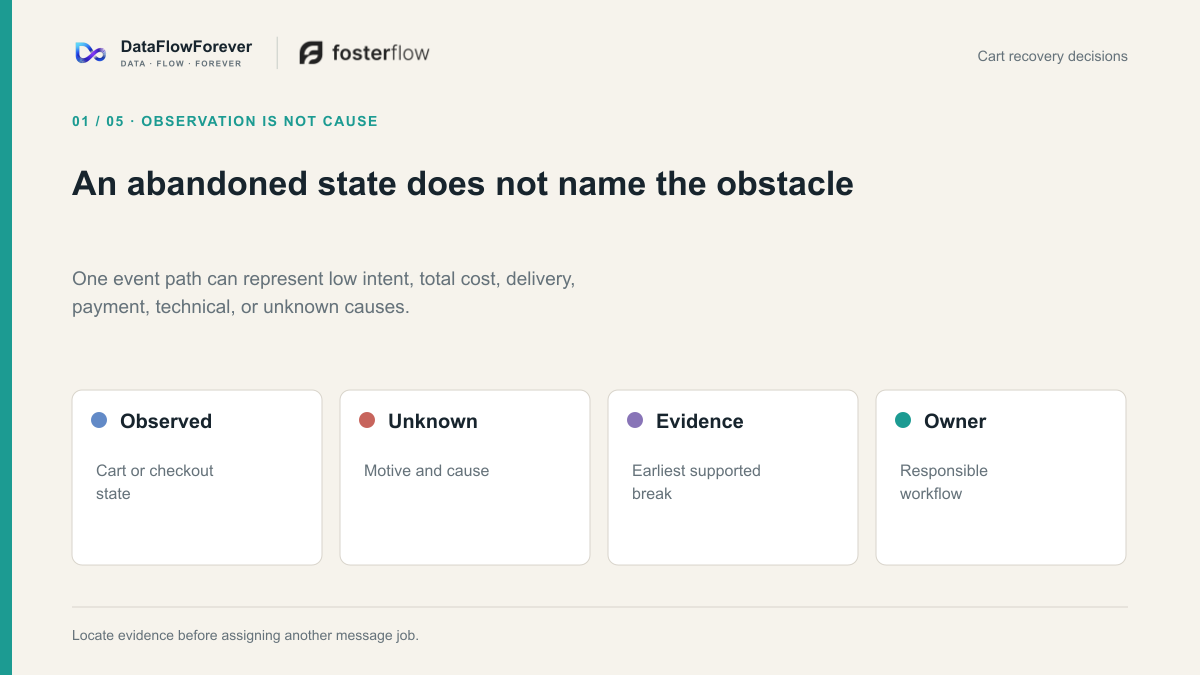
The intent boundary matters as well. A peer-reviewed study on online shopping-cart abandonment examined carts used for research, organization, and entertainment as well as purchase, and modeled several inhibitors. Its sample, period, and correlational design cannot assign a current reason to a present-day store or provide a current prevalence ranking. It supports a modest operating rule: preserve “intent unknown” as a valid state instead of treating every cart as an interrupted order.
Anonymous public discussions add useful voice-of-customer language. Merchants describe checkouts without sales and ask how to log checkout problems reported by shoppers. Consumers describe repeated cart reminders as intrusive. These accounts help teams recognize questions and failure language. They are not estimates of frequency, proof of a platform defect, or evidence that one cadence works for everyone.
Begin the audit with a literal observation: which cart, checkout, payment, order, and purchase facts were seen; which identity rules connect them; what time and channel boundaries apply; and which facts remain unknown. Labels such as “high intent” or “price sensitive” should not be promoted from the event alone.
Separate obstacles so each one has an accountable owner
“Abandonment” compresses several operationally different possibilities. A useful working taxonomy keeps at least six classes open:
- Intent unknown. The person may be comparing, saving, researching, waiting for approval, or planning a later purchase.
- Product, offer, fit, or trust. Product evidence may not answer a compatibility, size, quality, return, or support question. An offer may be unclear, expired, or inapplicable.
- Total cost, shipping, tax, or delivery. A destination may be unsupported, the full amount may appear late, or the delivery promise may not meet the shopper's need.
- Payment, authentication, or order state. Issuer declines, authentication requirements, unsupported methods, and delayed order creation require different responses.
- Technical or measurement integrity. Page errors, promotion conflicts, gateway return failures, missing events, and duplicated events can resemble a customer decision.
- Permission, reachability, and contact pressure. Current consent, suppression, deliverability, quiet periods, and communication from other campaigns can make another send inappropriate.
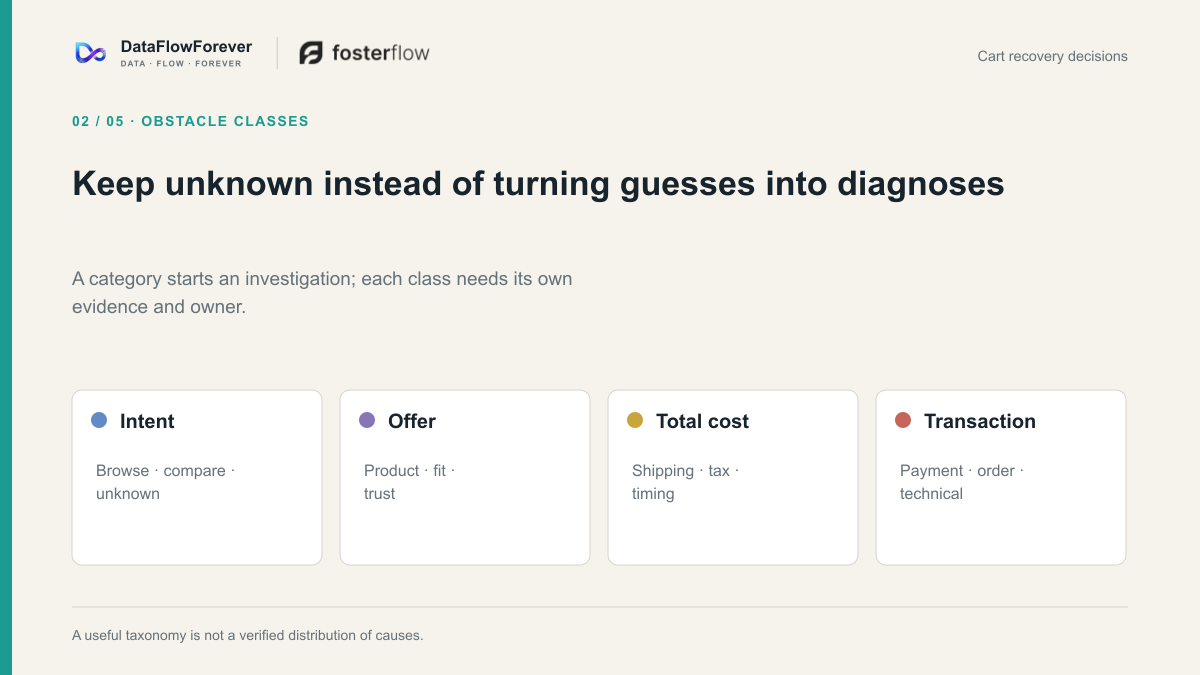
The taxonomy creates a handoff map. Merchandising or content owns product facts. Commercial owners confirm offer rules and cost. Fulfillment owns shipping eligibility and current delivery estimates. Payment, order, and support records constrain payment guidance. Data or engineering owners inspect event and page failures. The lifecycle team applies permission and contact rules and chooses a bounded message job. Messaging can explain, route, remind, and invite a choice; it cannot repair every upstream condition.
Shopify's official guide to recovering abandoned checkouts brings payment events, inventory and discount failures, unsupported shipping, third-party gateway return problems, and email eligibility into the same order-fact review. The page also identifies the Shopify experience to which its instructions apply. Use it to calibrate Shopify states and stop conditions, not as a universal contract for every platform. A checkout marked recovered may have completed through an email link or another route, so the status is not proof of incremental email impact.
Re-evaluate current state before every message
Entry eligibility is a historical fact by the time a later node runs. The shopper, cart, price, inventory, permission, payment, and order can all change. Every send should therefore run a fresh decision using current evidence.
Check six areas:
- Identity and contact eligibility. Can the observed activity be associated under the implementation's identity rules? Is the person currently reachable and permitted for this channel? Apply suppressions and the relevant quiet-period policy.
- Journey precedence. Has a purchase occurred through another device or channel? Has the case moved into order service, fulfillment, cancellation, or refund? Is another communication performing a more important job?
- Merchandise and cart validity. Are the selected item, variant, quantity, price, availability, and sellable state current? Is the cart still populated? Are offer terms still valid for the item and market?
- Checkout and delivery. Is the destination supported? Can shipping, tax, required fees, and delivery range be calculated from current facts? Is a known promotion or checkout defect unresolved?
- Payment and order. Did the latest attempt require authentication, corrected information, a different method, issuer contact, or no further automated retry? Was an order created even if one system has not caught up?
- Contact pressure and message novelty. What commercial communication has already arrived across channels? Does the proposed message help with a new task, or does it repeat the previous reminder?
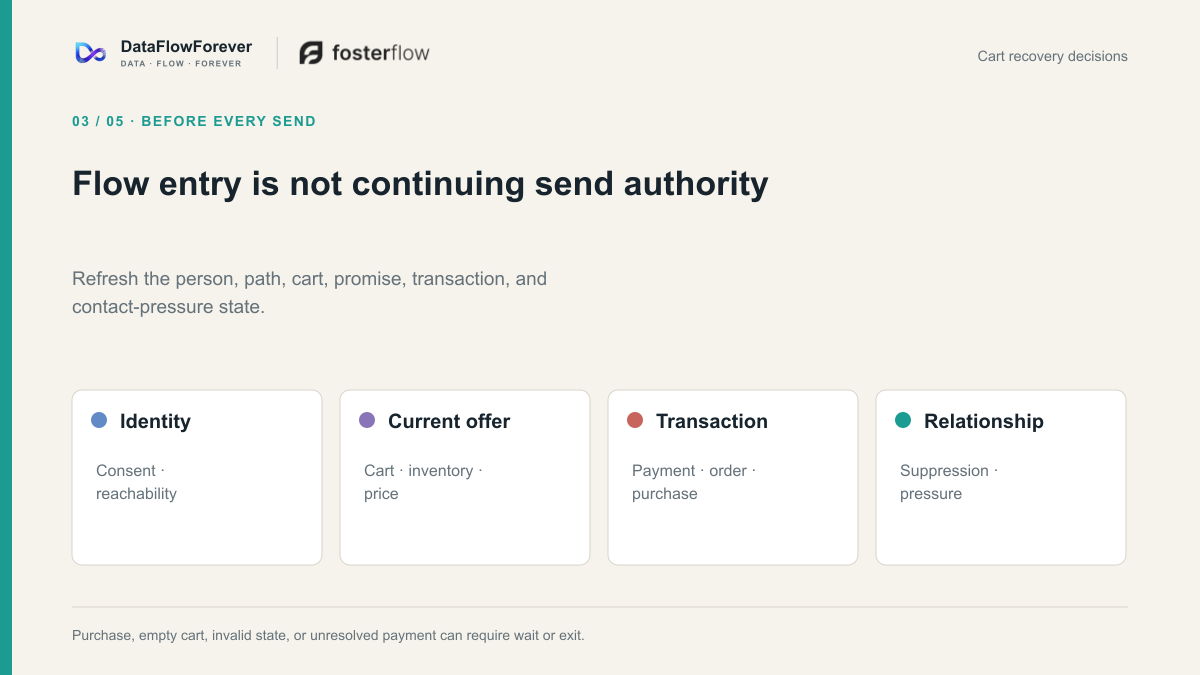
The decision should support four outcomes: send, wait, exit, or hand off. A completed purchase, an empty or removed cart, unavailable stock, unsupported shipping, an invalid offer, missing contact eligibility, or a contact-pressure conflict can require an exit or wait. Conflicting payment and order states, a known technical failure, or a case needing human judgment should move to the appropriate owner.
For US commercial email, the FTC's CAN-SPAM compliance guide explains primary-purpose classification, unsubscribe mechanisms, opt-out handling, and the sender's continuing responsibility when a service provider is used. It is US-specific and does not replace consent, privacy, or legal review for other jurisdictions. The operational lesson is bounded: opt-out and suppression belong inside the current send decision, not in a separate checklist that a Flow can overlook.
Handle payment declines without inventing a cause
“Payment failed” covers several next actions. Stripe's current decline-code documentation distinguishes conditions that may call for authentication, corrected fields, a different payment method, a later retry, issuer contact, or no further retry. These are Stripe-specific codes and guidance; another provider may expose a different interface.
For do_not_honor, the safe interpretation is narrow: the issuer declined the payment for an unknown reason. The customer can contact the issuer for more information or use another available payment method where checkout permits. The code does not establish insufficient funds, fraud, a stolen card, a Shopify defect, merchant fault, or payment-platform fault. Customer-facing copy should not guess at or reveal sensitive decline reasons.
An anonymous Shopify discussion asks specifically about DO NOT HONOR payment failures. It is useful VOC because it shows the operator's question and the need for clear support guidance. It does not prove the underlying cause or the rate of the problem. The current payment-provider documentation, payment-attempt record, order state, and issuer information remain the authorities for the action.
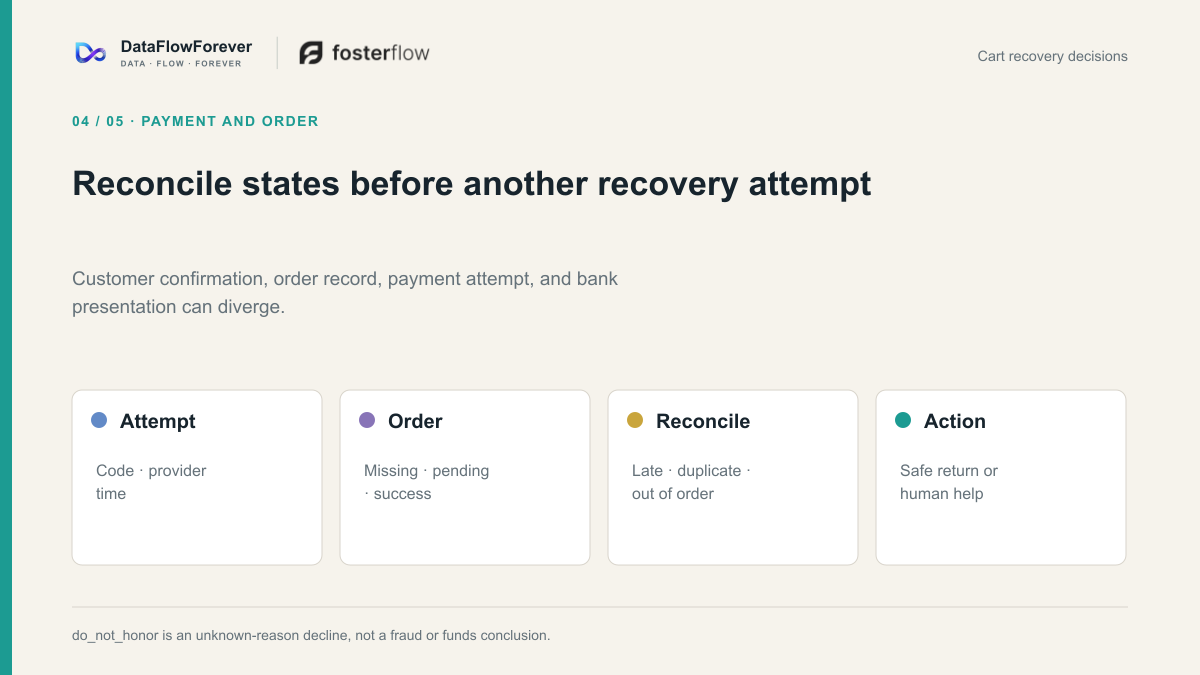
The operating sequence can stay simple. First, check whether payment or an order has already completed. Next, read the provider's current standardized state. Determine whether the supported action is authentication, correction, another method, issuer contact, a later retry, or a stop. Only then send the corresponding help. If records conflict, pause automation and hand the case to payment or support operations.
Give every later message a new job
When the current-state check permits contact, define one task for the next message. It might:
- return the shopper to a still-valid cart;
- explain current total cost, shipping eligibility, or delivery conditions;
- help complete authentication, correct a field, choose an available method, or reach support;
- answer a product-specific fit, return, or service question with a verifiable source;
- invite an optional short reason without presuming motive; or
- explain that the item or offer is no longer available and close the recovery path.
Three versions of “you left something behind” still perform one job. Urgency does not repair a gateway return, and a discount does not make an unsupported destination serviceable. An incentive also changes contribution and customer expectations. Treat it as a separately qualified commercial experiment with visible cost, rather than an automatic escalation.
A three-year, multichannel relationship study titled “Enough Is Enough!” examined communication volume, channel mix, customer preference, and repurchase responses. Its existing-customer setting is not an abandoned-cart Flow and provides no universal email count, interval, or quiet-hour rule. It supports testing total cross-channel pressure and preference alignment rather than counting cart emails in isolation.
Public conversations about three-step cart sequences and unwanted cart reminder texts or emails provide language and counterexamples. They cannot establish that three messages are excessive, one is optimal, or a specific schedule applies to another audience.
Use a Recovery Decision Record at every node
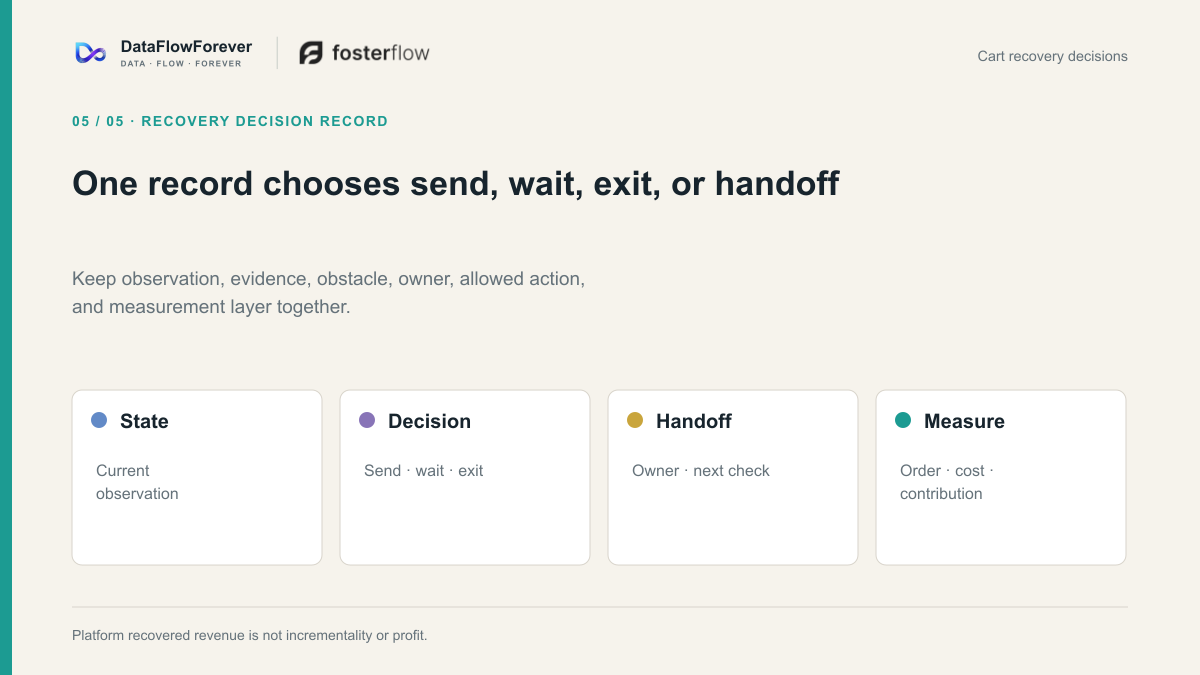
A Recovery Decision Record keeps the evidence behind each send, wait, exit, or handoff. It can be a compact table or structured event. The value comes from preserving the decision, not from adding another dashboard.
- Field: Observed state · What it should retain: Current cart, checkout, payment, order, and purchase facts, plus evidence time
- Field: Identity and contact eligibility · What it should retain: Identity scope, channel permission, reachability, suppressions, quiet period, and total contact pressure
- Field: Obstacle class · What it should retain: Intent unknown; product/offer; cost/delivery; payment/order; technical/data; permission/pressure, with multiple classes allowed
- Field: Evidence and unknowns · What it should retain: Sources supporting the judgment, conflicting records, and unresolved questions
- Field: Accountable owner · What it should retain: Lifecycle, merchandising, commercial, fulfillment, payment, engineering, or support
- Field: Allowed action · What it should retain: Send, wait, exit, or hand off, together with the message's single job
- Field: Recheck condition · What it should retain: The event or state change that triggers another decision
- Field: Measurement scope · What it should retain: Eligible population, message action, checkout/payment/order state, refunds, returns, and contribution costs
Consider a fully synthetic same-cycle example. It represents no merchant, shopper, account, order, or observed result.
A fictional shopper begins checkout. The item remains sellable, and current price and shipping eligibility can be verified. A payment attempt then returns do_not_honor; no confirmed order appears in the connected order record. Email eligibility is current, while a generic reminder has already been delivered. The record classifies the case as “payment/order state unresolved,” retains “issuer reason unknown,” and assigns payment and support operations. The allowed message offers neutral help: use another available payment method or contact the issuer. Before any later contact, the system must recheck payment and order state. A confirmed order exits recovery; conflicting records pause and hand off; continued inactivity does not become evidence that a larger discount is needed.
The example contains no performance number because it demonstrates a decision structure, not an outcome claim.
Treat reason capture as hypothesis collection
Optional short reasons can improve the team's vocabulary, but respondents select themselves into the sample. Incentives can change who answers and how they answer. A systematic review of incentives in surveys discusses response, data quality, nonresponse error, cost, and web surveys. It is not abandonment-specific and does not permit a higher response rate to stand in for representativeness or accuracy.
Triangulate each reason with relevant facts. Compare “shipping cost” with destination, rate calculation, delivery exits, and support questions. Compare “payment failure” with provider state, authentication, method, order creation, and retry outcomes. Compare “code did not work” with promotion rules, eligible items, conflicts, and page errors. Preserve “not buying now” as self-report rather than overwriting it with a behavioral story. Record no response as no response.
Fee presentation also deserves a separate test. A randomized field experiment on StubHub, published as “Price Salience and Product Choice”, compared earlier and later disclosure of mandatory fees and examined purchase behavior, product choice, and spending. It shows that fee salience can be isolated as an experimental variable. It does not endorse hidden fees, and its ticket-market effect sizes should not be transferred to general ecommerce.
Measure decisions, orders, costs, and incrementality separately
A platform's “recovered” order is usually an attribution state. Shopify's help documentation notes that a checkout may be recovered after a recovery-link visit or independently. That state is useful for operational review. It does not prove that the message caused the order.
Build the measurement chain in layers:
- Count records with current identity, permission, reachability, and a valid cart state.
- Record send, wait, exit, and handoff decisions with reasons at each node.
- Observe delivery and the customer's next supported action: return to checkout, complete authentication, choose support, or take no recorded action.
- Connect payment, order, cancellation, refund, and return to the same business facts.
- Calculate contribution after discounts, shipping subsidies, payment cost, product cost, refunds, and returns where the necessary data is available.
- Use an appropriate control or staged experiment to distinguish the recovery action from natural purchase, another channel, or a concurrent change.
Change one upstream condition at a time. Total-price presentation, shipping information, payment handling, page errors, message job, and incentive policy are different interventions. When all of them change together, an order movement cannot reveal which repair mattered.
Shipping promises also have a factual and jurisdictional boundary. The FTC's US Mail, Internet, or Telephone Order Merchandise Rule guide explains the need for a reasonable basis for shipping representations and addresses delay, cancellation, and refund duties within its scope. It does not explain abandonment prevalence or predict the conversion effect of delivery copy. Once a properly completed order exists, the journey should leave cart recovery and enter fulfillment, delay-consent, cancellation, or refund handling.
Audit one node before deciding on message four
Choose one node in the existing sequence and review a bounded sample of decision records. Ask what was observed at entry, what changed by send time, which obstacle had evidence, who could resolve it, what new job the message performed, which state caused an exit, and how attributed recovery connected to orders, refunds, and contribution.
If the third email repeated the first email's job, pause the fourth. If payment, shipping, inventory, offer, or page evidence points to an upstream defect, route it to the owner who can repair it. When current state and ownership are clear, write the smallest message that helps with that specific task.
DataFlowForever works with cross-border ecommerce teams to audit the path from cart evidence to order facts, current-state decisions, accountable handoffs, and defensible measurement. A useful starting point is one existing recovery sequence and one Recovery Decision Record—not a promise to send more messages.