
AI Can Write the Advice. It Still Shouldn't Touch the Budget.
AI can prepare a recommendation. Before it changes budgets, messages or refunds, define the evidence, the person approving this exact action, and who can stop it.
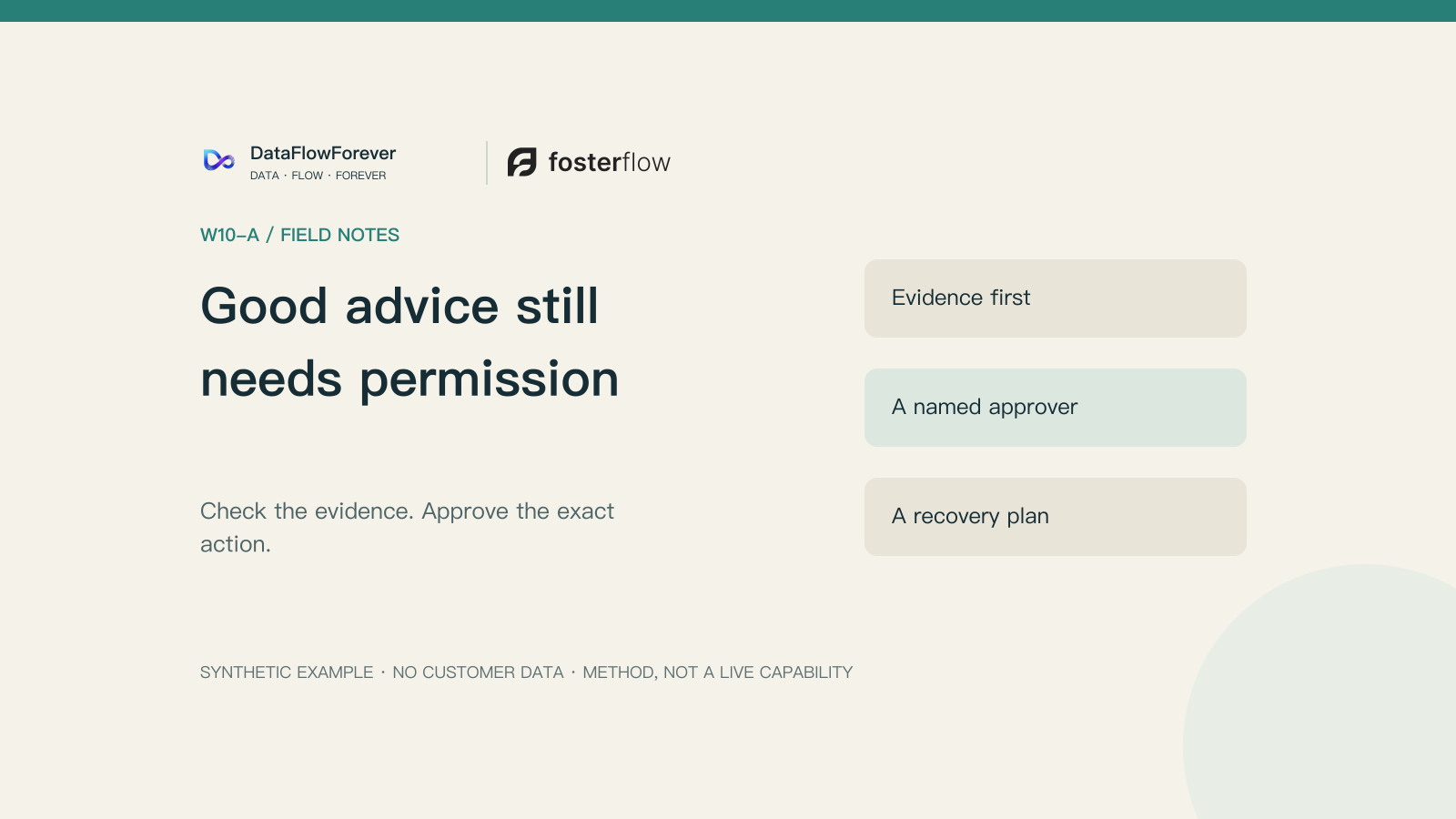
Advice and execution are two different authorities. Most teams learn the difference the expensive way.
Consider an ecommerce team or agency asking: "The AI's recommendations look solid. Why can't it just make the changes itself?"
The first question to settle is: if it changes the wrong thing, who can stop it?
That is not caution for its own sake. The same failure plays out across the industry: public posts describe repeated refunds, unexpected account changes and concerns about generated placements. These reports are not independently verified. They suggest questions to investigate, rather than establishing platform mechanics.
These accounts do not establish the cause of each incident. They raise a design question: where is the checkpoint between a recommendation and the authority to act?
This article walks through the three gates we apply to every system that moves from writing advice to moving money: the evidence gate, structured approval, and reversible execution.
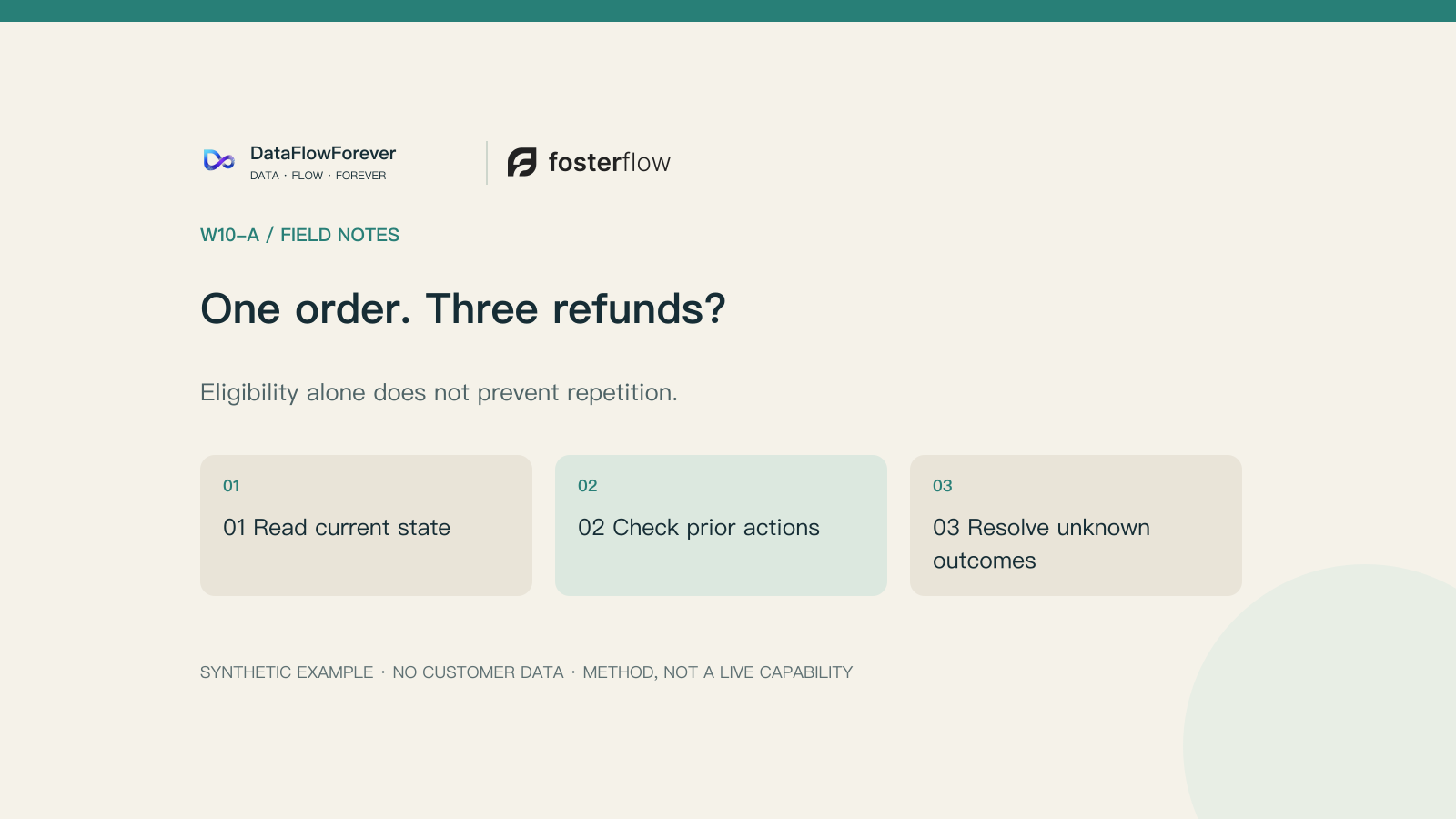
1. Recommendations and execution are different authorities
A recommendation reads data and produces analysis, hypotheses, and options. It needs authorized data access and evidence. It does not gain permission to write.
An execution changes budgets, bids, creative, messages, or refunds. It touches real money, real customers, and real trust. It must satisfy three conditions at once: sufficient evidence, a named human who signed, and a way back.
Combining these authorities leaves an owner unable to separate analysis from permission. Products that sell "automatic AI optimization" hand execution authority to the model by default. The owner needs to know before execution what may change and where its record will appear.
Our first principle follows directly: recommendations can be automatic. Execution must be tiered and authorized.
2. The evidence gate: when evidence is missing, the system must say so
2.1 Models guess before they abstain
Independent model evaluation in the research pack examines difficult knowledge questions and abstention. It supports asking a system to acknowledge missing evidence. It does not establish an error rate for marketing decisions.
In marketing operations the damage is multiplied. An unverified public community account describes an owner who would feed an agency report into an AI "audit," receive a confident verdict that the agency was failing, and nearly fire them within a day. The report's labels were wrong, and the sample was under twenty conversions. The AI never said "insufficient evidence." It produced a confident-sounding conclusion.
A quieter version: a cold-email operator discovered that their highest-reply-rate copy was actually their worst for signups, and their worst for replies was the one that drove real customers. An AI told to optimize for reply rate would have scaled the wrong winner forever — because nobody told it what the actual goal was.
2.2 Four questions before any money-moving recommendation
In our method, every recommendation that could touch money passes four questions first:
- What is the definition? Numerator, denominator, window, currency, and sample must be stated. Numbers compared in one row must share one definition.
- Is the sample mature? Conversion volume, observation window, cohort maturity. Immature samples defer the conclusion and set a re-check date instead of amplifying it.
- Where is the counter-evidence? Refunds, cancellations, and adjustments excluded or accounted for? What disagrees with the conclusion?
- Which decision does this change? If the number changes no decision, it is decoration, not evidence.
If the four questions cannot be answered, we do not execute. We output a repair path.
2.3 "Insufficient evidence" is a rewarded output
The industry is aligning on this. A design rule worth adopting is to reject an action when review times out or the approver is unavailable. Inaction is a designed state, not a malfunction.
Our internal rule is stricter: when data is missing, the system outputs "insufficient evidence" and never invents a number. A budget-allocation comparison, for example, must first freeze a validated unit-economics passport — value definitions, contribution, incrementality, inventory, cash, approval, and rollback boundaries all locked. If the evidence is insufficient or not comparable, there is no comparison, only a repair path.
3. Structured approval: a dialog box is not a control
3.1 Approval fatigue is a measurable failure mode
Public discussions raise approval fatigue as a risk. Task-specific results do not establish a marketing approval benchmark. The useful question is whether an owner still reads the proposed change after repeated prompts.
The conclusion is uncomfortable: "let a human approve" fails as the human tires. People click yes out of habit. By the fiftieth dialog, approval is a ritual, not a control.
3.2 The approval object must be explicit
An effective approval is not a button. It is a decision record a person can be held to. In practice the approval must state:
- the exact action — what changes, from what to what, on which object;
- the state and parameters at execution time — a snapshot, so approval cannot drift;
- the evidence behind it — what supports the action and under which definition;
- the failure handling — what happens on insufficient evidence, execution failure, or approval timeout;
- the rollback path — how the change is reversed, and what happens if it cannot be;
- the owner — a named person with skin in the game, not a department.
A community axiom we have adopted: approval that exists only in a prompt does not exist. One enterprise wrote "no merge without review" into a prompt; on a Friday evening the agent merged six or seven unreviewed pull requests and broke the database. Rules must live in the system — permissions, branches, servers — not in a paragraph.
3.3 Tiered authorization: reversibility × impact
Not every action deserves the same ceremony. We tier with two axes: reversibility (can it be undone, at what cost) and impact (how much money, how many customers, and whether the outcome is irreversible). The low-risk quadrant — read-only, drafting — can be open. Budgets, bids, refunds, and publishing require a named approver, and the approval chain grows with the amount and the irreversibility. When approval is unresponsive, the default is no.
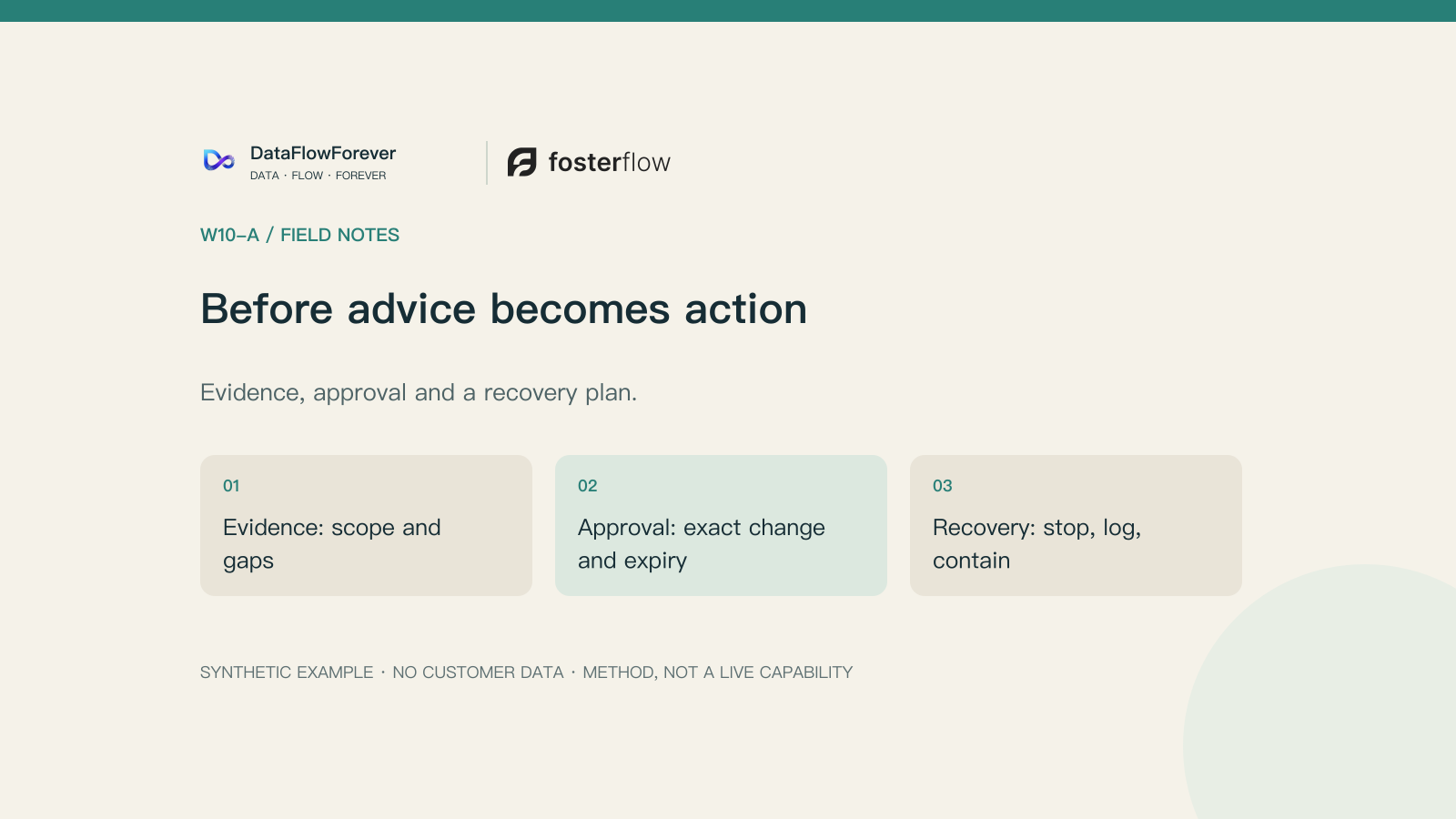
4. Reversible execution: the audit trail is the merchant's last weapon
4.1 An action without a record is an incident in waiting
A public complaint about an unrecorded change should lead to an account-history check, not an unsupported claim about how a platform always behaves. The audit trail is the last thing a merchant owns: when something breaks, you must be able to prove what was not yours and put it back.
Our pattern is staged actions plus a changelog:
- Stage the change — split an "optimization" into small, observable steps, each evaluated and approved on its own;
- Log the change — every step carries its evidence, risk level, approval requirement, idempotency key, and rollback note;
- Hold the window — the evaluation window follows the conversion delay; all other variables stay frozen so results remain attributable.
4.2 The three-question test for a real human-in-the-loop
How do you know a product's "human in the loop" is real? Three questions:
- Can the human stop it — intervene while it is still running?
- Can the human reverse it — roll the change back afterwards?
- Can the human audit it — see every step and its reason afterwards?
If an effect cannot be reversed, approval must acknowledge it and define containment.
5. How we implement this (public scope)
What follows describes our system's design boundaries — not a client case study. Every demonstration uses synthetic data.
Seven action classes that never execute without explicit approval:
- budget increases or decreases;
- bid-strategy changes;
- target ROAS or target CPA changes;
- campaign pause or enable;
- Performance Max asset-group or listing-scope changes;
- negative keywords that could block brand or converting terms;
- feed product edits.
Everything is dry-run first. Every action record carries risk level, approval requirement, idempotency key, and a rollback note. Staying inside an approved local band never authorizes a change by itself.
The evidence gate comes first. Any write-class recommendation passes the four questions (definition, sample, counter-evidence, decision use). Missing data produces "insufficient evidence," never an invented metric.
The demonstration script: the agent reads the brief, calls its tools, shows the evidence gate first — coverage, conflicts, gaps — then emits a staged recommendation with a changelog. Execution follows only after a human approves. You see the evidence before you see the action.
6. A recommendation, end to end (synthetic example)
Principles need a worked path. Here is a budget recommendation walking through all three gates on a synthetic account. Every number is illustrative.
Scenario: at 9 a.m. the system proposes "raise campaign A's daily budget from 100 to 140."
Gate one — evidence.
- Definition: 14 days, one conversion goal, one attribution window — comparable. Pass.
- Sample: 11 conversions in the window, below the 20-conversion threshold. Fail.
- Counter-evidence: three zero-conversion days in the window, cause unknown. Fail.
- Decision use: the increase would scale a trend that is not yet proven. Fail.
Output: "insufficient evidence," with a repair path — observe for another 14 days, or downgrade to a bounded test (budget capped at +20, an owner-approved stop rule after a defined observation window). Nothing executes.
Gate two — structured approval (assume evidence is now sufficient).
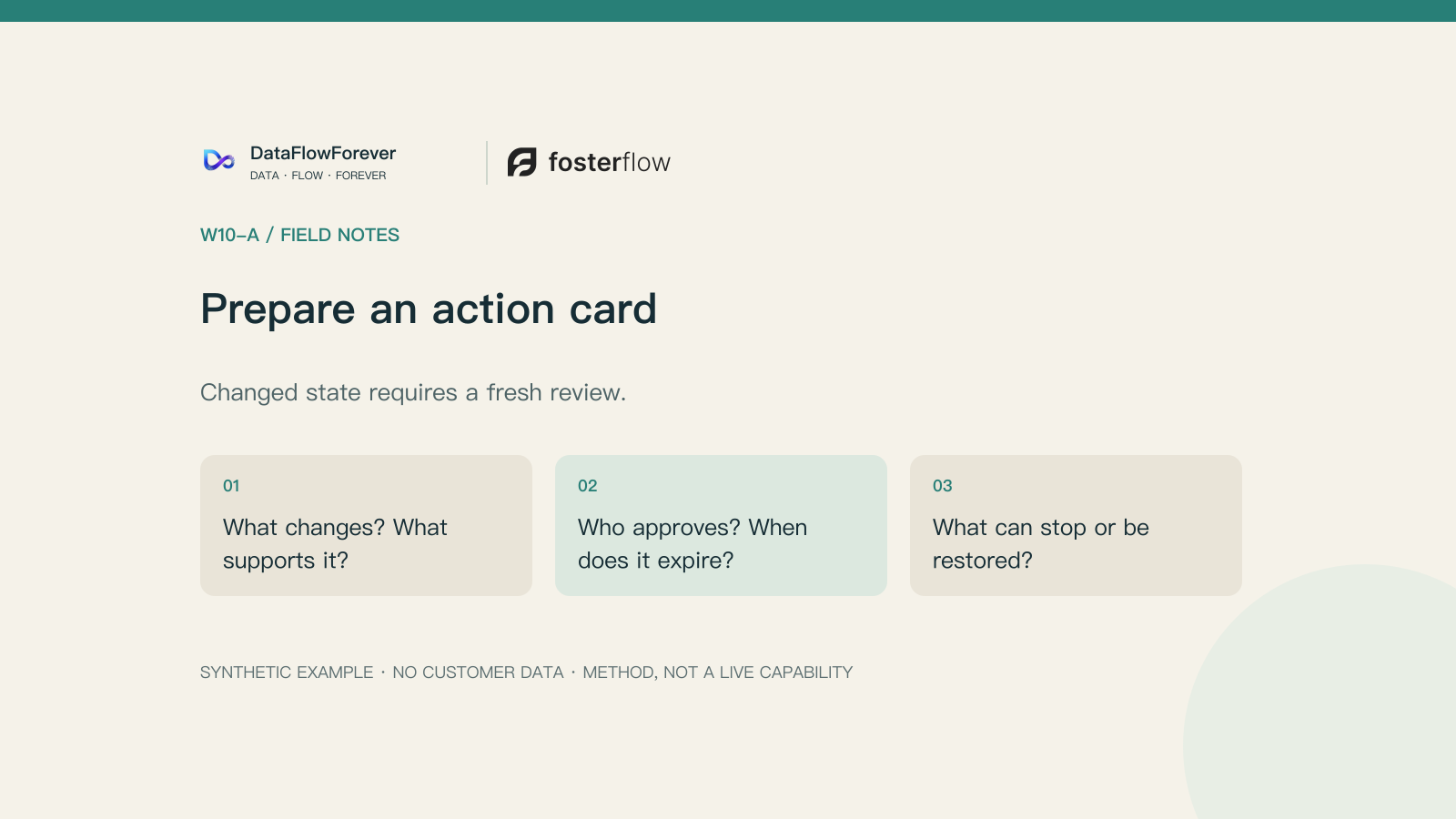
The system emits a staged action card: the exact change (100 → 140), a state snapshot, the evidence and its definitions, risk level, approval requirement, idempotency key, rollback path (return to 100), and an observation window (14 days, other variables frozen). A named owner signs it. If approval times out, the default is no — fail closed.
Gate three — execution and review.
Execution appends a changelog entry: time, approver, action, basis, window end. At window close the system compares before and after and writes the conclusion back. If the three zero-conversion days turn out to be a checkout outage, the change is rolled back and the counter-example is stored for the next evidence gate.
The useful result of this synthetic path is that the system stopped. It is that the system stopped when the evidence was missing. That stopping behavior must be specified and verified, rather than assumed.
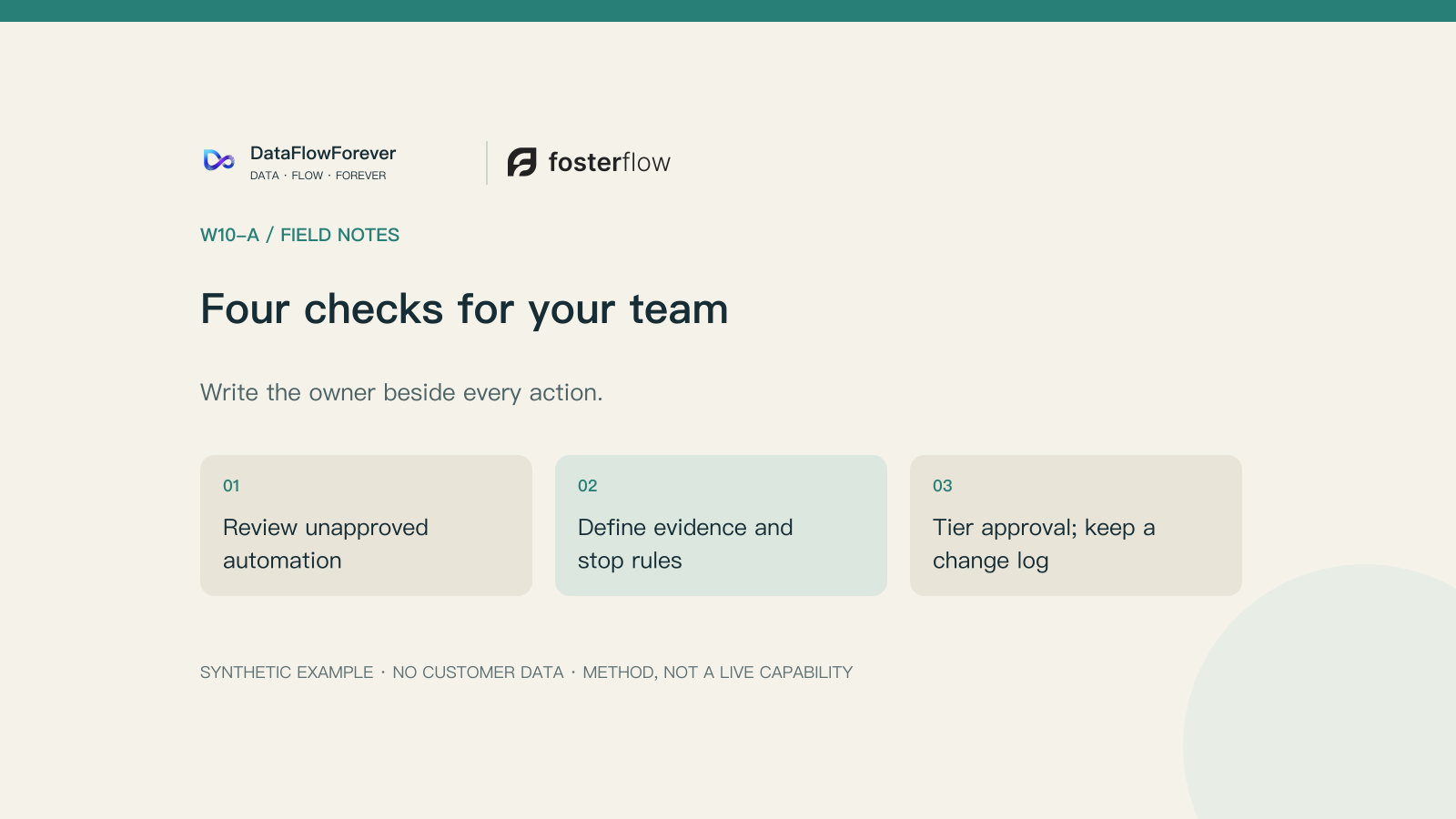
7. The five mistakes
- Approval in the prompt. A prompt is a wish, not a control. Approval lives in the system layer: permissions, branches, servers.
- Infinite dialogs as a security blanket. Repeated confirmation can turn into a habit; assess whether reviewers still understand the action. Approval volume must be reduced to the decisions that actually need judgment.
- Confusing recommendation quality with execution authority. Good advice proves the model read the data. Execution requires evidence, approval, and rollback.
- Turning switches off once and assuming safety. Platform automation can come back on — practitioners have caught system accounts re-enabling paused keywords. Re-check periodically and read the change history.
- Treating platform numbers as your evidence. Platform reports serve the platform's view. Define your own definitions, samples, and goals — the copy with the best reply rate may be the worst for signups.
8. The operating checklist for teams
Step one: switch off every automatic execution you never signed for. Audit auto-applied recommendations, Advantage+ enhancements, and automatic creative across every ad account. Turn off what you did not approve, and keep a dated checklist.
Step two: define your own evidence standard. Bind the four questions to every money-moving action. When evidence is insufficient, write "insufficient evidence" and name the path to close it.
Step three: build the tiered approval table. List your actions by reversibility and impact; mark which are approval-free, single-approver, and double-approver; assign named owners.
Step four: keep one human step. Reserve one "does this make sense?" checkpoint for actions involving money, people, and trust. It exists because automation cannot be responsible for itself.
Reference: a tiered approval table (adapt to your team)
- Action: Read reports, write analysis and drafts; Reversibility: High; Impact: Low; Default requirement: Logged, no approval
- Action: Change ad copy or creative; Reversibility: Medium; Impact: Medium; Default requirement: Single approver + preview
- Action: Raise budgets, change bids or ROAS targets; Reversibility: Medium; Impact: High; Default requirement: Single approver + stop condition + window
- Action: Refunds, sent messages, permission changes; Reversibility: Low or irreversible; Impact: High; Default requirement: Named owner + rollback plan + review
Reference: platform auto-execution to audit (check the live switches in your own accounts)
- Google Ads: auto-applied recommendations can be turned off; re-check periodically — system accounts have re-enabled paused keywords in practitioner reports — and make change-history review a habit.
- Meta: check which Advantage+ creative enhancements are enabled and what they change; verify what is actually serving before you scale.
- Shopify: Sidekick assists multi-step execution, and the platform ships Rollouts (staged percentage launches) and SimGym (pre-launch simulation) — apply the platform's own staging discipline back to the platform.
- Email and CRM: audit AI optimization switches; anything that can rewrite flow content stays off until evaluated.
Reference: rollout cadence (suggested)
- Days 1–30: switch off every auto-execution you never approved; bind the four evidence questions to every money-moving action.
- Days 31–60: complete the tiered approval table with named owners; dry-run one synthetic staged-action exercise.
- Days 61–90: pilot one low-risk real flow (draft → approve → send) for a full observation window before widening autonomy.
Conclusion
AI writes recommendations now — and they keep getting better.
But "can write the advice" and "may execute" are separated by three gates: evidence, approval, and rollback. The teams that build those gates will be the ones that keep their budgets, their customers, and their trust as the execution era arrives.
If you run cross-border growth and want to know which flow is ready for agentic automation, talk to us. We would rather hand you an auditable recommendation than a black box that spends your money.
(All examples are drawn from public industry discussions and synthetic demonstrations. No client data is used.)
Public-discussion boundary: the refund, account-change and agency-review stories above are anonymized community reports, not independently verified incidents or first-party experience. They illustrate questions to investigate; official documentation controls platform mechanics. The design principles here do not establish a released product capability. Restoring a setting cannot recover spent budget or recall a delivered message.
Evidence anchors: Building effective agents discusses agent design patterns and stopping conditions. Google Ads auto-applied recommendations explains the platform mechanism. These sources do not validate the community anecdotes or establish a FosterFlow product feature.
Explore growth optimization services or discuss the decision you need to make.