
Customer Segmentation Should Answer: Who Is Eligible for This Message Now?
Segmentation becomes operational when it changes a decision: who receives a message, when they receive it, which path they enter, and who should wait or be excluded.
Labels such as high value, engaged, lapsed, discount sensitive, or VIP summarize a past fact or an interpretation. They do not independently establish present relevance.
A customer who browsed a category, bought a product, and returned three months later is the same person in the identity layer. The correct lifecycle action can be different at each moment. A cohort that changes none of those actions may still be useful for reporting. It is not yet an operating segment.
Five Gates For Message Eligibility
- Permission and reachability: is the contact eligible for this message, and can the channel reach them?
- Current relationship: are they a subscriber, prospect, browser, cart abandoner, recent buyer, repeat buyer, or customer with no recent observable activity?
- Recent signal: what changed recently enough to make the message useful?
- Message job: does the message help the customer choose, complete, learn, use, replenish, or confirm continued interest?
- Timing and pressure: is a more important journey already active, or is the evidence too weak to justify another interruption?
The result does not have to be send. A useful audience decision can be send, wait, exclude, or observe.
Turn Static Labels Into Executable Conditions
Shopify documents customer segments as queries built from filters, operators, and values. Order count and last-order date can support repeat-buyer and recency cohorts, but they do not predict an individual customer’s next purchase or prove churn.
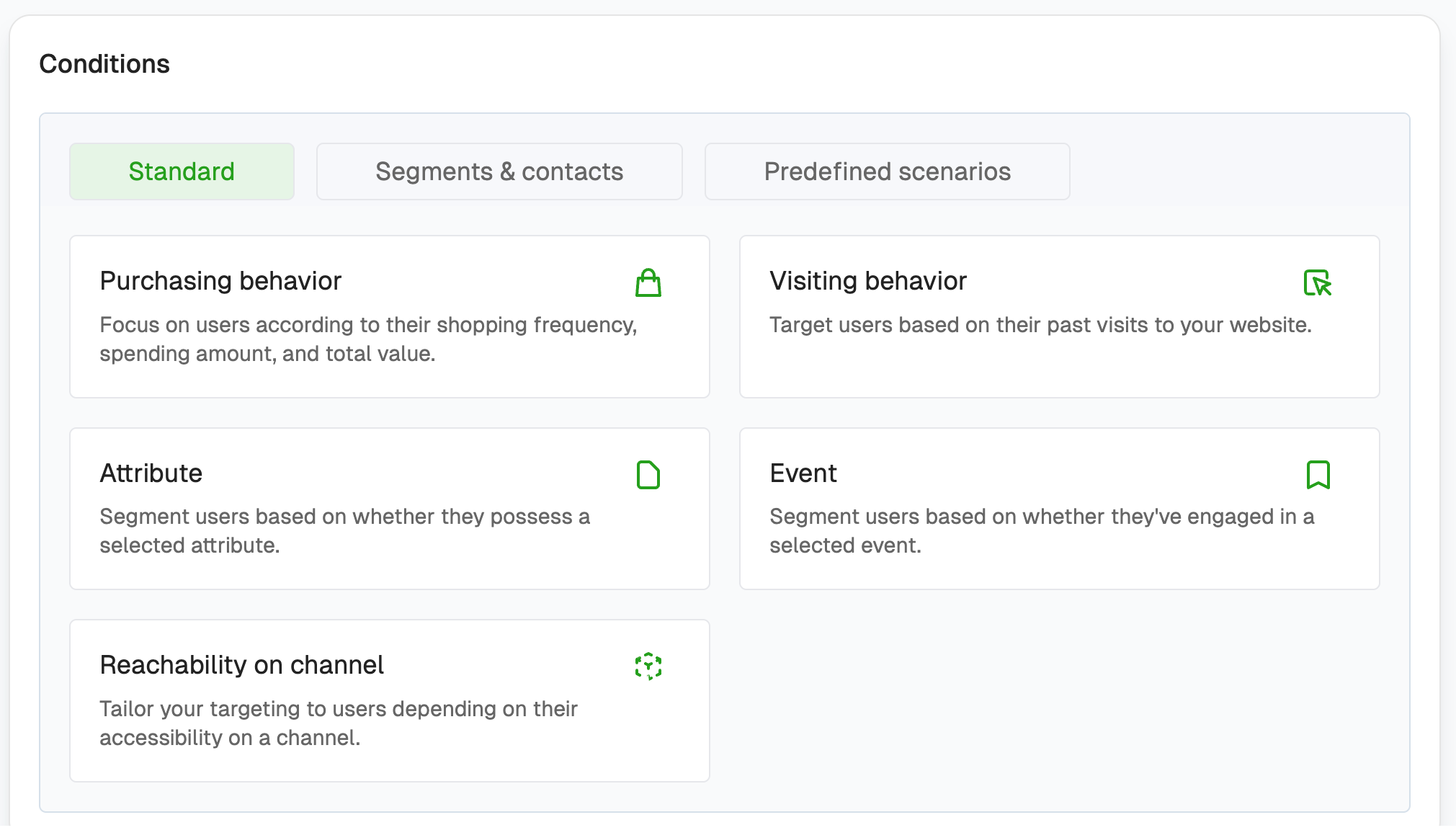
Two approved derivatives of real FosterFlow Segment Builder interfaces show how that idea becomes executable. The first exposes purchasing behavior, visiting behavior, attributes, events, and channel reachability as condition families.
The second interface shows a predefined Product page bounce rule. It selects people who visited more than one product page and did not add an item to cart, then allows an operator to bound the time range, narrow the rule by collection, and estimate the target audience.
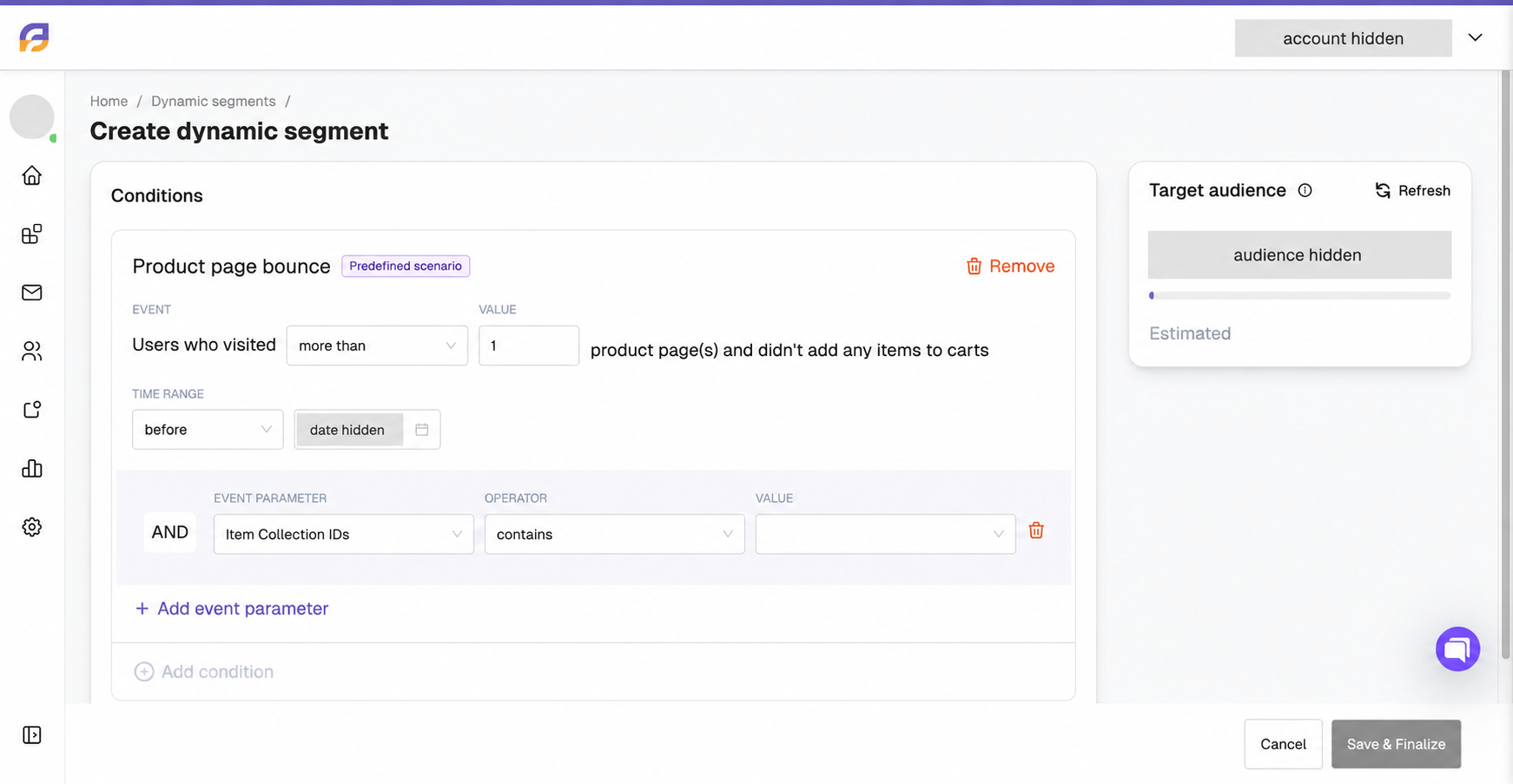
A production audience may still require permission, reachability, purchase-state, competing-journey, and data-freshness checks for its specific message job.
Opens And Clicks Are Incomplete Evidence
Open and click data can help, but they are incomplete. Apple Mail Privacy Protection can load remote content without human engagement, and Google cautions that low opens alone do not diagnose inbox placement. Customer-versus-lead status, purchase state, product relationship, reachability, and the intended message job may be more decisive.
Lean Teams Do Not Need Dozens Of Segments
A small list split into many micro-segments may not have enough sample, content, or operating capacity to support different actions. Start with the few distinctions that genuinely change content, timing, path, or exclusion.
A broad send can also be correct when every eligible recipient shares the same message job. Segmentation should earn its complexity by changing eligibility, content, timing, offer, or next action.
Audience Growth And Segmentation Solve Different Problems
Qualified audience growth expands the number of people who have a legitimate relationship and fit the intended job. Segmentation decides which of those people are currently eligible for a particular action. One cannot repair a failure in the other.
Temporary Inactivity Is Not Hard Ineligibility
Unsubscribed, invalid, complained, or otherwise suppressed contacts should remain separate from people who are still eligible but currently lack a recent signal. The latter may warrant lower pressure, a bounded re-permission decision, or observation. List age raises uncertainty; it does not establish one universal decay or invalidity rate.
A Reusable Segment Contract
- The message or lifecycle job.
- Required facts and time windows.
- Wait and exclusion conditions.
- Events that add or remove membership.
- The primary outcome and relationship-risk measure.
- Data gaps, refresh boundaries, and the next review date.
This turns a segment name into a decision that an operator, analyst, or Agent can inspect.
Before Creating Another Segment, Decide Who Should Receive, Wait, Or Be Excluded
Choose the campaign or Flow with the largest audience. Run it through the five gates before creating any new tags. Find one person who should wait, one who should be excluded, and one whose recent signal makes the message newly relevant.
Segmentation governs admission. The next operating question is exit: what change should remove a customer from a Flow immediately?