
Repeat Product Views Before Purchase: How to Audit Evidence Closure
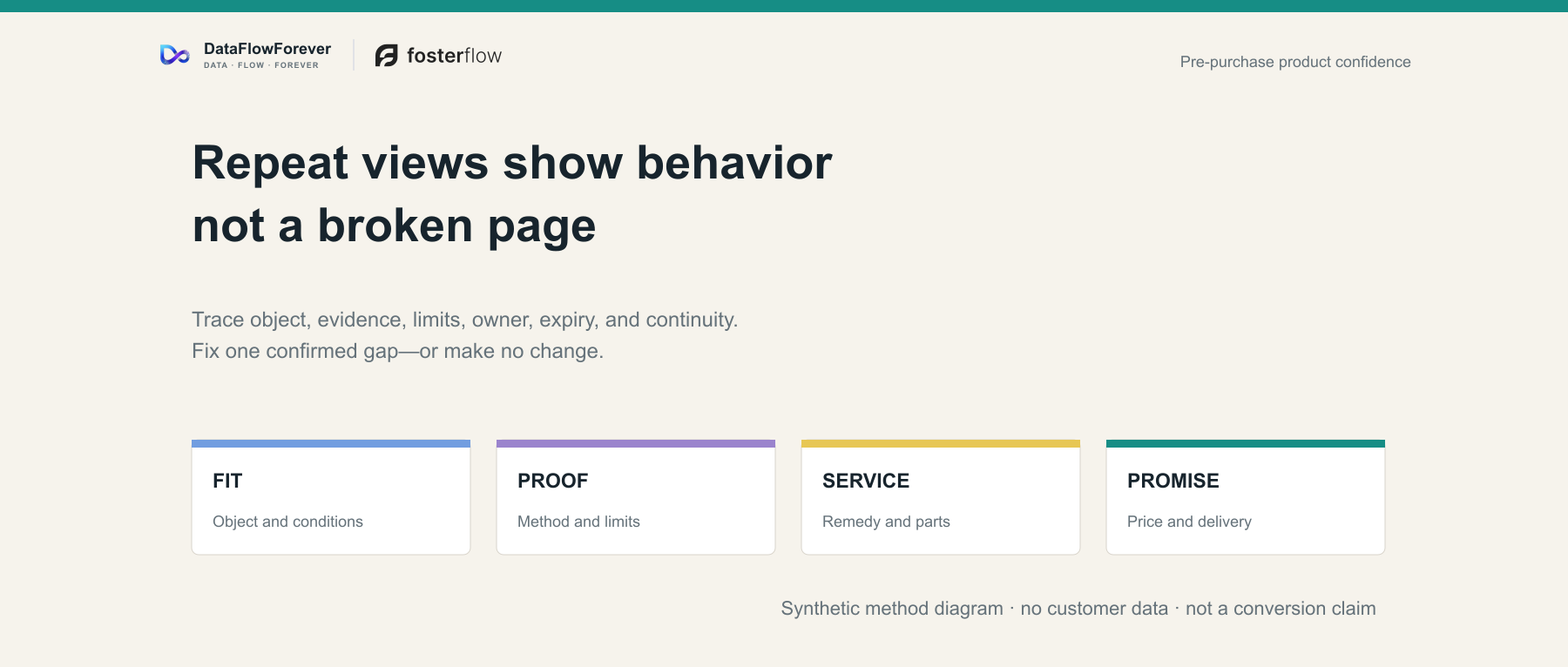
Repeat views prove behavior, not a hidden objection or broken page. Trace each consequential promise from exact object to evidence, limits, owner, expiry, and continuity—and make no change when no gap is found.
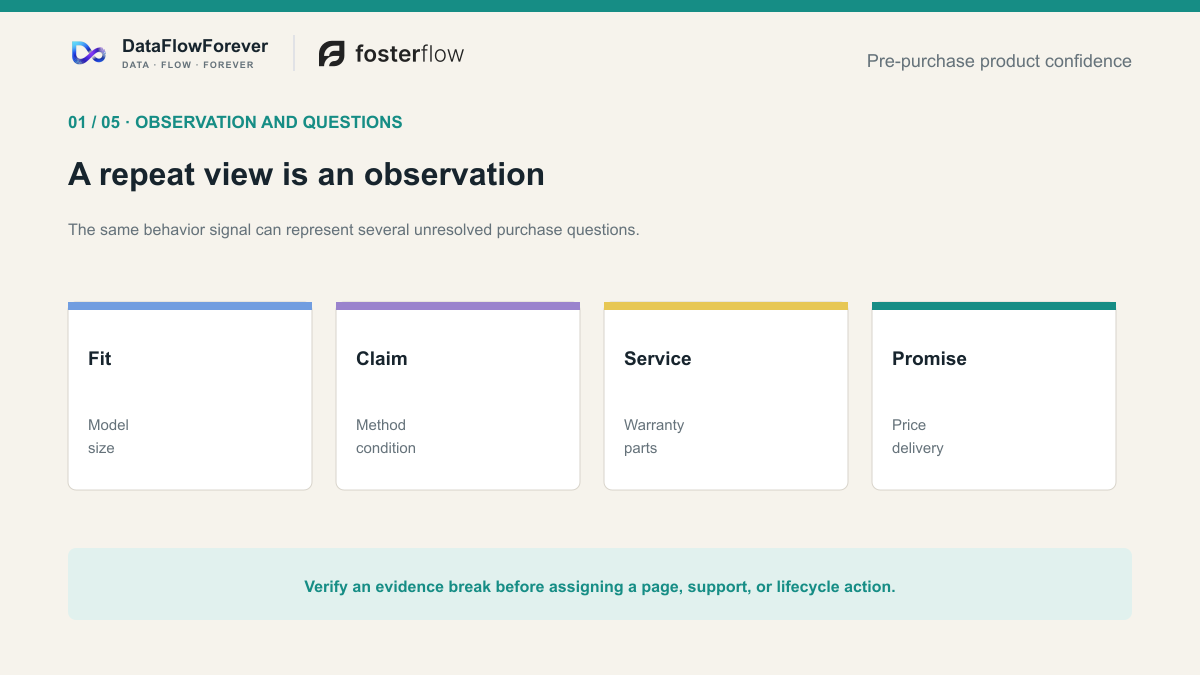
An analytics record shows several views of the same product page and no connected purchase in the chosen window. The sessions may include variant comparisons, exits, and later returns.
That is a behavior record, not a diagnosis. It does not reveal whether one person made every visit, whether any visitor could buy in the relevant market, or whether a product question remained open. Someone may be checking dimensions, a model number, test conditions, warranty eligibility, stock, or an arrival date. The page may also have answered every relevant question while budget, preference, approval, or timing changed elsewhere.
Calling the pattern a “trust problem” does not make it more actionable. A better unit of work is the consequential product promise: one statement whose failure could make the purchase unsuitable, unexpectedly expensive, late, difficult to return, or difficult to maintain.
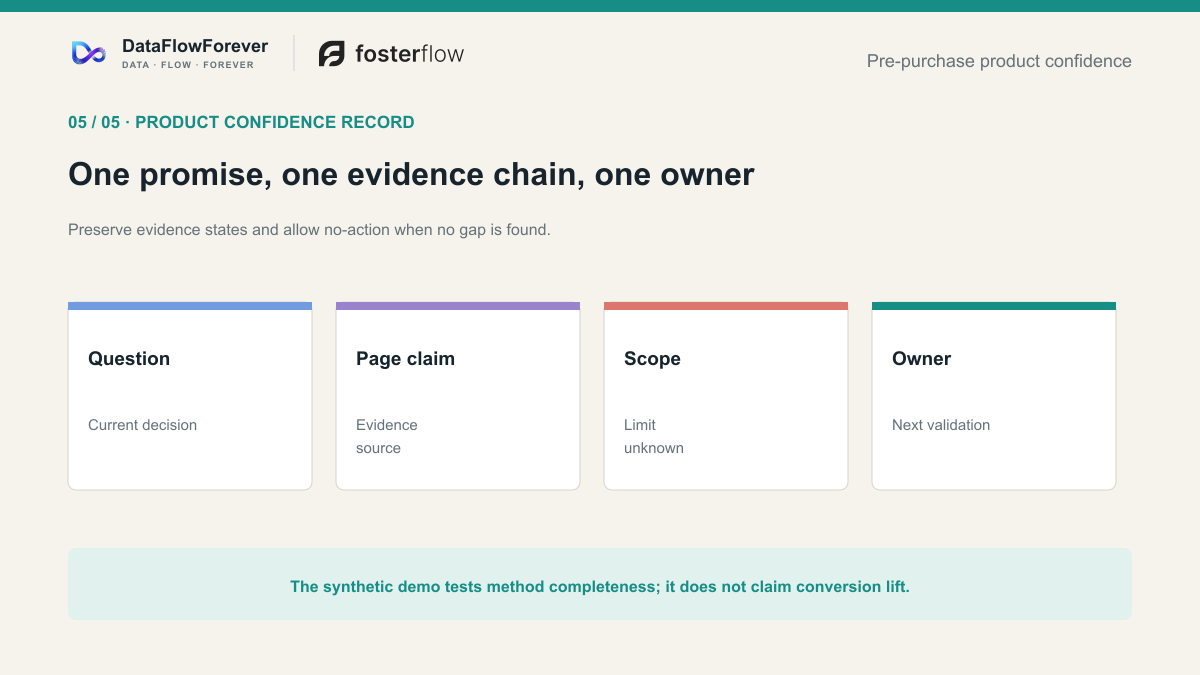
For each such promise, ask whether the page exposes the exact object, an evidence lookup, its conditions and unknowns, a responsible owner and expiry, and the same current state in checkout and support. If that chain is complete, leave it alone. No action is a valid review outcome when no consequential evidence gap is found.
Treat every important statement as an accountable record
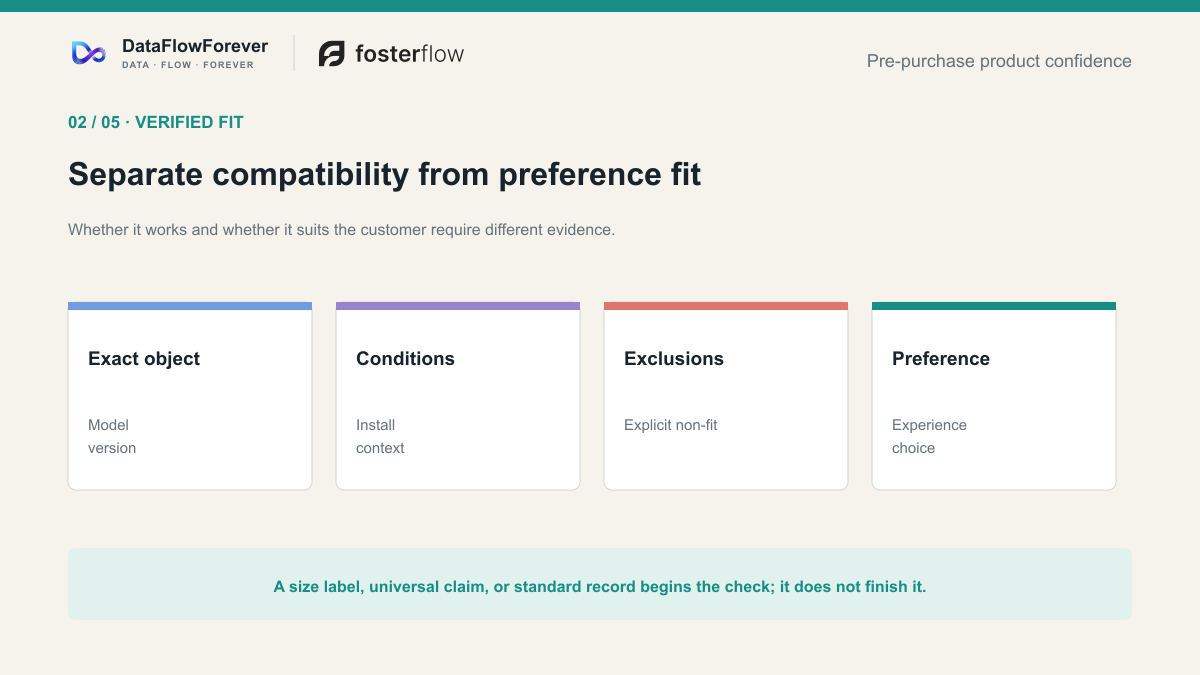
“Fits most models,” “tested for 20,000 cycles,” “verified review,” “repairable,” “in stock,” and “arrives Friday” sound different. Operationally, they need the same five forms of accountability.
- Exact object and context. Identify the purchasable variant, model, batch, market, destination, date, and matched object. A conclusion about a related sample or an older version is not automatically a conclusion about the item on screen.
- Evidence and lookup path. Connect the short statement to a measurement record, product registry, policy, calculation, source data, or named confirmation route. A badge with no scope or lookup is decoration, not closure.
- Conditions, exclusions, and unknowns. Show the load, method, adapter, region, eligibility rule, cutoff, or other limit that changes the answer. Preserve unknown when the evidence cannot support a conclusion.
- Owner and expiry. Name the team responsible for the fact and the event or date that makes it stale. Product engineering may own a test result; supply chain may own parts availability; fulfillment may own a ship-by state.
- Continuity. Check whether the visible page, machine-readable product data, cart, checkout, confirmation, and support guidance describe the same selected item and current conditions.
This is evidence closure, not evidence volume. The customer-facing answer may be one sentence. The underlying record must still be inspectable by the people expected to maintain or honor it.
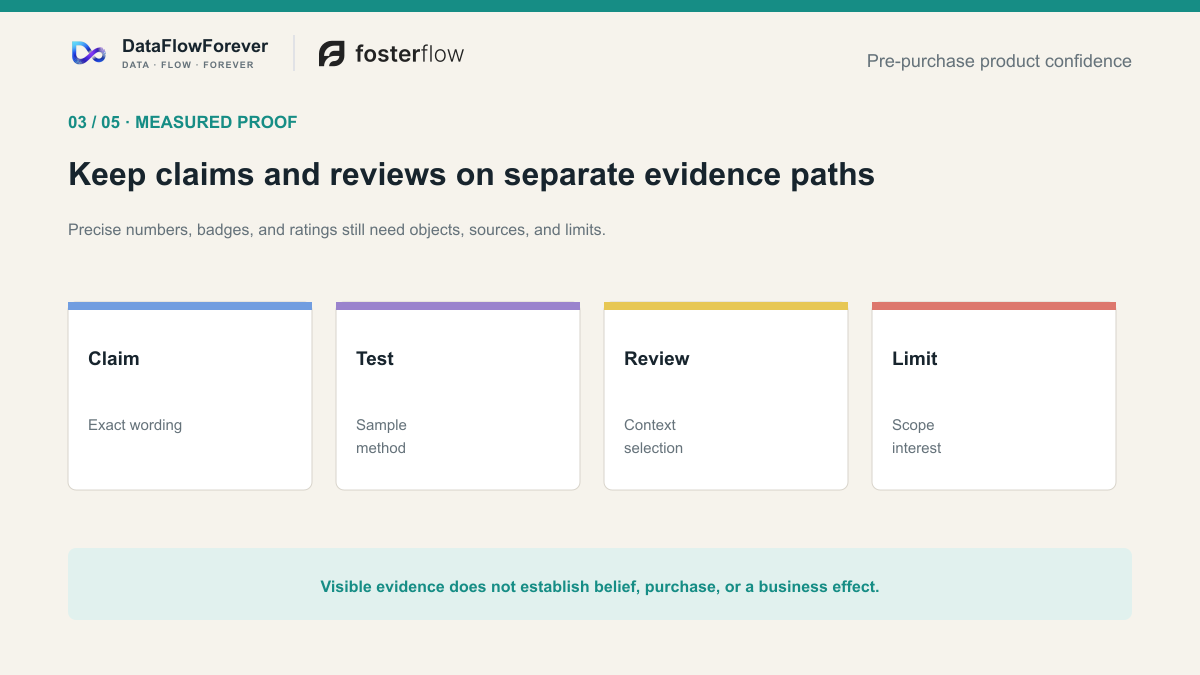
Product uncertainty research offers a useful conceptual boundary. A study of product uncertainty in online markets separated uncertainty about the seller from uncertainty about the product’s description, condition, and performance. Research on product fit uncertainty examined the difficulty of judging whether product attributes match personal preferences. These studies used particular platforms, samples, and periods. They do not diagnose a current storefront or forecast the effect of a page change. They help explain why one trust label can conceal several incompatible questions.
A short answer should open into evidence, not end the inquiry
Two public systems show what this chain can look like when its boundaries remain visible.
Case 1: a phone label links comparison metrics to a model record
The European Commission’s 2026 consumer guide for smartphone and tablet energy labels describes labels introduced for covered EU products in June 2025. A label can show energy efficiency, standardized battery runtime, battery cycle durability, drop robustness, ingress protection, and a repairability class. Its QR code leads to the product’s model record in the European Product Registry for Energy Labelling, or EPREL.
The useful design pattern is not the number of icons. It is the path from a compact comparison result to a model-specific record. The guide also states an important limit: standardized battery runtime supports comparison, while actual runtime depends on factors such as applications, brightness, network use, and signal conditions.
This case applies to covered smartphones and tablets in the EU. The guide is non-binding and does not replace the regulations. Neither a label nor a registry record proves a merchant’s current stock, support capacity, real-world battery outcome, or commercial effect.
Case 2: a repairability score can be decomposed
France’s consumer regulator explains the country’s repairability index for the categories covered when the source was reviewed on 25 August 2026. Manufacturers calculate a score from factors that include documentation, disassembly and tools, spare-parts availability, spare-parts price, and category-specific criteria. For online sales, the score appears near the price and the calculation parameters are available from the same product page.
That structure matters. A shopper sees a summary, can inspect its dimensions, and can return to the source of the calculation. Yet the boundary matters just as much. The index is not an independent laboratory certification, a warranty, a lifespan guarantee, or proof that a particular spare part is in stock now. Coverage and calculation rules can also change.
Case 3: an anonymous furniture page has media but no decision object
Consider a safely abstracted public-discussion pattern, not a representative survey. A furniture page contains polished room images, a price, and material copy. It omits the item’s maximum external dimensions, packaged dimensions, and the minimum clearance needed along the delivery route.
The problem is not “insufficient content” in general. It is an unclosed fit promise. The exact object is the selected furniture variant plus the shopper’s doors, turns, stairs, and room. The evidence should expose defined measurement points and tolerances. The boundary is the route and installation condition. Product content owns the specification; fulfillment owns delivery constraints. Support needs the same dimensions and an escalation path when the route is unusual.
This example shows what to inspect. It does not establish how common the omission is, why any observed shopper left, or what a page change would cause.
More media can answer one question and create another burden
When a page feels uncertain, teams often add images, video, reviews, interactive modules, or augmented reality. Those formats can be useful. They are not substitutes for defining the decision task.
A 2024 peer-reviewed study on augmented-reality product presentation used two studies, including a comparison of mobile AR with traditional two-dimensional presentation and a natural-experiment setting involving AR-supported products. The authors reported higher perceived diagnosticity alongside higher perceived cognitive load, with differences by product type. The work does not support a universal AR or sales claim. It illustrates a narrower point: a richer format may help one judgment while adding effort elsewhere.
An earlier laboratory experiment on text, image, and video reviews used 110 usable student participants and three products: a camera, backpack, and video game. The influence of presentation format varied with product type. Its small, young sample and purchase-intention setting cannot establish current order or return effects for an independent store.
Choose the medium after defining the unresolved task. Dimensions may need a diagram and measurement method. Subjective drape may benefit from contextual images. A performance number needs a test record. Eligibility may need a short rule plus the full terms. If a plain table closes the decision, an immersive module can be unnecessary.
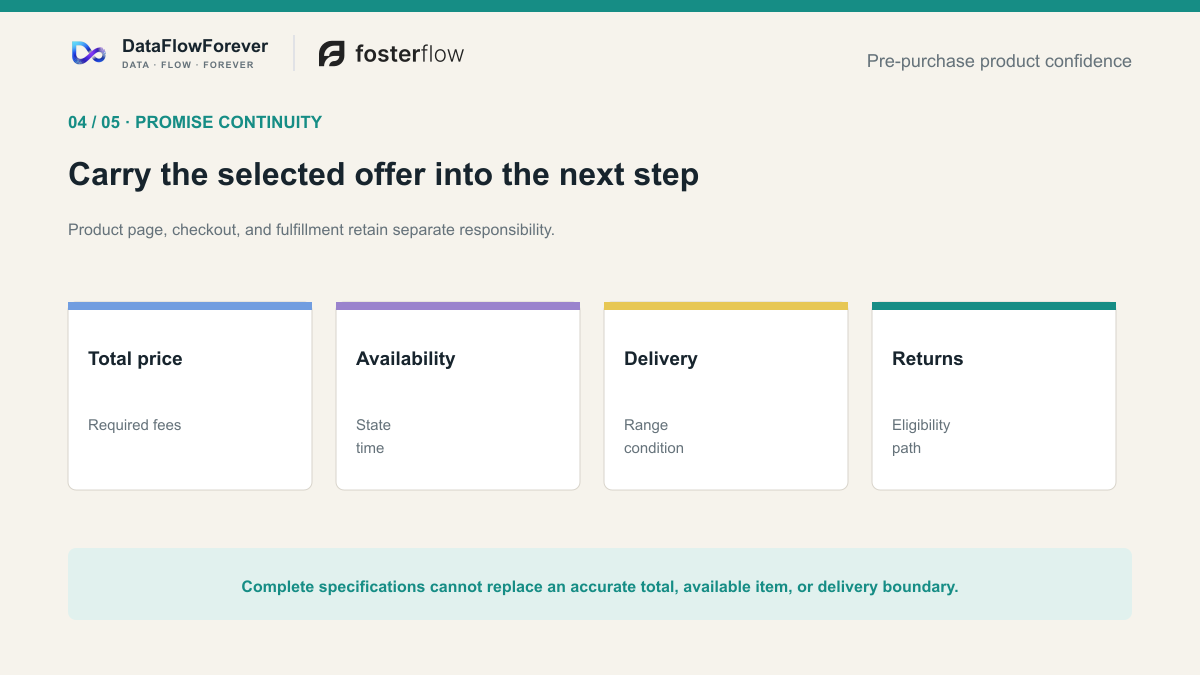
Carry the promise beyond the visible product page
Evidence closure fails if the page is accurate but the surrounding system contradicts it. The selected variant may show one price while cart applies another. “In stock” may describe component inventory while checkout reveals a made-to-order lead time. Support may rely on a warranty document for an older model. Search systems may ingest a stale availability value.
Google’s official Product structured data documentation shows that merchant-listing data can express variants, apparel sizing, price, availability, shipping, and returns. It may work alongside Merchant Center data. This creates another surface to compare with the human-visible page and checkout.
For the upstream record problem, see why uploaded products can still be hard for a platform to interpret. That article owns product-data foundations; this one owns the consequential promise a shopper must be able to verify.
Structured data is a synchronization layer, not evidence that the underlying fact is true. It does not prove customer understanding or guarantee a search feature, ranking, traffic, purchase, or conversion. The operating check is simply whether every exposed surface refers to the same exact item, market, time, and policy version.
For an “arrives Friday” statement, for example, trace the selected SKU, destination, inventory location, order cutoff, handling time, carrier service, and exceptional conditions. Fulfillment owns the calculation and expiry. The page and checkout should render the same current answer. Support should be able to identify the inputs, explain a change, and offer the applicable route when the promise can no longer be met.
Fill the record before rewriting the page
The following suitcase is fully synthetic. It has no merchant, customer, account, product ID, or observed result. Its purpose is to show how mixed evidence states can coexist without being compressed into one trust score.
- Promise: “External size: 55 × 38 × 22 cm” · Exact object and context: Fictional black medium suitcase, SKU SYN-M-BLK, current shell revision · Evidence lookup: Approved drawing R4 plus dated three-point measurement record · Conditions or unknowns: Includes wheels and fixed handles; 5 mm production tolerance shown · State: Verified · Owner and expiry: Product engineering; expires at any shell, wheel, or handle revision · Continuity or fallback: Same dimensions in specification, cart item details, and support article; remove verified state on revision
- Promise: “Wheel assembly tested for 20,000 cycles” · Exact object and context: Current four-wheel assembly on SYN-M-BLK · Evidence lookup: No report maps the stated cycles, load, surface, or sample to the current assembly · Conditions or unknowns: Test method and sample are absent · State: Unsupported · Owner and expiry: Product engineering; immediate review · Continuity or fallback: Remove the number from page and structured data until a matching report exists
- Promise: “Cabin compatible” · Exact object and context: SYN-M-BLK for an unspecified airline, route, fare, and operating decision · Evidence lookup: Product dimensions are verified; public airline limits differ and may change · Conditions or unknowns: Acceptance can depend on carrier rules and trip conditions · State: Conflicted · Owner and expiry: Content and compliance; recheck referenced carrier rules on their stated cycle · Continuity or fallback: Replace universal claim with dimensions and a trip-specific comparison prompt; support must not guarantee acceptance
- Promise: “Replacement wheels available across the EU” · Exact object and context: Current wheel module for SYN-M-BLK in each destination market · Evidence lookup: Supplier list names the part but lacks country-level sellable stock and ordering routes · Conditions or unknowns: Market coverage, price, and lead time are unconfirmed · State: Unknown · Owner and expiry: Supply chain; resolve within seven days and refresh monthly · Continuity or fallback: Show “confirm availability for your country” and give support the same unresolved-state code
- Promise: “Leather care treatment required” · Exact object and context: Polycarbonate shell with polyester lining; no leather component · Evidence lookup: Current bill of materials and approved material specification · Conditions or unknowns: Applies to neither the sold item nor its accessories · State: Not applicable · Owner and expiry: Product content; expires if materials change · Continuity or fallback: Omit the instruction from page, care guide, order email, and support script
- Promise: “Five-year limited warranty” · Exact object and context: Original retail purchaser of SYN-M-BLK in the stated market · Evidence lookup: Dated pre-sale terms identify backer, period, exclusions, evidence, process, and remedies · Conditions or unknowns: Eligibility depends on proof of purchase; wear exclusions are visible · State: Verified · Owner and expiry: Legal operations and support; expires when terms or market coverage change · Continuity or fallback: Link identical terms before purchase and from the order record; support uses the same version identifier
The table does not award the product a score. It assigns a next state. Verified claims can remain. Unsupported claims should be removed, narrowed, or substantiated. Conflicted claims need a bounded statement and confirmation route. Unknown claims need an owner and deadline, not invented certainty. Not-applicable content should disappear so it cannot distract or mislead.
Review the highest-consequence gap first
A practical review can stay small:
- List the statements that could change suitability, total cost, timing, recourse, or long-term use.
- Select one promise with high customer consequence and weak or conflicting evidence.
- Trace its exact object, source, conditions, owner, expiry, and downstream surfaces.
- Assign one state: verified, unsupported, conflicted, unknown, or not applicable.
- Make only the action that follows from that state. Then test whether the decision task is now complete.
Testing the page task is separate from testing a business outcome. A team may verify that the correct fact renders for every variant, that a shopper can find the answer in a task-based usability check, or that support can reproduce the state from the same record. Those findings can show that the information chain works.
They do not show that the change caused purchases. A commercial effect claim needs a stable scope, suitable comparison or explainable baseline, sufficient observation, and a record of concurrent changes. Without that design, report the bounded result: the promise is now traceable; the business effect remains unverified.
If every consequential promise already has a current source, visible conditions, an accountable owner, and consistent downstream treatment, do not redesign the page merely because repeat views exist. The remaining explanation may sit outside the page, or there may be no problem requiring intervention.
The operating conclusion
Repeat views can identify a journey worth reviewing. They cannot identify the missing answer.
Inspect the promises that carry real consequences. Name the exact product and context. Give the summary a path back to evidence. Expose the conditions, conflicts, and unknowns. Assign an owner and expiry. Carry the same current state into machine-readable data, checkout, confirmation, and support.
This approach does not ask a product page to eliminate uncertainty or manufacture trust. It asks each important statement to remain answerable. Sometimes that produces a clearer specification, a narrower claim, a confirmation route, or a corrected checkout state. Sometimes it produces no change at all. Both are better outcomes than treating repeated behavior as proof of a hidden objection.