
Why Uploaded Products Can Still Be Misunderstood—or Receive No Shopping Traffic
Upload is only a receiving receipt. Trace the exact offer, processed values, page promises, eligibility, and item-level delivery before changing the catalog or campaign.
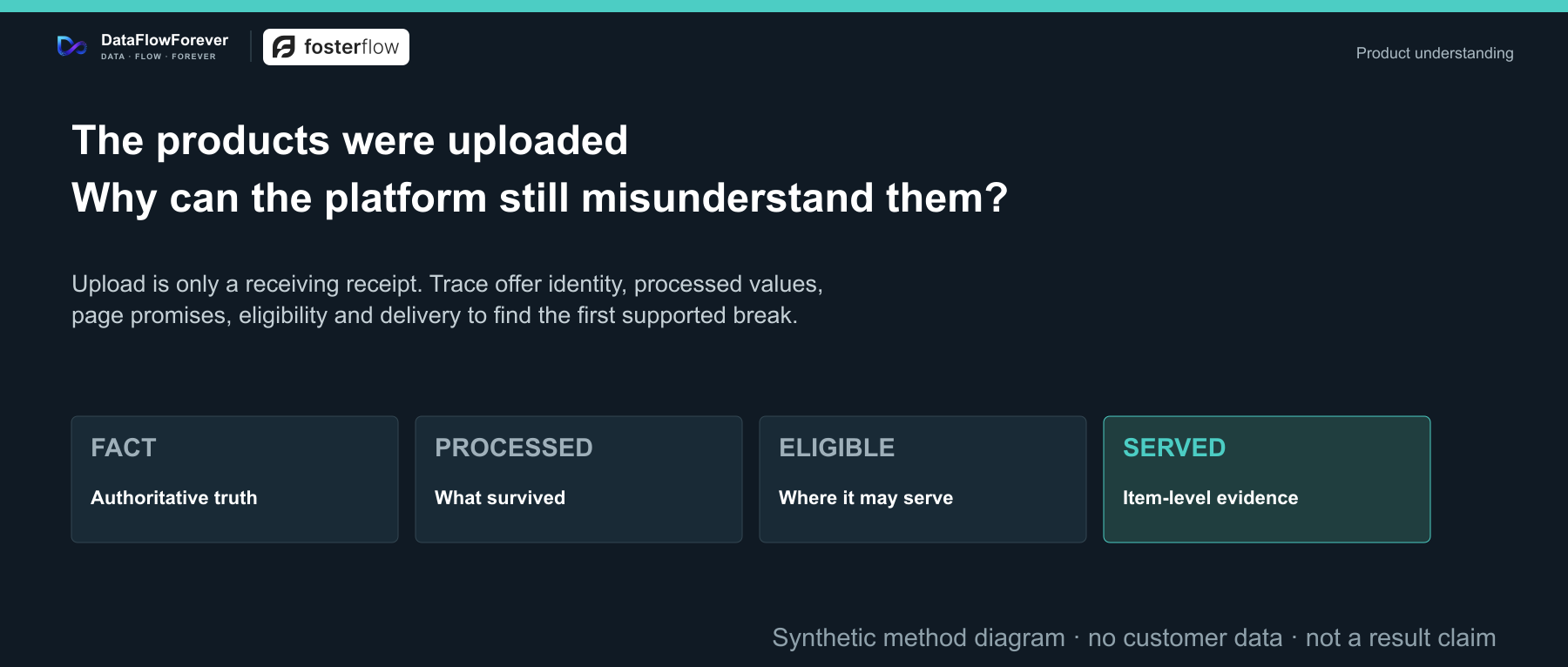
A common catalog review begins with a reassuring screen. The upload completed. Most products are active or approved. No obvious file error explains the weak delivery.
Then the operator opens individual items. One variant carries a parent-level price. Another says “in stock” in the feed while the page promises a later delivery. A third appears fully approved but has no item-level impressions. The discussion quickly turns to title formulas, keywords, bids, or how long Google needs to “learn” the catalog.
The green upload receipt cannot answer those questions.
Upload success confirms that data entered an ingestion process. It does not confirm that the platform formed the intended final product record, granted eligibility in every country and destination, served the item, or produced a useful business result. Product data may be wrong before submission, changed by a connector or rule, contradicted by the page, or perfectly accurate while demand and campaign controls still limit delivery.
A safer diagnosis follows one exact purchasable offer from its authoritative facts to the processed platform record, the customer-facing page, item-level eligibility, observed traffic, and business evidence. The first supported break identifies the next owner. It also prevents a feed change from being credited for a result it did not prove.
1. An upload receipt proves very little
Google’s current Merchant API documentation distinguishes a submitted product input from the final processed Product. The processed record reflects source merges and rules applied after submission. It can also carry different statuses and issues by reporting context, destination, and country.
That creates several separate questions:
- Did the platform receive the item?
- Which values survived processing?
- Is the item eligible in the intended market and surface?
- Did it receive an impression?
- Did anyone click?
- Did the visit produce a valid purchase or another declared result?
- Was that result economically worthwhile?
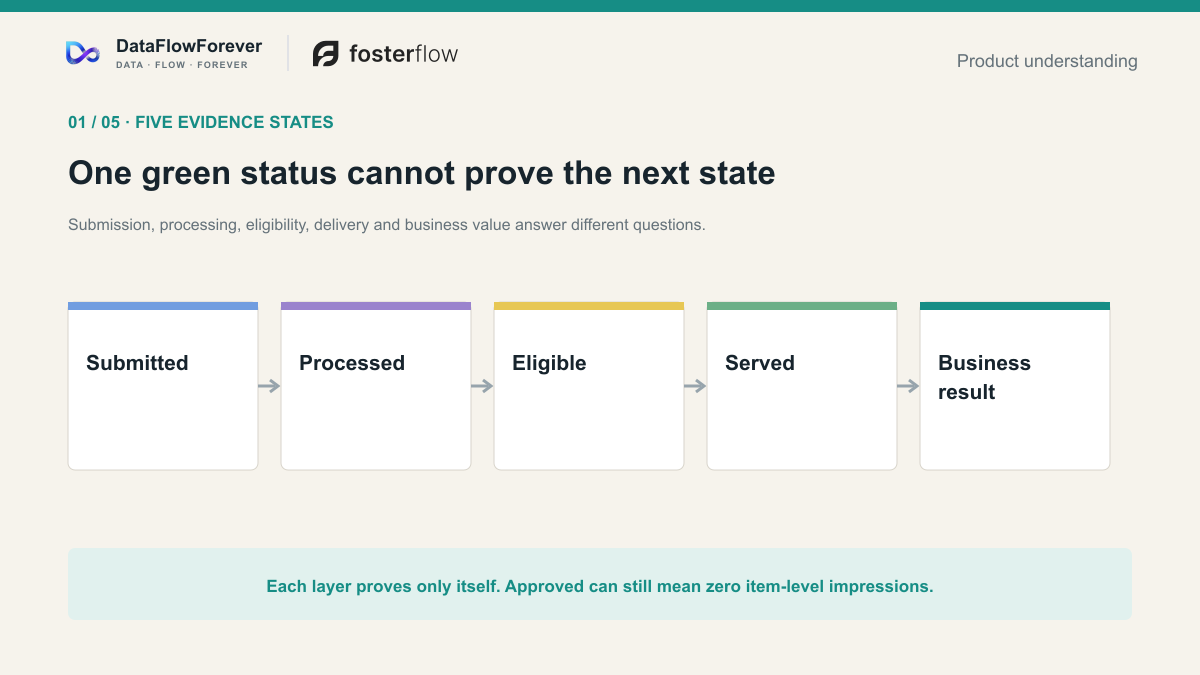
A “yes” at one step cannot fill the next row. An approved item can report zero impressions. An impression does not establish a qualified click. A purchase report does not establish incrementality, profit, or cash contribution.
This distinction matters because “the platform does not understand our product” is often used to describe several different failures. Sometimes the processed title or category really did diverge from the source. Sometimes the selected variant, price, or availability conflicts with the page. Sometimes eligibility is clean and the remaining explanations sit in demand, query matching, campaign scope, listing groups, budget, bidding, competition, or measurement.
Begin by naming the state you can actually observe. Avoid turning one green status—or one manual search—into a complete diagnosis.
2. Start with the sellable offer, not the catalog row
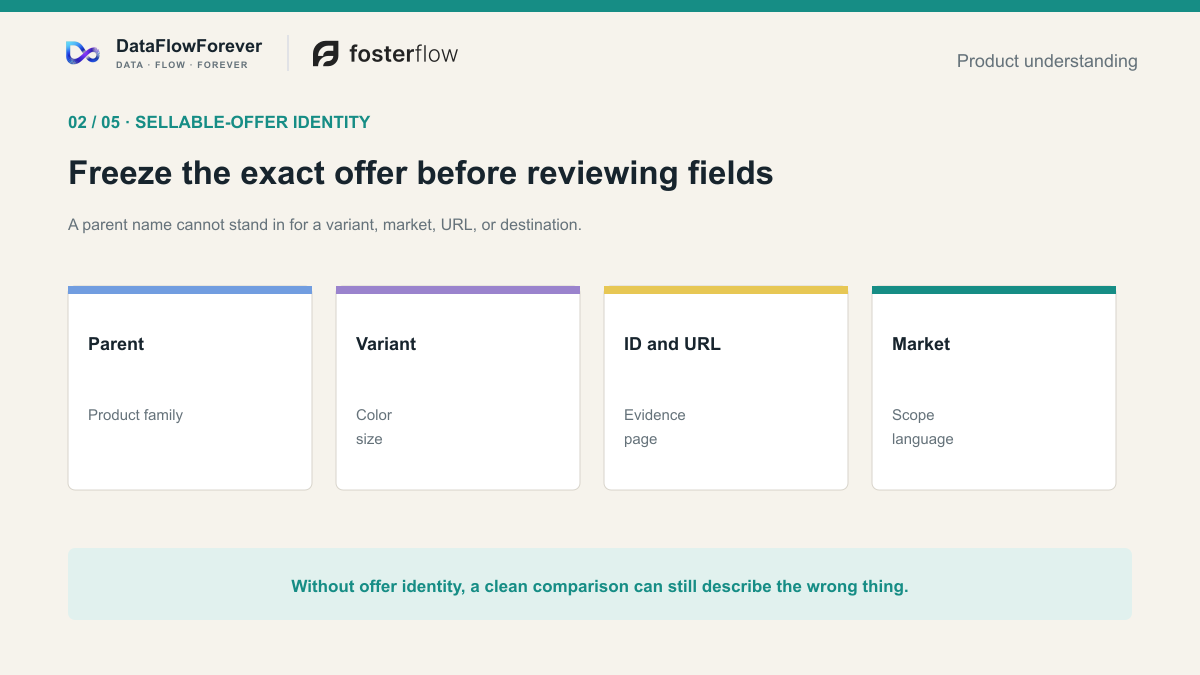
The platform needs to identify the thing a customer can buy in a specific market. That unit is often narrower than the merchant’s internal idea of “the product.”
A shirt family may contain separate sizes and colors. A replacement part may carry fitment claims for particular models. A bundle, multipack, custom product, private-label item, and pre-order can each have a different identity contract. The exact offer combines the physical item or serviceable variant with its ID, URL, market, destination, price, availability, and relevant attributes.
For each sampled offer, write down:
- the internal product and variant;
- the stable offer ID and item-group relationship;
- the URL and selected variant state;
- the manufacturer identity, when one exists;
- the market, language, feed label, and intended destination;
- the attributes that distinguish this offer from its siblings.
Manufacturer identifiers deserve special care. Google’s unique product identifier guidance says to use correctly assigned GTIN, MPN, and brand values when available and not to guess, invent, or borrow values from similar products. Not every product has a GTIN. A missing identifier and a product that was never assigned one are different conditions.
The same discipline applies beyond identifiers. A parent price range cannot silently stand in for a purchasable variant’s price. Parent stock cannot automatically describe every child variant. A copied ID does not turn the same physical offer into a legitimate query-specific experiment.
Until the team agrees on the exact offer under review, every later comparison can be technically neat and commercially wrong.
3. Complete data can still be wrong
Catalog teams are often rewarded for reducing empty fields. That is useful only when the added values are true.
Google’s product data specification classifies attributes as required, condition-dependent, or optional. The contract changes with the product, variant, country, and destination. “Populate every field” is therefore a poor universal rule.
A practical catalog needs at least five evidence states:
- State: Verified · Meaning: A named authoritative source supports the value for this exact offer.
- State: Undisclosed · Meaning: The value may exist, but the current source does not provide it.
- State: Unresolved · Meaning: The team has not yet established the correct value or source.
- State: Not applicable · Meaning: The attribute genuinely does not apply under the relevant contract.
- State: Conflicted · Meaning: Two or more sources disagree and no approved resolution exists.
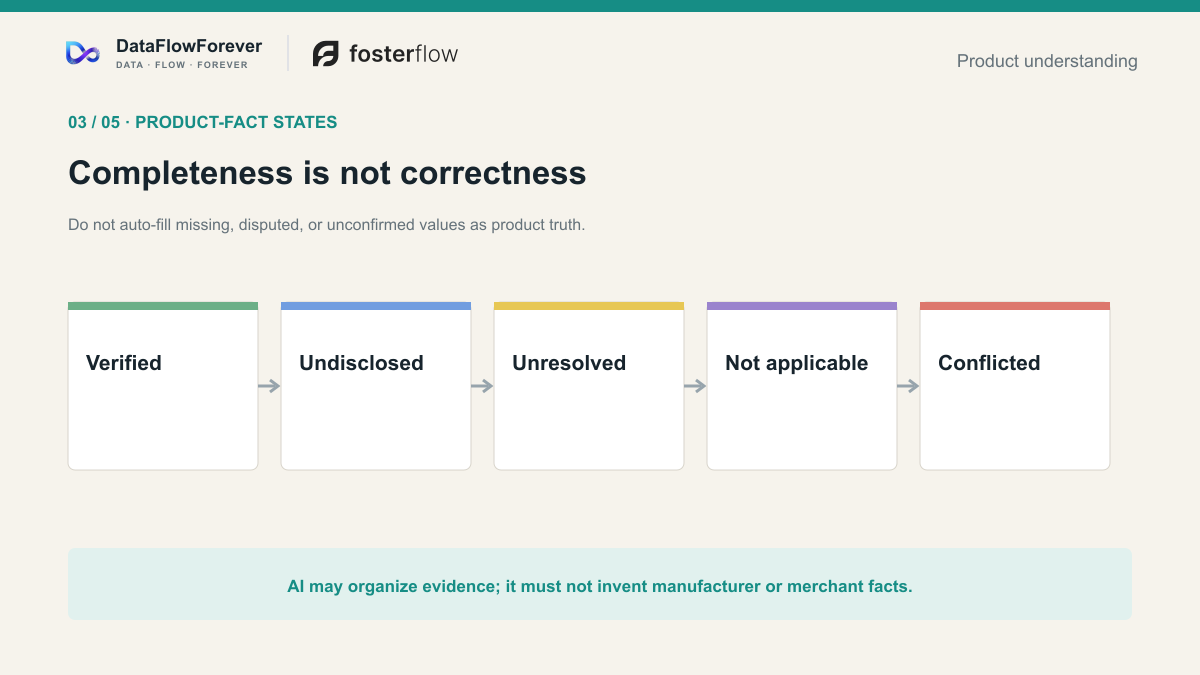
These states are operationally different. Undisclosed cannot be converted to “not applicable” merely to clear a warning. Conflicted cannot be resolved by selecting the most convenient source. An AI system may extract a likely material, normalize a color name, or propose a category. It should not publish that proposal as a product fact without source evidence and review.
Independent datasets help explain why this is hard. MAVE studies attribute extraction from multi-source Amazon product profiles, while WDC-PAVE covers extraction and normalization across multiple websites. They show that product attributes are dispersed, heterogeneous, incomplete, and difficult to normalize. They do not describe Google’s internal processing, prove manufacturer truth, or connect automated extraction to Shopping traffic.
Completeness is a measurement of coverage. Correctness requires provenance.
4. Trace each field to the final processed record
A field rarely travels straight from the commerce system to its displayed destination. It may pass through a connector, primary data source, supplemental source, mapping rule, platform normalization, automatic update, and page markup.
Use attribute-specific lineage rather than one global source hierarchy. For a title, category, price, or availability value, record:
- the authoritative business fact and its owner;
- the raw source value and timestamp;
- the connector or export mapping;
- the submitted attribute and item ID;
- each applicable rule or supplemental join;
- the final processed value and processing timestamp;
- the value visible on the selected page variant;
- the value or promise at checkout;
- any status or issue attached to the relevant destination.
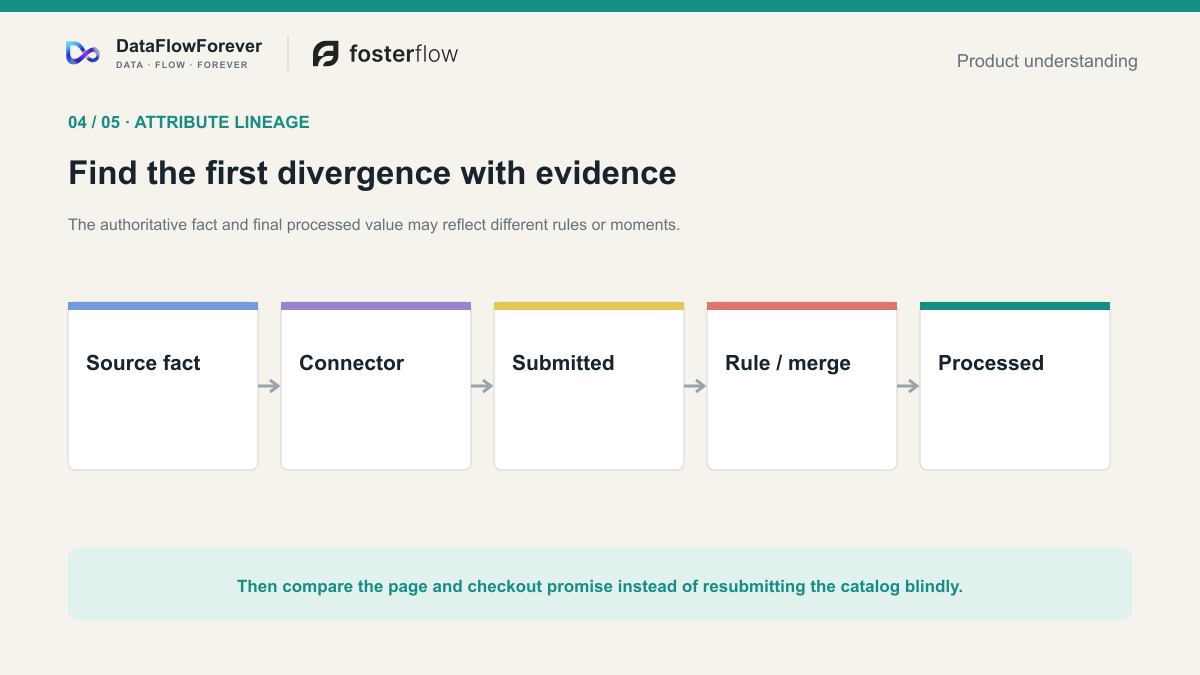
The current Merchant API guide describes the final processed Product as the state after data-source merges and rules. It also warns of processing delay. A submitted snapshot and a processed record may therefore both be valid observations from different moments and still disagree.
That disagreement is a finding, not an invitation to guess. Check timestamps, mapping versions, source ownership, and exact offer identity. If a rule altered the value, record the rule and its intended scope. If the processed record is correct but the page is stale, route the issue to the page or commerce owner. If the authoritative fact itself is unknown, stop the transformation and ask for evidence.
A processed value proves that the system accepted or derived a value. It does not prove that the value is true.
5. Make the feed, page, structured data, and checkout agree
Price and availability are customer promises. Variant identity, title, and key attributes determine which promise the customer thinks they are accepting.
Google’s product data optimization guidance recommends current, accurate product information and consistency with the landing page. Mismatched price or availability can lead to disapproval. The selected landing page should also represent the same variant shown in the listing.
Review the journey as a shopper would experience it:
- Does the click open the exact or clearly selectable offer?
- Is the advertised variant already selected where required?
- Do the visible title and attributes describe that variant?
- Do feed, structured data, visible page copy, and checkout agree on price and purchasability?
- If an item is on pre-order or backorder, is the customer-facing availability promise supported by a real estimate?
- Can the order actually be completed under that promise?
Automatic item updates can mitigate certain observed mismatches. They are not a replacement for authoritative commerce facts. Nor should a team invent a rolling future date merely to satisfy a field requirement. A false date may remove a visible schema gap while creating a false customer promise.
Consistency is necessary for reliable eligibility and presentation. It is not sufficient for traffic. Once the record agrees, the diagnosis still has to inspect item-level status and delivery rather than assume the feed repair created demand.
6. Read eligibility before you explain ROAS
When a field is corrected, the next check is not account-wide ROAS. It is whether the exact item became eligible in the intended context.
The processed Product can expose destination statuses and item-level issues. Read them with their full scope:
- reporting context or destination;
- country and, where relevant, language or feed label;
- approved, pending, or disapproved state;
- issue code and severity;
- affected attribute;
- resolution owner and current documentation;
- processing and recheck timestamps.
An account-level green indicator can hide item-level variation. One item can be approved for one destination and disapproved for another. A resolved source error may still be processing. An eligibility repair can complete successfully while delivery remains unchanged.
Keep three receipts separate:
- Fix receipt: the authoritative fact or mapping changed.
- Eligibility receipt: the processed item now shows the intended status and no blocking issue in scope.
- Delivery receipt: item-level reporting shows impressions or other served evidence in a declared period.
Only then should the team interpret clicks, purchases, return-adjusted contribution, or another business result. This order prevents a clean catalog status from being mistaken for advertising performance.
7. Approved products can still receive no impressions
Google’s Merchant Center performance guidance treats approval, impressions, clicks, click-through rate, and purchases as separate measurements. It explicitly allows the possibility of an approved product with zero reported impressions.
That state does not have one automatic cause.
Product data may still be less relevant or less competitive for available queries. Demand may be sparse. A Shopping campaign may exclude the item through product scope or listing groups. Budget, bid targets, auction pressure, geography, schedule, assets, or processing delay may constrain delivery. Free listings and paid campaigns also have different scopes. Reporting may lack enough data for a conclusion.
Manual search is a weak test. Results vary by query, location, device, time, personalization, auction conditions, and surface. Failure to find an item once does not prove zero impressions; finding it once does not establish useful coverage.
Use item- and query-level evidence where available. Record the period, market, destination, campaign scope, impressions, clicks, and unresolved reporting gaps. If the product is eligible but unserved, move the investigation to demand and delivery controls while keeping product-data quality as a competing explanation—not a settled cause.
The same boundary applies when traffic appears. Impressions do not prove the platform understood every field correctly. Purchases do not prove the ads caused incremental profit. Each question needs evidence at its own layer.
8. Build one Product Understanding Record
The fastest way to improve the discussion is to place the evidence on one page. The Product Understanding Record is not a universal feed score. It is a handoff for one exact offer, one declared market and destination, and one current decision.
Below is a fully synthetic example. It contains no customer, account, campaign, SKU, budget, or live performance data.
- Record field: Exact offer scope · Synthetic entry: Fictional “Demo Trail Jacket,” blue, medium; one test market and Shopping destination
- Record field: Identity state · Synthetic entry: Variant relationship verified; manufacturer identifier status unresolved
- Record field: Authoritative availability · Synthetic entry: Backorder with a supplier-supported estimated date
- Record field: Source and timestamp · Synthetic entry: Commerce catalog; named owner; current refresh timestamp recorded
- Record field: Submitted value · Synthetic entry: Availability submitted as in_stock by an older connector mapping
- Record field: Rule or transformation · Synthetic entry: Legacy mapping converts all purchasable items to in_stock
- Record field: Final processed value · Synthetic entry: in_stock; processed after the last source refresh
- Record field: Page and checkout · Synthetic entry: Page says backorder and shows the estimate; checkout accepts the order under that promise
- Record field: Eligibility evidence · Synthetic entry: Illustrative availability-mismatch issue for the intended destination
- Record field: Served evidence · Synthetic entry: Not evaluated while the earlier eligibility break remains open
- Record field: Business evidence · Synthetic entry: Not evaluated; no result claim
- Record field: Competing explanations · Synthetic entry: Processing delay and another source override remain possible
- Record field: Owner and next action · Synthetic entry: Catalog/integration owner corrects the mapping for this exact offer after approval
- Record field: Recheck condition · Synthetic entry: Confirm submitted value, processed value, page, checkout, and destination status after the refresh is processed
- Record field: Stop and rollback · Synthetic entry: Stop expansion if another variant changes unexpectedly; restore the prior rule version and investigate scope
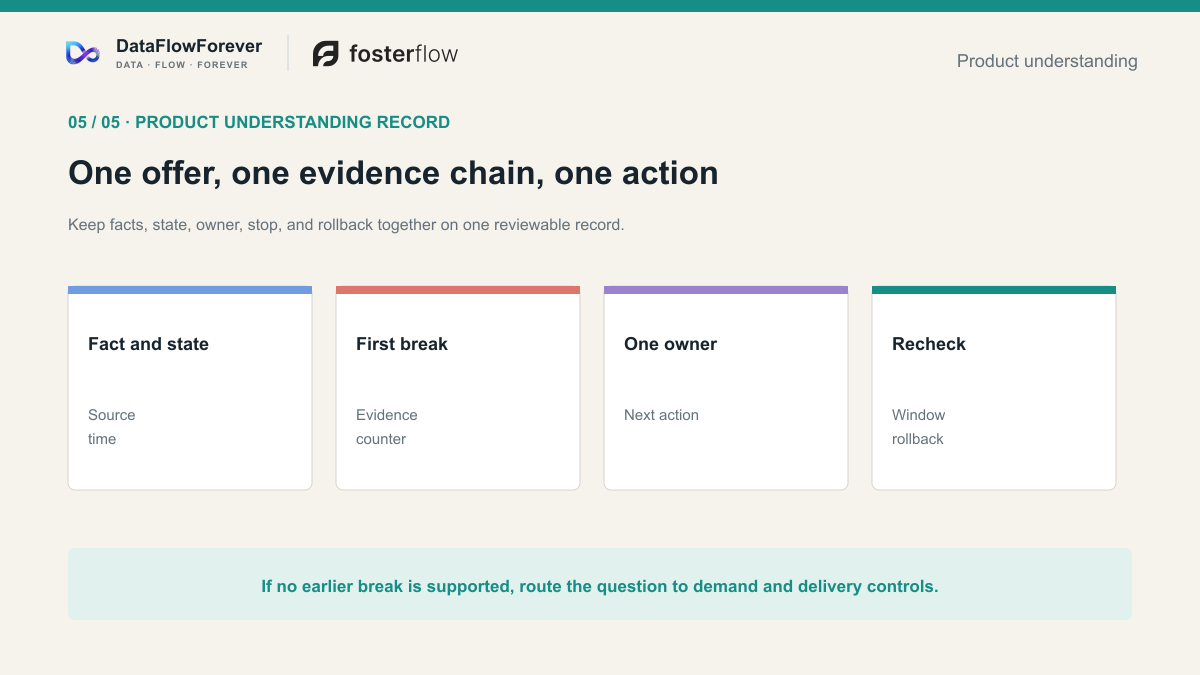
The earliest supported break sits between the authoritative availability fact and the submitted value. That makes a title rewrite, bid change, or campaign restructure premature. The next action is narrow: correct one mapping for one controlled offer, preserve the source evidence, wait for the actual processing state, and verify the full path again.
For a larger catalog, select a bounded sample based on risk: unresolved identity, variant complexity, price or availability exposure, high business importance, and known issue patterns. Do not apply a guessed fix across the catalog merely because one demonstration worked.
Automation can assemble records, compare values, flag conflicts, and prepare a change preview. A person should approve any transformation that changes product identity, customer promises, feed rules, targeting, bids, or budget. Unknown remains an acceptable result.
Turn “platform misunderstanding” into a testable handoff
A platform does not need a prettier catalog in the abstract. It needs truthful facts about an exact offer, delivered through the right fields and kept consistent with what the customer can buy.
The operator needs something equally concrete: the final processed record, eligibility in the intended context, observed delivery, and a business result that has not been stretched beyond its evidence.
DataFlowForever’s One-Time Advertising Diagnosis can begin read-only. We define the offer sample, compare available source and processed evidence, separate item issues from delivery, and return prioritized findings with one bounded next action, owner, observation window, and stop or rollback condition. Production changes remain separately authorized.
Bring one exact offer, its source record, the processed item view or export, the landing page, destination status, and item-level traffic evidence. The first objective is to locate the earliest supported break—not to promise traffic from a feed edit.
Sources and boundaries
Platform mechanics in this article are calibrated against Google’s current public documentation for the product data specification, unique product identifiers, processed products and item issues, product-data optimization, and Merchant Center performance, reviewed in August 2026. These sources define platform fields and reporting concepts; they do not prove any account’s implementation or result.
MAVE and WDC-PAVE support the narrower observation that product attributes can be multi-source, incomplete, and difficult to normalize. Their datasets, categories, and platform contexts do not transfer into Merchant Center rules or performance claims. Community discussions informed the operating questions and dangerous shortcuts only. No usernames, copied posts, customer facts, private metrics, or promised outcomes are used.