
DataFlowForever
DataFlowForever
Back to Convert services

Convert · Diagnosis

Payment Conversion Diagnosis

支付成功率诊断

Start with one market or primary payment method. Map initiation, risk, 3DS, authorization, capture, refunds, and disputes. We align the three core metrics, review recovery, duplicate submission, and data gaps, then hand over confirmed issues, unknowns, and priorities.

Delivery status

A standalone, fixed-scope diagnosis. Your team can execute the findings or decide later whether ongoing consulting or payment orchestration is useful.

Who this is for

Cross-border ecommerce teams with stalled payment conversion, fragmented failure evidence, or a need for clarity before investing in data or system work.

Decision this page supports

Locate payment loss, establish what current data can prove, and decide whether configuration, ongoing data operations, or system work should come next.

Questions covered

  • payment conversion diagnosis
  • payment failure analysis
  • 3DS review
  • duplicate payment review
  • payment risk diagnosis

Align definitions first

Three metrics answer three different questions

The diagnosis does not blend checkout conversion, payment conversion, and authorization rate. Denominators, attempts, and final states must align before a cause can be located.

01

Checkout Conversion Rate

Formula
Completed paid orders ÷ users or sessions that started checkout
What it answers
Measures how many checkout starters ultimately complete an order.
Boundary
Its denominator is a checkout user or session, not a payment transaction request.
02

Payment Conversion Rate

Formula
Successfully authorized payment transactions ÷ initiated payment transactions
What it answers
Covers the full payment funnel across initiation, risk, 3DS, and issuer authorization.
Boundary
Transaction, attempt, duplicate-submission, and final-state definitions must be aligned first.

03

Authorization Rate

Formula
Successful authorization requests ÷ authorization requests submitted to issuers
What it answers
Measures performance only after a request reaches issuer authorization.
Boundary
It excludes payments blocked, abandoned, or failed before issuer submission.

01

Map the payment journey

Confirm how storefronts, payment methods, PSPs, 3DS, risk, orders, and callbacks connect and who owns each handoff.

  • Inventory cards, wallets, BNPL, local methods, and primary providers by market.
  • Map orders, transactions, attempts, authorizations, captures, refunds, and disputes.
  • Review synchronous results, asynchronous callbacks, pending queries, and final order state.
  • Separate known facts, public clues, client confirmation, and items requiring backend validation.

02

Locate loss and duplication

Go beyond the final decline rate to review recovery and whether repeat submission creates duplicate orders or charges.

  • Build the initiation → risk → 3DS → authorization → capture → settlement → refund / dispute loss tree.
  • Segment by fail code, PSP, payment method, country, device, and repeated attempt.
  • Review soft and hard declines, 3DS challenges and abandonment, timeouts, state inconsistency, and recovery.
  • Review double clicks, repeated requests, webhook replay, and idempotency signals.

03

Balance acceptance and risk

Stricter risk controls are not automatically safer; the review considers false declines, fraud, chargebacks, and responsibility together.

  • Review current rules, 3DS triggers, exemptions, manual approval, and provider decision points.
  • Separate confirmed fraud, false declines, disputes, chargebacks, and operating cost.
  • When assessing PSPs, Forter, Riskified, or other candidates, separate client evidence from vendor claims.
  • Do not recommend changing providers or relaxing rules without data and contract evidence.

04

Leave the team with an executable plan

Rank work by potential impact, risk, implementation effort, dependencies, and verifiability.

  • Issues addressable through configuration, flow, or frontend experience.
  • Issues requiring better data, continuous monitoring, or a defined experiment.
  • Issues that may require provider coordination or orchestration capability.
  • For each action, define owner, data, validation method, and stop condition.

Pricing

One-Time Project Fee

What the client provides

The first conversation does not require production access. Formal diagnosis uses the minimum necessary read-only data or exports.

  • Primary sites, markets, payment methods, PSPs, 3DS, and risk-provider list.
  • Available order, payment result, fail-code, refund, and dispute samples.
  • Current payment flow and examples of duplicate submission or failed recovery.
  • Participation from business, payment, data, risk, and technical owners.

Typical deliverables

  • Payment asset, journey, and responsibility inventory.
  • Three metric definitions, payment loss tree, and data gaps.
  • Failure recovery, duplicate submission, 3DS, and risk findings.
  • Prioritized actions, data requirements, and a target-architecture blueprint.

Acceptance criteria

  • Both sides confirm the journey, metrics, and responsibility boundaries.
  • Each material conclusion is marked as fact, inference, or item to validate.
  • Every priority issue includes impact, recommendation, owner, and validation method.
  • The deliverables can be used independently for implementation or provider discussions.

Complete capability view

After diagnosis, choose the next step by value

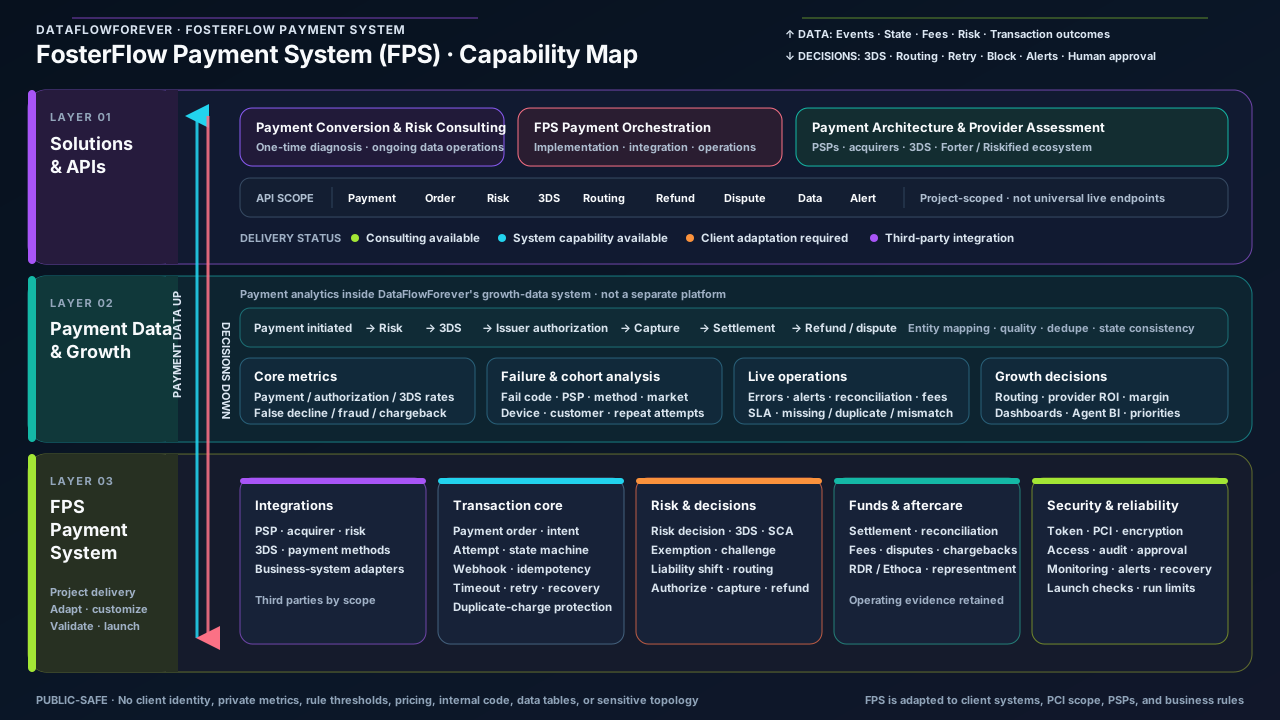
The map shows how one-time diagnosis, ongoing payment data operations, and payment orchestration relate. Accepted journey, metric, and priority work can continue into later stages.

Three-layer FosterFlow Payment System capability map: solutions and APIs, payment analytics and growth, and the FPS payment system

APIs describe scoped delivery categories, not universal live endpoints. Third-party capabilities, PCI scope, 3DS strategy, and routing rules are confirmed per project.

Open the 1280×720 map for full detail

Not included

Diagnosis boundaries

  • No continuous data pipeline, operating dashboard, or production payment system is built.
  • No production payment, 3DS, risk, routing, or provider rule is changed.
  • No fixed conversion uplift, zero fraud, zero false declines, or zero chargebacks is promised.
  • When data is insufficient, the gap is documented instead of quantifying an unverified loss or cause.

Frequently asked questions

Do we have to continue after the diagnosis?

No. The journey, metrics, issues, and improvement blueprint are delivered for your team to use independently or with another provider.

Will the diagnosis change production configuration?

No. It is based on read-only data, public pages, and interviews by default. Production changes require separate authorization and implementation scope.

Can we start with incomplete data?

Yes. Start with the current journey and available evidence. The report distinguishes what is known from what requires additional data.

Does diagnosis mean we need orchestration?

No. Many teams first improve configuration or establish ongoing payment data operations. Orchestration is considered only when the value and implementation conditions are clear.

Start with the payment problem worth solving now

Share the primary site, market, payment methods, and the problem creating the most friction. The first conversation only confirms scope and required data.

Book an initial conversation

Contact us

Start with one growth problem

This takes about three minutes. No complete report pack is required; we reply within one business day and recommend the right starting point.

We never share your information.