DataFlowForever
DataFlowForever
Back to Convert services

Convert · Payment consulting

Payment Conversion & Risk Consulting

支付成功率与风控咨询

Implement payment-data access, metric definitions, a baseline, dashboards, alerts, and a review rhythm once. Then continuously analyze failure, recovery, 3DS, false declines, risk, PSPs, and fees. Your team keeps production authority while each review supports a clear decision: tune configuration and flow, change a provider, or assess system work.

Delivery status

Based on existing team delivery experience; scope, data, and acceptance criteria are confirmed per engagement.

Who this is for

Cross-border ecommerce owners, payment leaders, risk leaders, and growth teams responsible for checkout performance.

Decision this page supports

Decide whether a one-time payment diagnosis should become an ongoing data, dashboard, alert, and improvement program.

Questions covered

  • payment conversion consulting
  • payment data operations
  • 3DS optimization
  • payment risk consulting
  • PSP performance analysis

Align definitions first

Three conversion metrics teams often mix together

Different denominators produce different decisions. Implementation aligns entities, attempts, final states, and observation windows; every later review uses the same definitions.

01

Checkout Conversion Rate

Formula
Completed paid orders ÷ users or sessions that started checkout
What it answers
Measures how many checkout starters ultimately complete an order.
Boundary
Its denominator is a checkout user or session, not a payment transaction request.

02

Payment Conversion Rate

Formula
Successfully authorized payment transactions ÷ initiated payment transactions
What it answers
Covers the full payment funnel across initiation, risk, 3DS, and issuer authorization.
Boundary
Transaction, attempt, duplicate-submission, and final-state definitions must be aligned first.

03

Authorization Rate

Formula
Successful authorization requests ÷ authorization requests submitted to issuers
What it answers
Measures performance only after a request reaches issuer authorization.
Boundary
It excludes payments blocked, abandoned, or failed before issuer submission.

01

Track payment loss continuously

Turn the payment funnel into a reproducible operating view by market, payment method, PSP, and customer cohort.

  • Initiation → risk → 3DS → issuer authorization → capture → settlement → refund / dispute funnel.
  • Segment by fail code, PSP, payment method, country, device, customer cohort, and repeated attempt.
  • Separate 3DS challenge, abandonment, and pass rates; issuer soft and hard declines; capture and state-consistency issues.
  • Review false declines, fraud, chargebacks, recovery, and operating cost within one business boundary.

02

Turn every review into the next action

Check data reliability first, then explain change, set priorities, and review the outcome of previous actions.

  • Map Payment, Order, Intent, Attempt, Authorization, and Dispute entities.
  • Check missing events, duplicates, retries, state delays, and amount definitions before building a reproducible baseline.
  • Use cohorts, time series, and before / after comparisons; define samples and windows separately when experiments are needed.
  • Prioritize by potential impact, risk, implementation cost, dependency, and verifiability.

03

Ongoing PSP, 3DS, and risk assessment

Use transaction mix and contract conditions to review providers over time rather than relying on one blended success rate.

  • Compare PSP, acquirer, 3DS, and risk coverage, regional and payment-method fit, interfaces, and operations.
  • For providers such as Forter or Riskified, assess decision placement, false-decline boundaries, dispute responsibility, data needs, and integration impact.
  • Model rates, fixed fees, minimum commitments, SLAs, guarantees, and exit cost without publishing private terms.
  • Use incremental contribution profit and total cost of ownership; do not present vendor marketing claims as DataFlowForever outcomes.

04

Payment analytics, dashboards, and Agent BI

Help the team detect anomalies, explain change, and route important issues to accountable owners on a defined cadence.

  • Transaction and amount funnels; payment conversion, authorization, 3DS challenge, false-decline, fraud, and chargeback rates.
  • Error and state monitoring, PSP fees and SLA, reconciliation variance, and vendor ROI.
  • Operating dashboards, anomaly alerts, and Agent BI reports with sources retained for material conclusions.
  • Later rule, routing, or integration changes retain human approval and follow the project's responsibility model.

Pricing

One-Time Implementation Fee + Monthly Consulting Service Fee

Data required

The first conversation does not require a complete report pack. Implementation confirms the minimum data, access, refresh, and masking needed for continuous operation.

  • Order, payment transaction, attempt, authorization, capture, refund, dispute, and chargeback events or exports.
  • PSP / acquirer / 3DS / risk statuses, normalized fail codes, timestamps, and fees.
  • Minimum fields needed for payment method, country, currency, device, customer, and order cohorts.
  • Current rules, workflows, vendor contracts, and metric definitions, handled only inside the controlled project scope.

Typical deliverables

  • Metric dictionary, payment-entity mapping, data access, and a reproducible baseline.
  • Payment operating dashboards, anomaly alerts, and a recurring review rhythm.
  • Ongoing failure, recovery, 3DS, authorization, false-decline, chargeback, and fee analysis.
  • PSP / risk-provider assessment, prioritized actions, and outcome follow-through.

Acceptance criteria

  • Key metrics can be reproduced from agreed sources with denominators, deduplication, and final states documented.
  • Each review includes facts, change explanation, recommended action, owner, and validation method.
  • Vendor conclusions distinguish client evidence, contract facts, vendor claims, and hypotheses still to validate.
  • Acceptance does not depend on a fixed uplift; experiments are reviewed against agreed samples, windows, and external conditions.

Complete capability view

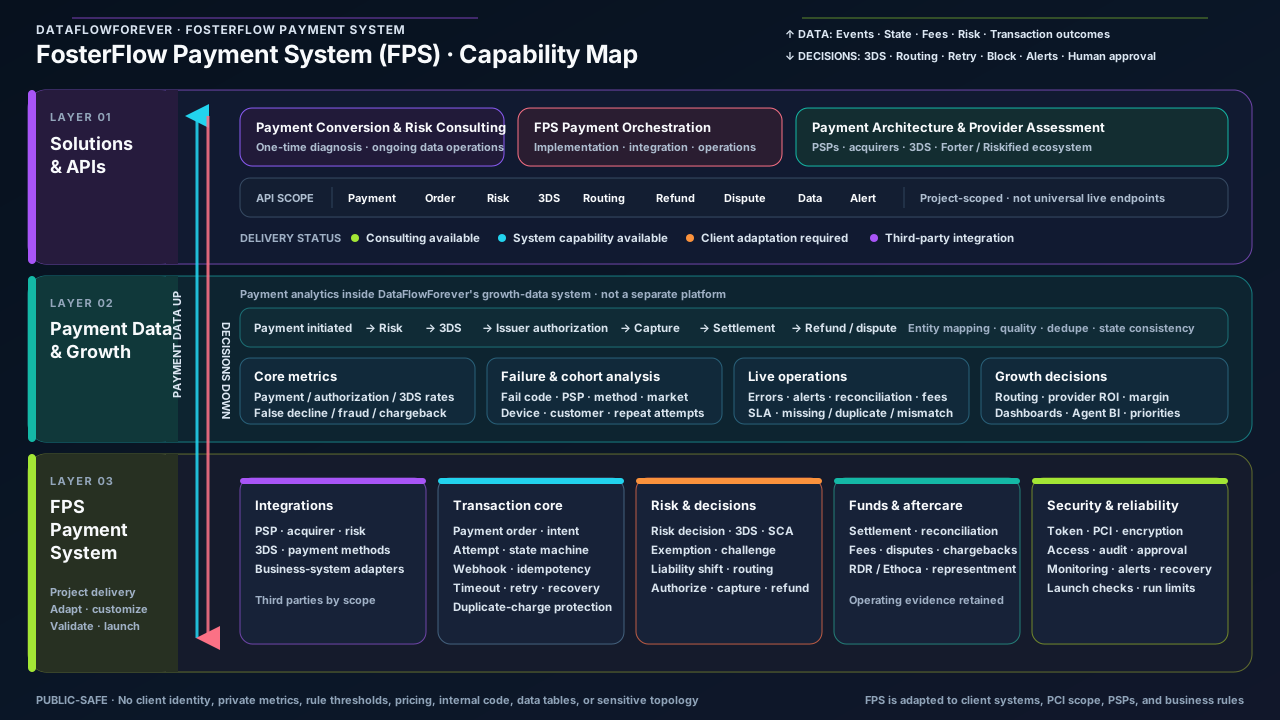
The three-layer FPS payment capability map

The top layer covers consulting, implementation, and APIs; the middle is the payment-domain capability inside DataFlowForever's existing growth-data system; the bottom is the FPS payment system implemented and adapted per client project.

Three-layer FosterFlow Payment System capability map: solutions and APIs, payment analytics and growth, and the FPS payment system

APIs in the diagram describe scoped delivery categories, not universal live endpoints. Third-party capabilities, PCI scope, 3DS strategy, and routing rules are confirmed per project.

Open the 1280×720 map for full detail

Boundaries

Capability and information boundaries

  • Consulting is based on existing team delivery experience; outcomes depend on data completeness, sample size, region, payment methods, and business constraints.
  • We do not promise a fixed uplift, zero fraud, zero false declines, zero chargebacks, or that one provider always outperforms another.
  • Forter, Riskified, and PSPs appear only as ecosystem and assessment examples; no client pricing, rules, metrics, or contract terms are published.
  • This page is not legal advice, compliance certification, PCI certification, or an issuer commitment. Responsibilities are set in the project scope and agreement.

Frequently asked questions

How is ongoing consulting priced?

The one-time implementation fee covers data access, metric baselines, dashboards, alerts, and the review mechanism. The monthly consulting service fee covers ongoing analysis, reviews, and improvement follow-through. Accepted diagnosis outputs are reused rather than rebuilt.

Are payment conversion rate and authorization rate the same?

No. Payment conversion starts at payment initiation; authorization rate only covers requests actually submitted to issuers. Define and reproduce them separately.

Do we have to replace our PSP or risk provider?

Not necessarily. The issue may sit in data, retries, 3DS, rules, routing, issuer behavior, or operations. Diagnose first, then decide whether to tune, add, or replace capability.

Can you assess Forter or Riskified?

Yes, as candidate risk providers assessed on coverage, integration, decision boundaries, false declines, dispute responsibility, fees, and contract conditions. Vendor marketing numbers are not treated as project evidence.

Does ongoing consulting require a payment orchestration platform?

No. Payment data operations can run independently. Orchestration is considered only when ongoing evidence supports the investment and PSP, PCI, security, and interface conditions are clear.

How quickly will payment conversion improve?

There is no universal timing or fixed uplift. Data readiness, volume, failure mix, vendor lead time, and approval speed affect the observation window, so each project first defines a baseline and acceptance method.

Turn payment analysis into an operating rhythm

Share one market, primary payment method, and the data currently available. The first conversation confirms implementation scope, review cadence, and accountable owners.

Discuss ongoing payment consulting

Contact us

Start with one growth problem

This takes about three minutes. No complete report pack is required; we reply within one business day and recommend the right starting point.

We never share your information.