DataFlowForever
DataFlowForever
Back to Convert services

Convert · Payment system

Payment Orchestration Platform

支付中台 · FosterFlow Payment System (FPS)

Add markets, payment methods, or providers without rebuilding a fragmented payment flow each time. FPS creates consistent transaction state, decision, interface, and operating boundaries between business systems and PSPs, acquirers, 3DS, risk, and payment methods, bringing routing, recovery, refunds and disputes, reconciliation, and monitoring into one auditable flow.

Delivery status

Complete system capabilities are available through client-specific implementation and integration; this is not no-implementation, turnkey SaaS.

Who this is for

Cross-border ecommerce owners, CTOs, payment product leaders, and technical or operating teams unifying multiple PSPs and risk decisions.

Decision this page supports

Decide whether growth is being constrained by multi-PSP integration, transaction-state, and recovery complexity, then confirm the deliverable scope and implementation boundaries of FPS.

Questions covered

  • payment orchestration
  • payment orchestration platform
  • payment routing
  • multi-PSP
  • 3DS and risk integration

Operating metric foundation

The system must preserve three distinct denominators

FPS keeps checkout, initiated-payment, and issuer-authorization grains separate so the analytics layer can explain where a problem occurs.

01

Checkout Conversion Rate

Formula
Completed paid orders ÷ users or sessions that started checkout
What it answers
Measures how many checkout starters ultimately complete an order.
System requirement
Its denominator is a checkout user or session, not a payment transaction request.

02

Payment Conversion Rate

Formula
Successfully authorized payment transactions ÷ initiated payment transactions
What it answers
Covers the full payment funnel across initiation, risk, 3DS, and issuer authorization.
System requirement
Transaction, attempt, duplicate-submission, and final-state definitions must be aligned first.

03

Authorization Rate

Formula
Successful authorization requests ÷ authorization requests submitted to issuers
What it answers
Measures performance only after a request reaches issuer authorization.
System requirement
It excludes payments blocked, abandoned, or failed before issuer submission.

01

Positioning and fit

When multiple markets and providers begin to slow expansion or amplify payment interruptions and operating complexity, orchestration creates one system boundary without rebuilding every provider capability.

  • You use or plan to add multiple PSPs, acquirers, risk providers, 3DS providers, or local payment methods.
  • Business lines duplicate payment integrations while state, retry, and refund rules diverge.
  • Routing, recovery, approval, reconciliation, and dispute operations need consistent records.
  • Payment data should enter the existing growth-data system for conversion, cost, risk, and vendor analysis.

02

Core payment-system capabilities

Select the necessary scope from adapters through security and resilience, then accept it scenario by scenario.

  • PSP, acquirer, risk, 3DS, and payment-method adapters.
  • Payment Order, Payment Intent, Payment Attempt, and transaction state machine.
  • Webhooks, idempotency, duplicate-charge prevention, timeouts, retries, compensation, and recovery.
  • Risk decisions, 3DS, SCA, exemptions, liability shift, routing, authorization, capture, void, and refund.
  • Settlement, reconciliation, disputes, chargebacks, alerts, RDR / Ethoca, and representment integration.
  • Tokenization, PCI boundary, encryption, permissions, audit, monitoring, and disaster recovery.

03

API and event scope

Names describe deliverable categories. Protocols, fields, SLAs, and versions are designed per project.

  • Payment API: create, confirm, retrieve, and cancel payments.
  • Order API: synchronize order-payment relationships, amounts, and business state.
  • Risk, 3DS, and Routing API: decisions, authentication, exemptions, routing, and manual approval.
  • Refund and Dispute API: refunds, disputes, chargebacks, alerts, and representment flows.
  • Data and Alert API: events, state, fees, risk outcomes, monitoring, and anomaly alerts.

04

Integration and decision flows

Bring third-party capabilities into a consistent state and responsibility model without hiding their contractual or technical boundaries.

  • Upward data flow: events, states, fees, risk, and transaction outcomes enter payment analytics.
  • Downward decision flow: 3DS, routing, retry, block, alert, and manual approval return to the payment system.
  • PSP, 3DS, risk, payment method, and business-system integrations retain source, version, timeout, and error semantics.
  • Third-party availability, responsibility, pricing, and regional coverage remain governed by their own contracts and service conditions.

05

Payment analytics and operating monitoring

This is the payment-domain capability inside DataFlowForever's existing growth-data system, not a second standalone platform.

  • Payment-entity mapping, data quality, deduplication, state consistency, and amount reconciliation.
  • Payment, risk, 3DS, authorization, capture, settlement, refund, and dispute funnels.
  • Fail-code, PSP, payment-method, country, device, and customer-cohort analysis.
  • Real-time errors, anomaly alerts, reconciliation, fees, SLA, routing assessment, vendor ROI, operating dashboards, and Agent BI.

Pricing

Architecture Design Fee + Staged Implementation Fees

What the client provides

Implementation begins by confirming responsibility, data, and interface boundaries instead of applying a fixed architecture without understanding the current system.

  • Business flows, payment methods, markets, currencies, and order, refund, and dispute rules.
  • Current PSP, acquirer, 3DS, risk, and payment-method contracts, sandboxes, documentation, and necessary access.
  • Business-system interfaces, events, states, and data fields, plus network, security, and release coordination windows.
  • Risk strategy, 3DS principles, routing priorities, manual approval, and incident-response owners.

Typical deliverables

  • Target architecture, responsibility boundary, payment entities, and state model.
  • Implemented interfaces, events, idempotency, recovery, and permission controls for the agreed integration scope.
  • Risk, 3DS, routing, refund and dispute, reconciliation, and monitoring flows.
  • Testing, migration, launch, rollback, operating guides, and handover materials.

Acceptance criteria

  • Agreed success, failure, timeout, duplicate, refund, and dispute scenarios pass testing.
  • Idempotency, duplicate-charge prevention, state consistency, audit, and access boundaries have reviewable evidence.
  • Monitoring, alerts, reconciliation, operating guides, rollback plan, and owners are confirmed.
  • Production launch conditions, provider dependencies, PCI scope, and residual risks are documented.

Complete capability view

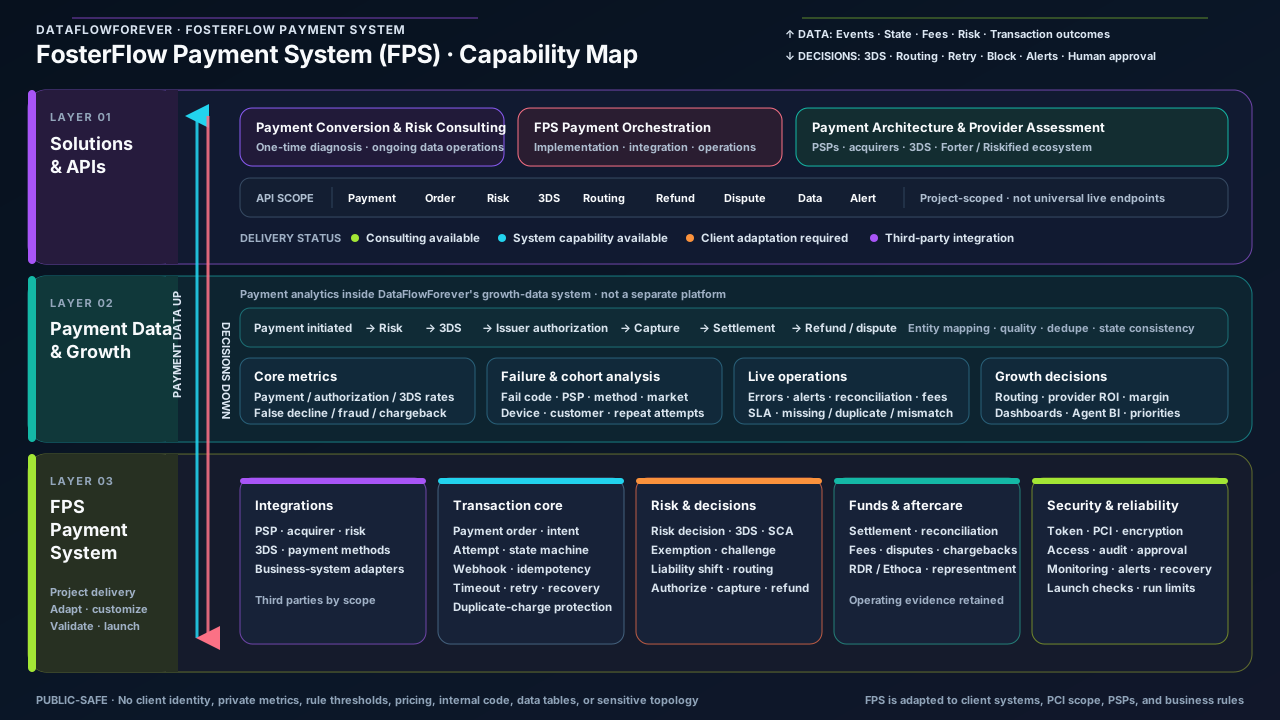
The three-layer FPS payment capability map

The map keeps solutions and APIs at the top, payment analytics and growth in the middle, and the FPS payment system at the bottom, with upward data and downward decision flows.

Three-layer FosterFlow Payment System capability map: solutions and APIs, payment analytics and growth, and the FPS payment system

The diagram includes no client names, client metrics, internal code modules, database tables, or sensitive topology. Interfaces, providers, and security scope are set in project design.

Open the 1280×720 map for full detail

Boundaries

Implementation, security, and responsibility boundaries

  • FPS is a complete project-delivered capability, not turnkey no-implementation SaaS, and does not imply universal production APIs already exist.
  • PCI scope, tokenization, keys, and card-data responsibilities must be set during architecture; sensitive topology is not described publicly.
  • 3DS, SCA, exemptions, risk, and routing policies are confirmed against markets, contracts, data, and risk appetite.
  • Third-party PSP, acquirer, Forter, Riskified, and related capabilities are integrations whose availability, fees, and responsibility remain governed by their contracts.
  • This page does not promise a fixed conversion uplift, universal compliance, or any issuer, scheme, or third-party response.

Frequently asked questions

Is FPS a SaaS product we can switch on immediately?

No. FPS describes a complete payment-orchestration capability delivered through architecture, integration, testing, and launch tailored to the client's business, providers, data, security, and operating model.

Do we have to replace our existing PSP?

No. FPS can first unify existing PSPs and transaction state, then add providers, routing, or risk capability as needed. Migration depends on diagnosis, contracts, and implementation risk.

Can we always stay outside PCI scope?

That cannot be assumed. Hosted payment pages, tokenization, frontend collection, refund operations, and log fields affect scope. Project architecture and accountable compliance owners must confirm it.

Where is the system deployed, and who controls the data, code, and intellectual property?

Deployment is agreed for each project based on PCI scope, security, the client's cloud environment, and operating model. The client controls its business data, PSP accounts, secrets, and production approvals; DataFlowForever retains its pre-existing platform and general technology. Rights to custom code, adapters, source delivery, use, and intellectual property are set item by item in the signed agreement. Ongoing operations support after launch is optional.

Are all APIs listed here universal production endpoints today?

No. They are deliverable interface categories. Endpoints, protocols, fields, versions, SLAs, authentication, and permissions are designed and accepted inside the project scope.

Clarify architecture and implementation boundaries first

Share current payment methods, PSPs, primary markets, business systems, and the flow you most want to unify. The first conversation tests fit without requiring an immediate production migration.

Request implementation scoping

Contact us

Start with one growth problem

This takes about three minutes. No complete report pack is required; we reply within one business day and recommend the right starting point.

We never share your information.