
Why Every Customer Lifecycle Stage Needs a Different Email Job
Welcome, abandonment, post-purchase, and winback are operator labels. Customers experience whatever they are still trying to complete.
A customer can subscribe on Monday, compare products on Tuesday, add one to the cart on Wednesday, purchase on Friday, and spend the following week waiting for delivery and trying to use what they bought. Months later, the same person may or may not have a reason to return.
If every stage receives a variation of “buy now,” the business has automated a sentence rather than designed a customer lifecycle.
Welcome, Abandoned Cart, Post-purchase, Replenishment, and Winback are useful operator labels. They tell the team where a Flow sits in the platform. They do not tell us what the customer is trying to finish, what evidence supports the message, or which new state should make the path stop.
The practical question is: what does this customer still need to understand, complete, or resolve, and what can the business usefully do next?
A Flow Inventory Is Only the First Page of the Review
Lifecycle planning often starts with a checklist: Welcome, Browse Abandonment, Cart Abandonment, Checkout Abandonment, Post-purchase, Review Request, Cross-sell, Replenishment, Winback, VIP, Back-in-stock, and Price Drop. The list is useful for discovery. It is not a universal priority order or a completeness standard.
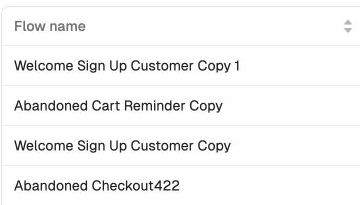
The screenshot proves that familiar Flow names can exist in an operating interface. It does not establish entry eligibility, ownership as behaviour progresses, current send-time qualification, observed runtime, or a business outcome.
- Customer job: Which unfinished task does the Flow serve?
- Entry eligibility: Are event, identity, consent, product, and order facts reliable?
- Handoff: Which deeper or different state should take ownership?
- Send-time checks: What must still be true before each later action?
- Runtime evidence: Can the team explain sends, waits, skips, exits, and handoffs?
- Outcome and guardrails: Does measurement fit the Flow job without hiding complaints, unsubscribes, or economic cost?
Some items on a typical list are not independent lifecycle strategies. Discounts and cross-sells are often treatments inside an eligible path. Reviews are a post-purchase request that should wait for usable product experience. Back-in-stock requires authoritative inventory transitions and defensible interest. VIP recognition requires a stable cohort and benefits the business can actually deliver.
Template libraries should be read in the same way: as scenario prompts, not instructions to copy.
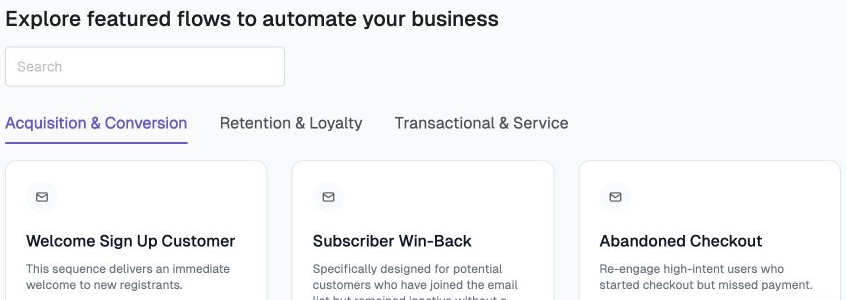
A durable-goods store and a consumables store may use the same labels while needing very different journeys. There is no reliable universal “top seven Flows.” Start with the store, customer situation, data readiness, expected value, and relationship risk.
Welcome: Deliver the Signup Promise Before Repeating the Offer
The customer situation
A new subscriber is often verifying whether leaving an email address was worthwhile. They may be looking for a promised guide, an availability update, a clearer view of the product range, or enough trust to continue considering the store.
The common shortcut
Many Welcome series become three versions of the same coupon. An offer can support a first purchase, but it cannot fulfil a content promise, explain product fit, answer a delivery concern, or establish why the business deserves attention after the offer expires.
If the form promised a guide, deliver it. If it promised product alerts, explain which alerts will arrive. For a considered product, help the reader understand use cases, comparison points, shipping, warranty, setup, sizing, or support.
Evidence needed
At minimum, retain the acquisition source, form promise, consent and confirmation state, profile identity, intended list membership, prior-purchase status, and early product interest.
Single and double opt-in are source and risk decisions. Double opt-in normally provides stronger evidence that the mailbox owner confirmed the subscription, while adding a step that reduces the number reaching the list. Single opt-in reduces confirmation friction and still requires clear consent evidence, source provenance, abuse controls, and review against applicable rules. Neither policy guarantees engagement, inbox placement, or revenue.
Confirmation is not the end of the operational chain. Submission, confirmation, consent record, profile identity, list membership, Flow entry, and a wait, send, or skip decision are distinct states.
Entry, handoff, and exit
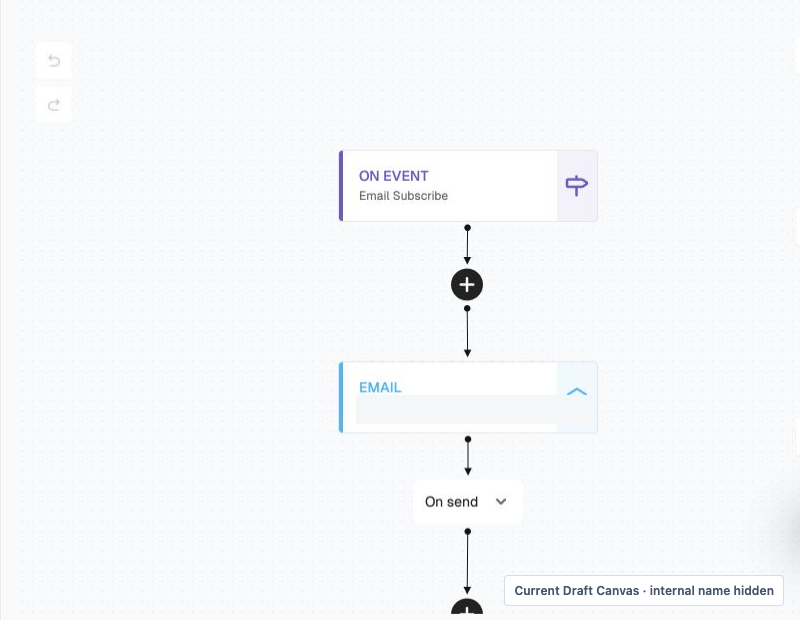
Welcome should begin with a valid, reachable marketing relationship and a known acquisition promise. Deeper product intent can change the next message. Purchase ends the first-purchase job and hands responsibility to post-purchase service. Lost consent, invalid reachability, or a conflicting current state should prevent the next action.
Practical check: Place the first Welcome message beside the signup form. Does the email deliver the promise before asking for something else? If the subscriber purchased before message two, is the remaining content still appropriate?
Abandonment: An Event Shows Where Progress Stopped, Not Why
The customer situation
Browse, cart, and checkout events show increasing intent. They do not explain motive. One shopper may be comparing products. Another may be uncertain about delivery. A third may have encountered an account, payment, trust, or page problem. Some people were never ready to buy during that visit.
Baymard's checkout research is useful for building a friction checklist. Its cross-site evidence is not one merchant's cause distribution and does not predict how much email will recover.
The common shortcuts
The first shortcut is to assume every pause is a price objection and send a discount immediately. The second is to let Browse, Cart, and Checkout recovery contact the same person independently. The third is to keep sending after purchase because the old event still exists.
What the message should do
A recovery message can preserve a direct path back, restate accurate product or cart facts, clarify a concern supported by evidence, or wait when the current state is too uncertain. It should not invent the customer's reason.
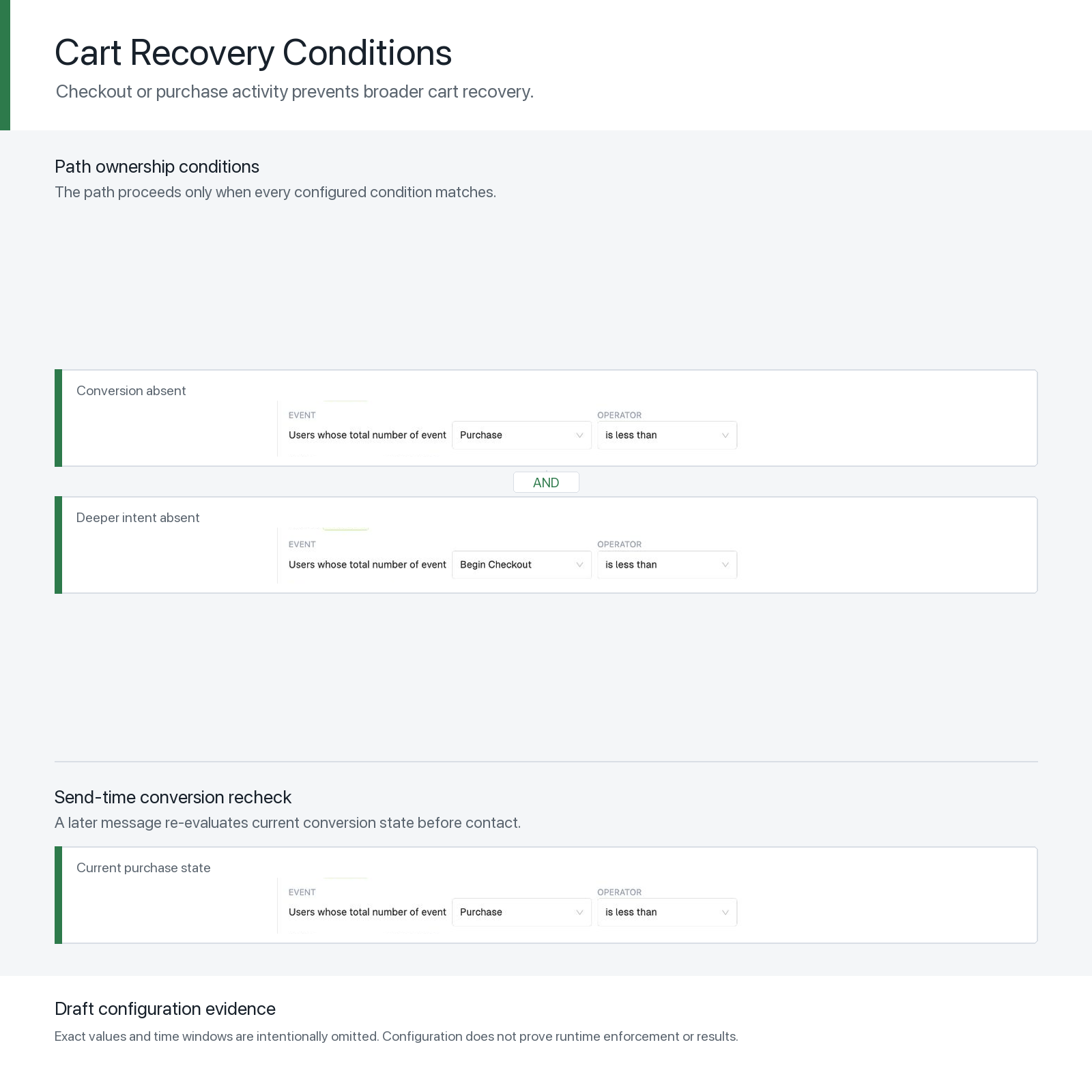
Within one correlated shopping episode, the deepest current verified intent should own the next recovery action: Browse -> Cart -> Checkout -> Purchase. Browse yields to Cart, Cart yields to Checkout, and Purchase ends recovery. The deeper path must still qualify independently through consent, reachability, suppression, contact pressure, data freshness, and accurate message facts.
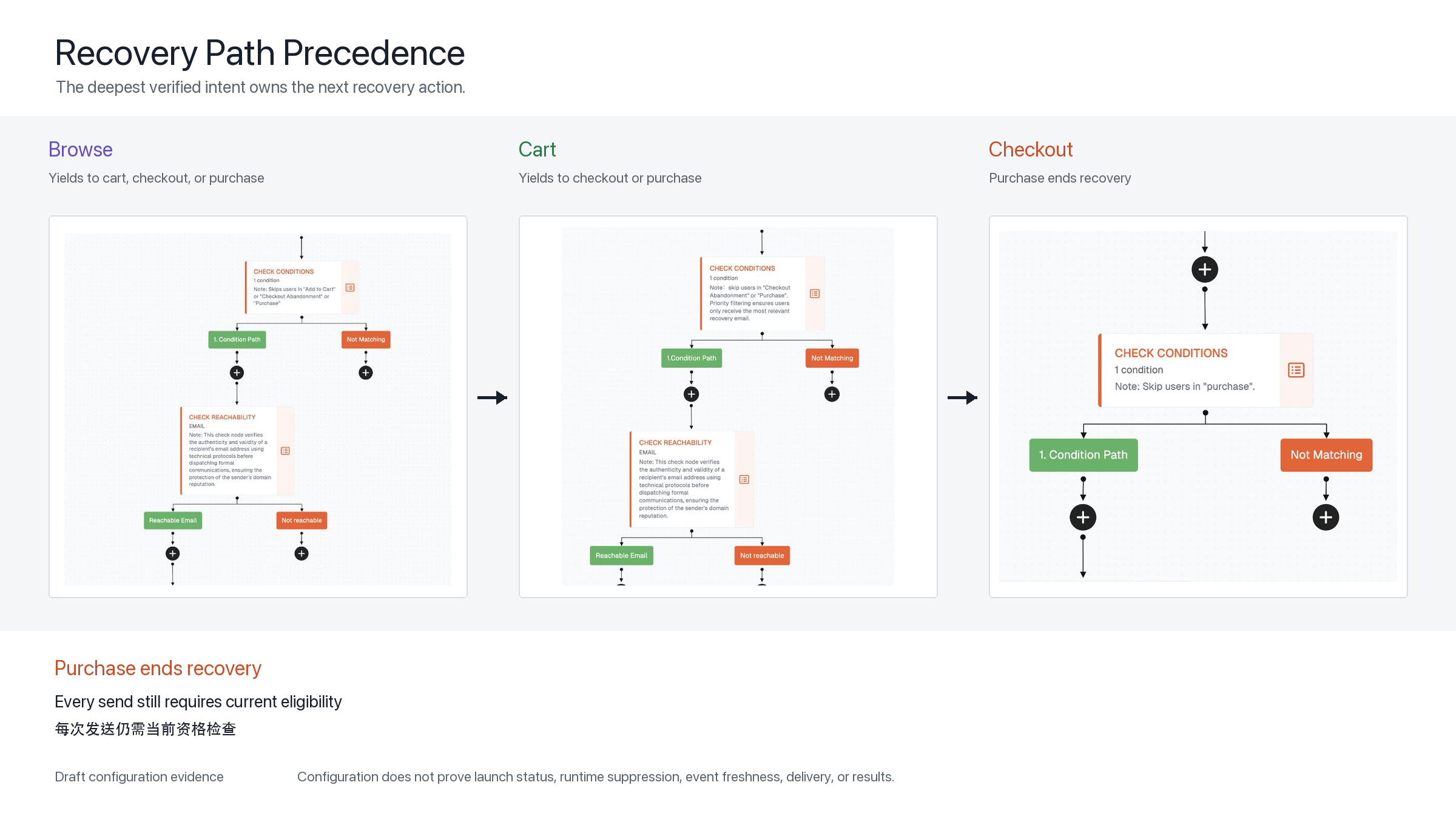
Canvas topology shows where a decision sits. The opened condition view is needed to see which deeper events are excluded and whether a later purchase is checked again.
Entry, handoff, and exit
Reliable episode, identity, product, and cart context should qualify the path. A deeper event transfers ownership only when it can be correlated. Delayed or conflicting evidence should lead to a wait or skip, not a fallback to the broadest path. Purchase ends recovery and may independently qualify a post-purchase journey.
Practical check: Enter recovery with a test profile, purchase before a later message, and inspect the recorded skip or exit reason. “The email did not arrive” is less useful than evidence of why the system decided not to send it.
Post-Purchase: Help the Customer Receive and Use What They Bought
The customer situation
Payment creates a more specific set of responsibilities. The customer may need an accurate order confirmation, delivery information, setup guidance, sizing or installation help, warranty details, support, or a clear return path. For a considered product, that process can last much longer than checkout.
Service and marketing are different jobs
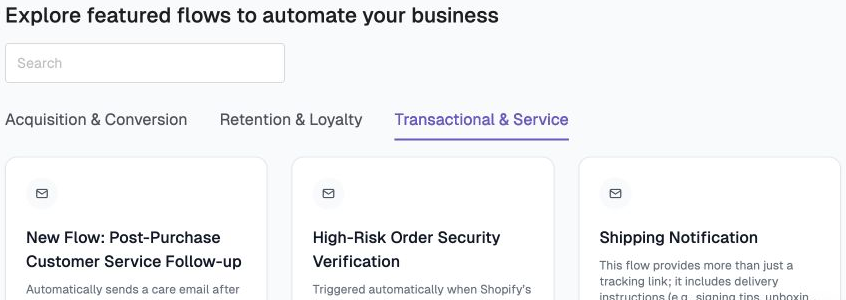
Order confirmation, shipping notification, and risk verification use authoritative operational facts. Product education, review requests, related-product recommendations, and later repurchase messages need their own current state and permission.
The common shortcut
A review request arrives before delivery. A recommendation arrives before setup. A promotion arrives while a support issue remains unresolved. Each message may look acceptable alone, but the sequence puts the company's next request ahead of the customer's current problem.
What the message should do
Keep order and shipping facts accurate. Time setup or use guidance for when it can help. Wait until the customer could reasonably experience the product before requesting a review. Make a cross-sell useful to the current use case rather than triggering it for every buyer of the same SKU.
Cancellation, refund, return, fraud review, delivery failure, or an open service issue may change the path. Post-purchase is a family of service, education, support, review, and later commercial jobs, not one upsell series.
Entry, handoff, and exit
Purchase can qualify the family, while order, fulfilment, delivery, product, and customer state decide the next task. Delivery hands responsibility to setup or use. Product experience can later qualify review. Resolved use and suitable timing may qualify a recommendation. A new order, return, or service problem can reset the sequence.
Practical check: Read every post-purchase message in the order the customer would receive it. For each one, ask whether the claimed state would already be true and whether the business request is ahead of the customer's need.
Replenishment and Winback: Rebuild Relevance From a Real Cycle
The customer situation
Consumables, accessories, seasonal products, and durable goods do not share one reorder clock. Even within one category, usage and replacement patterns differ.
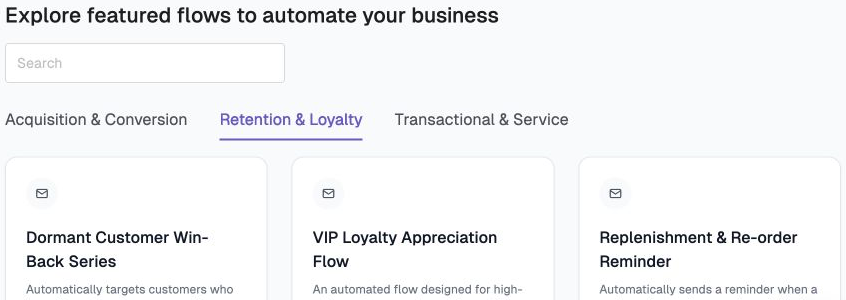
The current FosterFlow template library groups Replenishment, Winback, Loyalty, Recommendation, and Review under Retention and Loyalty. That grouping helps a team discuss possible jobs. It does not establish that every template applies or that its example timing and thresholds should be launched.
The common shortcuts
A fixed 90-day rule labels every customer inside the window in the same way. A historic open keeps a person in a high-pressure segment even when recent clicks, site behaviour, and purchases have changed. A new order occurs, but the old Winback state does not reset.
Evidence needed
Start with the narrowest stable cycle available: a product or category replacement or consumption pattern. Add comparable customer history when enough reliable orders exist. When evidence is sparse, use a wider cohort window and state the lower confidence.
Before contact, recheck inventory, current orders, consent, reachability, recent activity, other active paths, and contact pressure. A predicted or estimated due window means “evaluate now,” not “send regardless.”
Winback also needs a credible renewed reason. A relevant need, material product change, solved objection, or genuinely different value is more useful than “we miss you.” A missing open does not prove the relationship is over, while an old open does not prove present demand.
Entry, handoff, and exit
Evidence of a due or lapsed state can qualify evaluation. New purchase resets replenishment or Winback. Meaningful browsing may hand responsibility to a current consideration path. Low confidence, unavailable inventory, unresolved service, or excessive contact pressure may justify waiting.
Practical check: Sample ten profiles entering Winback and write the evidence for “why now” beside each one. If the only answer is that a timer expired, the journey needs better evidence.
Review Message, Configuration, Runtime, and Outcome Separately
Professional message production matters. Copy, product facts, links, offer details, mobile rendering, accessibility, and brand consistency all deserve review.
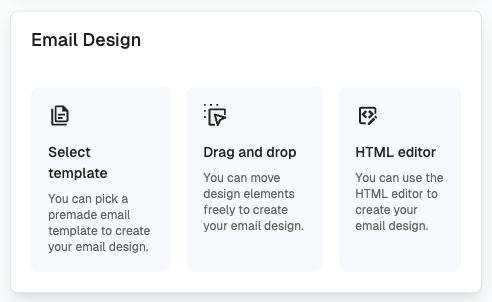
An email set still proves only that message artifacts exist. If only screenshots are available, perform a message review and mark Flow evidence incomplete. If only a Canvas is available, review the configured path and leave launch, runtime, and results unproven. Platform-attributed orders are observed attribution evidence, not automatic proof of incremental value.
- Message artifact: Is the copy clear and accurate? Are links, product facts, offer details, mobile rendering, and accessibility correct?
- Flow configuration: Are trigger, eligibility, waits, branches, path ownership, send-time checks, exits, and re-entry coherent?
- Observed runtime: Did this version send, wait, skip, exit, or hand off for the expected reason using current evidence?
- Business outcome: What happened for the eligible population, and what relationship or economic guardrails moved with it?
A One-Page Lifecycle Flow Audit
Choose one high-volume, high-friction, or collision-prone Flow. Record:
- Customer state: What has just happened?
- Unfinished job: What is the person trying to understand, complete, or resolve?
- Known evidence: Which current consent, identity, event, order, product, inventory, or service facts support the decision?
- Unknowns: Which causes remain operating hypotheses?
- Message job: What useful step does this message help complete?
- Entry eligibility: Why should this profile start the path?
- Handoff and exit: Which new state should make it wait, yield, end, or reset?
- Runtime evidence: Can the team see send, wait, skip, exit, and handoff decisions with reasons?
- Outcome and guardrails: Which result belongs to this job, and which relationship or economic costs must remain visible?
If the same paragraph can be placed unchanged into Welcome, abandonment, post-purchase, and Winback, the customer job is probably still undefined. Clarify the job, evidence, and handoff before adding another message, incentive, or timer.
Related Reading and Next Step
Sources and Boundaries
- Shopify and Klaviyo documentation support current platform mechanics, not universal provider behaviour.
- Baymard supports the bounded point that abandonment can have multiple causes, not an email conversion claim.
- Customer-journey research supports connected stage framing, not a fixed email sequence.
- Community discussions provide operator problems and hypotheses, not universal Flow counts, timing, incentives, revenue rankings, or FosterFlow outcomes.