
Why Relevant Search Terms Still Fail to Produce Qualified Customers
Lexical relevance is only the start. Verify the customer task, post-click arrival, and qualified outcome before changing the account.
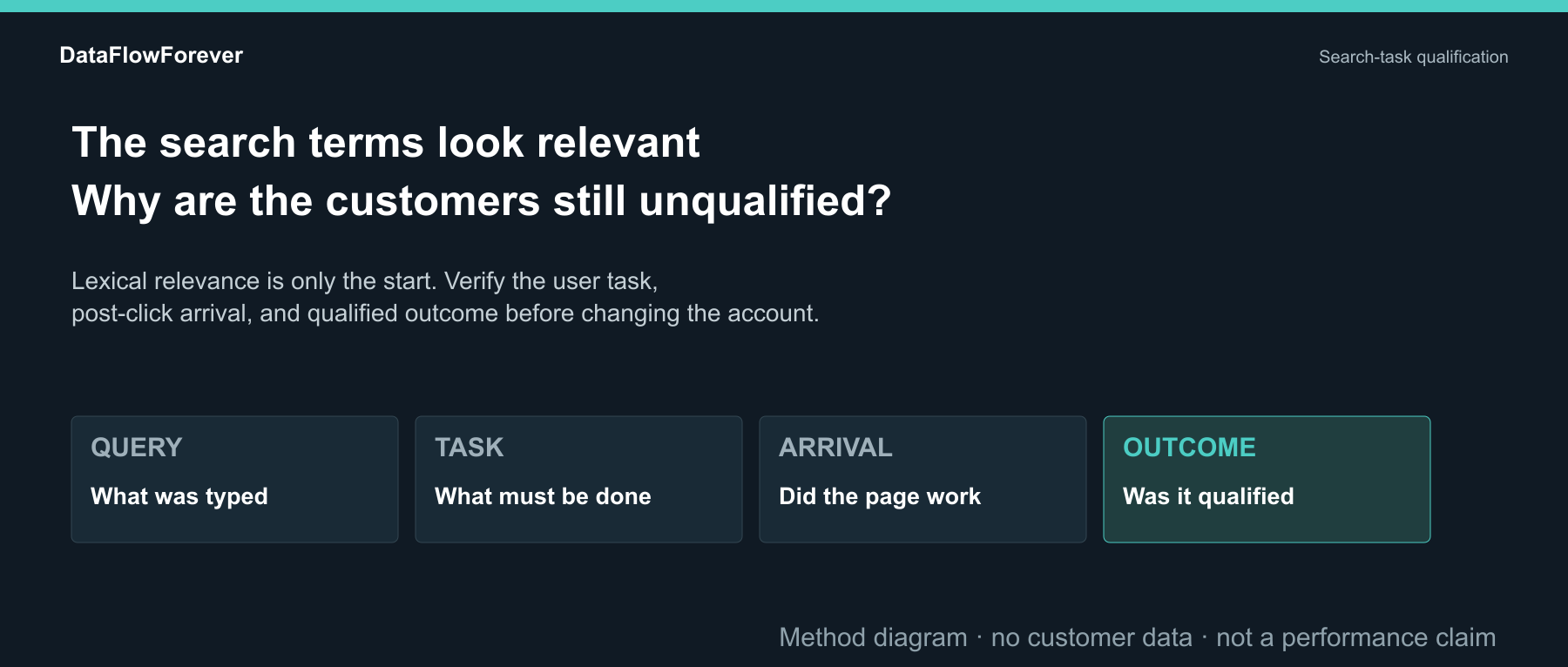
The search terms report looks reassuring. The phrases belong to the right industry. Several include the product category. Clicks are arriving, and the cost does not look alarming.
The sales result tells a different story. Orders are absent, leads do not fit, calls concern jobs or repairs, and some visitors appear to be collecting information rather than choosing a supplier. The team starts arguing about broad match, the landing page, tracking, and whether the market has enough demand.
All four questions may deserve investigation. The report alone cannot settle any of them.
Advertising platforms have to decide whether a query is relevant enough to enter an auction and which campaign, keyword, asset, or destination should respond. A business has another decision to make: was this person trying to complete a task that the offer can serve, and did the journey produce a qualified result?
That distinction changes the diagnosis. Start with the actual query and the customer's likely task. Verify that the click reached a usable page and that measurement describes what happened. Compare the ad's promise with the landing action. Then check the downstream business result. The first break supported by evidence tells the team where to work; it does not automatically prove why the break occurred.
1. A query can be relevant in three different ways
Consider a seller of specialist vehicle parts. Searches for a product name, an installation guide, a compatibility chart, a repair service, a manual, a nearby job, and a replacement part can all share the same vocabulary. They do not represent the same customer task.
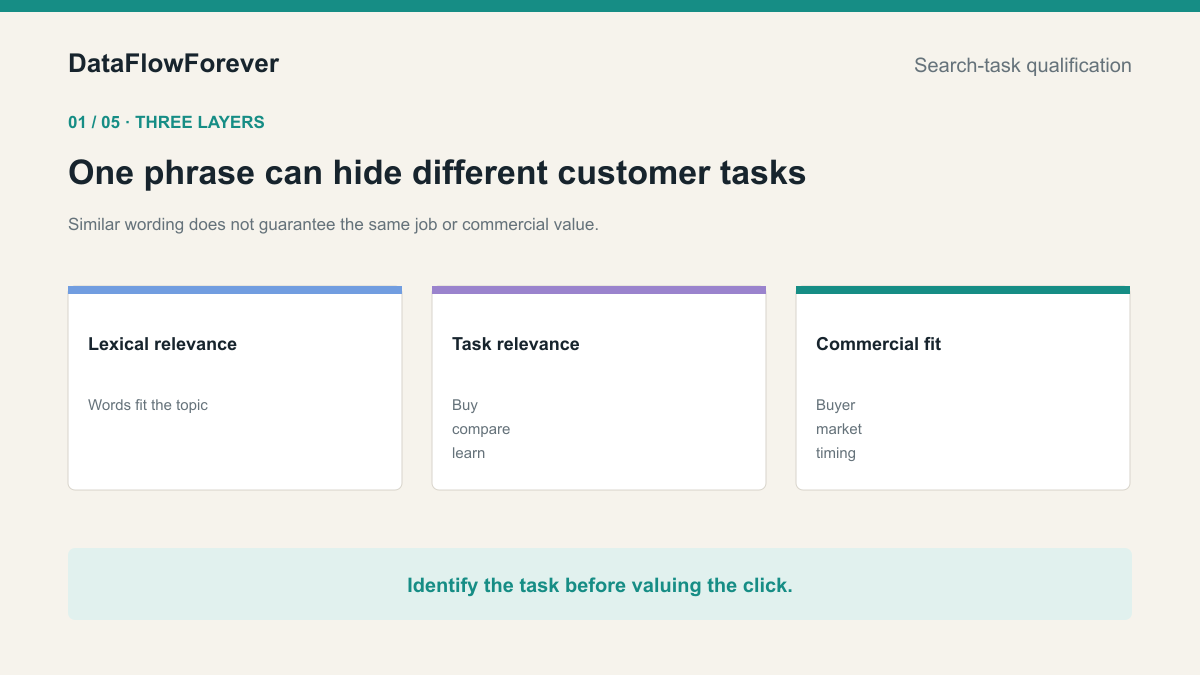
It helps to keep three forms of relevance separate:
- Lexical or topical relevance. The query contains words associated with the category, brand, product, symptom, or application.
- Platform relevance. The advertising system considers the query related to a keyword, campaign theme, creative, asset, URL, or other available signal.
- Commercial task qualification. The person is trying to complete a task that this offer, in this market and at this moment, can credibly serve.
Google's current keyword matching FAQ explains that matching can consider meaning and intent, not only identical words. That is useful platform documentation. It does not define a merchant's qualified order, a firm's qualified lead, or the economic value of the visit.
The distinction also has a research basis. Broder's classic taxonomy of web search separated informational, navigational, and transactional tasks. The taxonomy is a prompt for better questions, not a current paid-search prescription. Modern customer journeys can cross categories and sessions, and one short query may not contain enough context for a confident label.
Treat the task as a hypothesis. Record what the words support, which alternatives remain plausible, and which downstream behavior would strengthen or weaken the interpretation. A query for a product-model manual may be research before purchase, post-purchase support, a repairer's reference, or a request for a free document. A label assigned from the phrase alone cannot decide which.
2. Define the business result before judging the traffic
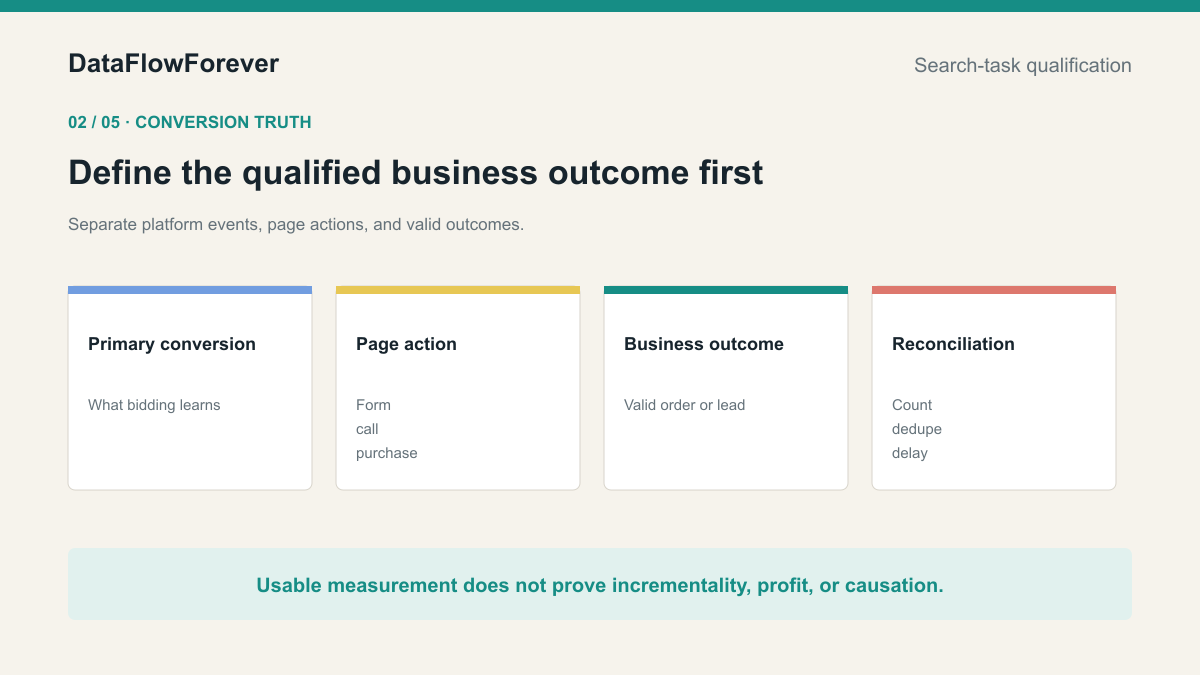
A campaign can collect conversions while sending few qualified customers. The conversion action may count a page view, button click, form submission, phone connection, or another event that sits upstream of the real business outcome. Duplicate submissions, test events, unsuitable enquiries, job applications, support requests, and low-quality calls can all look successful if the definition stops too early.
Write a small conversion contract before deciding that the query set is healthy or broken:
- Which outcome should qualify the traffic: a valid order, a sales-qualified lead, an eligible appointment, or another confirmed result?
- Which platform action is primary for optimization, and which actions exist only for diagnosis?
- How is one result counted and deduplicated?
- What delay normally exists between the click, the platform event, and business confirmation?
- Which cancellations, invalid records, refunds, or disqualifying states change the result?
- How does downstream quality return to campaign review and, where appropriate, the optimization signal?
This check prevents two opposite errors. A page-view conversion can make irrelevant traffic look productive. A long or offline qualification cycle can make useful traffic look empty before the evidence has matured. Neither should be repaired with a match-type opinion.
Passing the conversion check does not establish incrementality or profit. It gives the team a usable definition for the next question: which queries, promises, pages, and campaign jobs are associated with confirmed outcomes under that definition?
3. Review actual queries with the campaign job beside them
Keyword lists and campaign names describe configuration. Search terms describe at least part of what people typed. Begin with the highest-cost visible queries because they identify where investigation can matter soonest. Cost sets the review order; it is not an automatic exclusion rule.
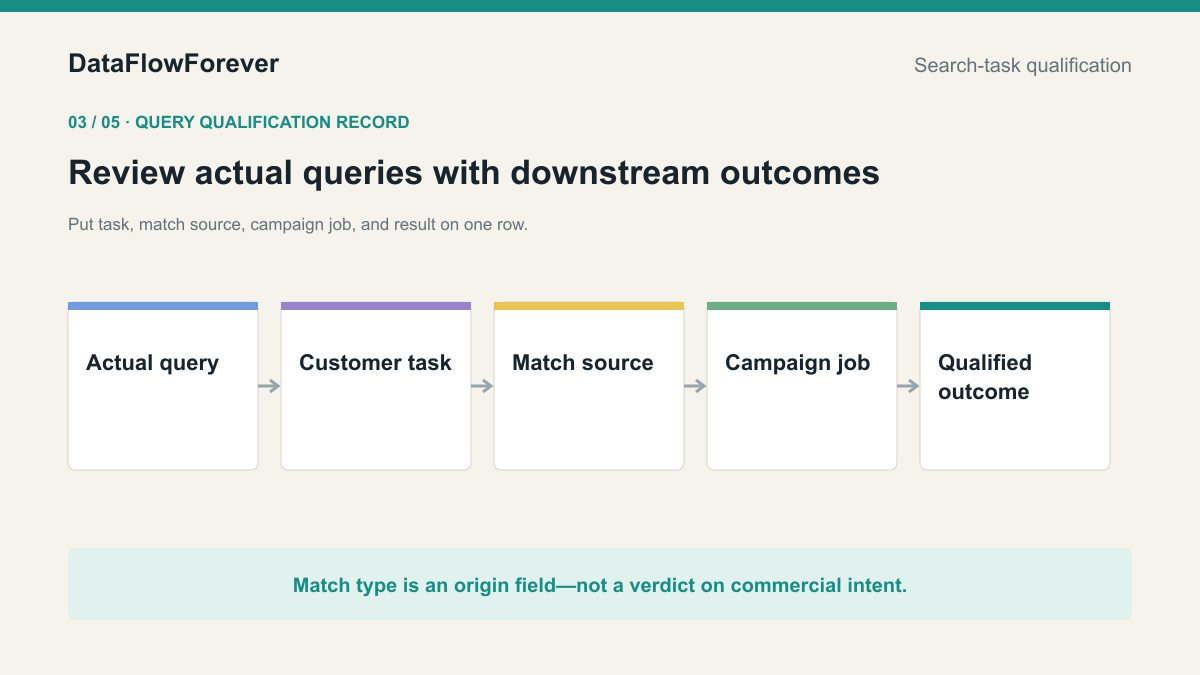
For each query, place these fields on one row:
- Field: Actual query · Question: What did the person type?
- Field: Task hypothesis · Question: Purchase, compare, navigate, research, repair, support, job seeking, or still unknown?
- Field: Match source · Question: Keyword, broad expansion, keywordless matching, search theme, or another reported source?
- Field: Campaign job · Question: Brand capture, generic demand, competitor comparison, remarketing, product category, or another declared role?
- Field: Ad promise · Question: Which product, outcome, price, condition, proof, or next step did the ad imply?
- Field: Actual destination · Question: Which URL loaded after redirects and tracking?
- Field: Qualified result · Question: What confirmed downstream state, if any, followed?
- Field: Visibility boundary · Question: Which query detail, attribution, identity, or outcome remains unavailable?
The campaign job matters because the same query may be eligible in several places. Current Google documentation describes keyword prioritization and AI-based relevance rules, while AI Max for Search adds search-term matching, keywordless reach, asset optimization, URL controls, and reporting fields. Those mechanisms help explain why a campaign or asset may have served. They do not decide whether the company wanted that task or whether the result was commercially valuable.
Keep brand and generic work explicit as well. A branded query may reflect demand created elsewhere, navigation by an existing customer, or the final step of a longer evaluation. A generic query may introduce new demand or simply attract research. Historical research has examined possible spillover between generic advertising and later branded search, but a result from one setting cannot determine the current account's incrementality or budget.
Search-term visibility is also incomplete. Privacy thresholds, aggregation, reporting definitions, and low-volume rows can leave a gap between detailed terms and total activity. Mark that gap as unknown. Do not classify unseen traffic as waste, and do not treat its absence from the report as evidence that it is healthy.
4. Confirm that the click became a real, usable arrival
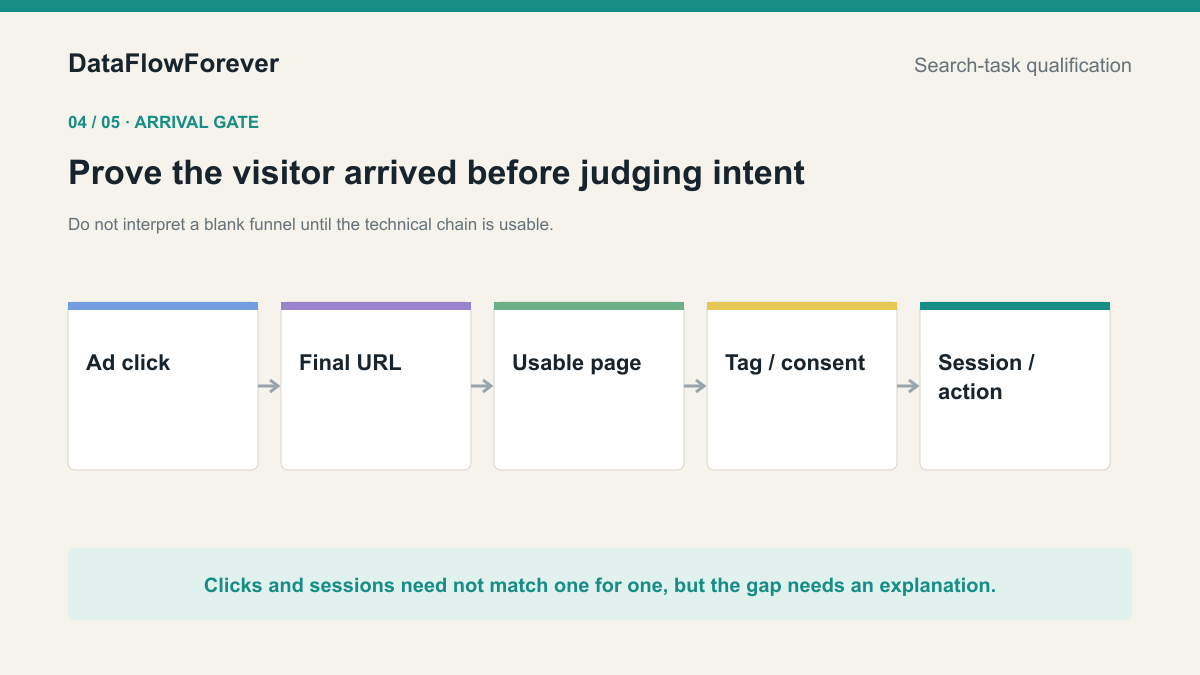
When Ads reports many clicks and analytics reports fewer sessions or page views, the temptation is to name one culprit immediately: bots, consent, tracking, or a broken page.
Clicks and analytics sessions are different records. They do not have to match one for one. A careful arrival check separates several possible transitions:
- Did the final URL and redirects resolve to the intended domain and page?
- Was the click identifier preserved where the measurement design requires it?
- Did the page return successfully and become usable on the relevant device and browser?
- Did consent and tag behavior operate as designed for that visitor and jurisdiction?
- Did the analytics event fire, arrive, and appear under the expected source and session rules?
- Could cross-domain navigation, app handoff, reloads, or session boundaries explain part of the difference?
Keep the evidence states precise. A reproducible destination error is a fact. Missing analytics with an otherwise successful page load may support a measurement hypothesis. A visible gap with no reproduction remains unresolved. None of these states establishes low-quality traffic by itself.
This Gate also protects the page team. If the customer never received a working page, changing copy cannot solve the earliest break. If the page worked but the event is missing, the measurement owner has the next validation. If both arrival and measurement are usable, the investigation can move to the promise and the customer's task.
5. Follow the promise from the query to the page action
A query, headline, and landing page can repeat the same category words and still fail the customer.
The person may be comparing compatible products, while the page opens with a broad brand statement. The ad may imply immediate availability, while the destination hides stock or delivery information. A search for a part that fits a specific application may land on a generic category with no visible compatibility path. A visitor seeking a commercial quote may reach an educational article with no appropriate next step.
Review the journey in ordinary language:
- What task did the query appear to express?
- What did the ad promise about the product, outcome, condition, proof, price, or next step?
- Which page actually loaded?
- What could the visitor understand in the first useful view?
- Which action could they complete there?
- What evidence reduced the main purchase or qualification risk?
- Did the confirmed downstream result fit the business definition?
AI Max's Final URL expansion and text customization can select or generate combinations using page and asset information. Google's documentation also gives advertisers URL controls and reporting views. These are useful mechanisms for observing and constraining delivery. They do not guarantee that every selected page answers the customer's task, that tracking templates work, or that the resulting visitor will qualify.
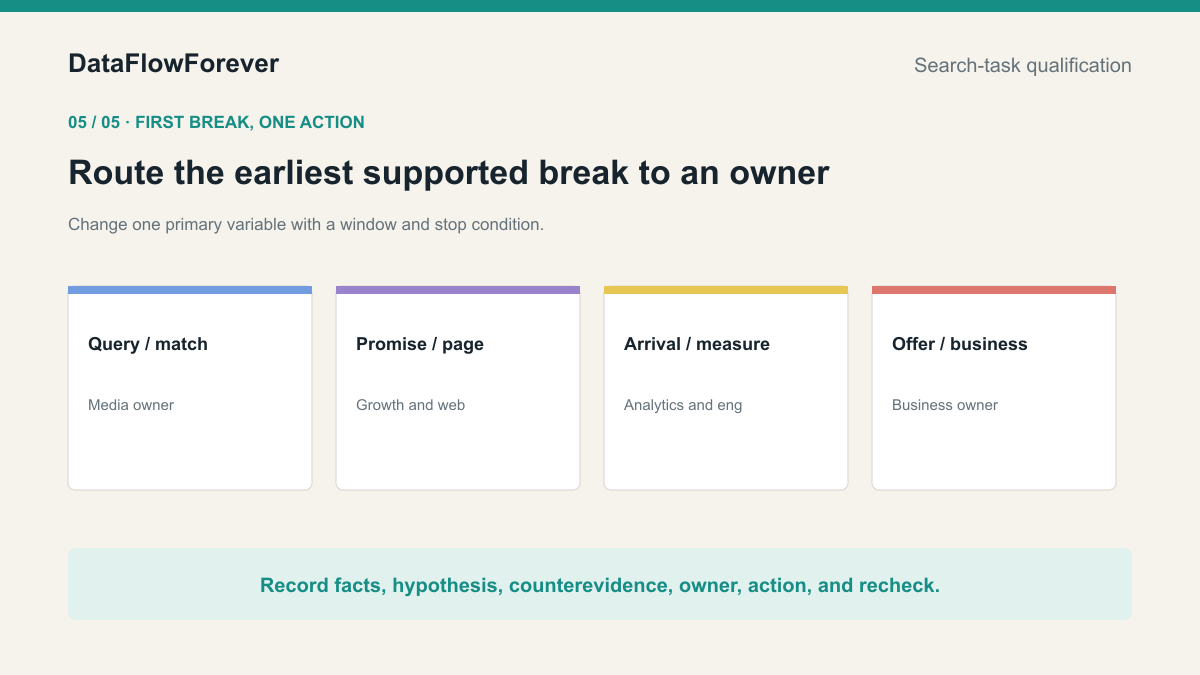
A discontinuity here needs a specific owner. Query drift belongs with the query and campaign owner. A misleading or incomplete promise belongs with creative and Offer owners. A correct promise that reaches an unsuitable or unusable page belongs with the page owner. Missing events belong with measurement. A high volume of platform conversions that fail downstream qualification belongs with the business definition and feedback loop.
6. Route the earliest supported break to one accountable owner
Several problems can coexist. The purpose of the diagnostic sequence is to choose the next validation without pretending the other explanations disappeared.
Use this routing logic:
- The actual query serves the wrong task. Review query coverage, brand controls, negatives, campaign jobs, and matching sources. Protect converted queries, brand terms, compatibility or component intent, and strategically valuable research before proposing exclusions.
- The query fits, but the ad promise does not. Clarify the product, condition, Offer, proof, eligibility, or next step. Keep the landing experience stable long enough to interpret the creative change.
- The promise fits, but the page does not complete it. Repair the actual destination, mobile task, product information, proof, CTA, or checkout handoff before expanding traffic.
- Clicks arrive, but the evidence cannot describe the visit. Reproduce URL, consent, tag, cross-domain, session, and event behavior. Use a measurement-only state until the record can support another owner.
- Conversions occur, but customers do not qualify. Tighten the outcome definition and return sales or order-quality feedback to reporting and optimization. Do not ask the page-view event to stand in for a qualified result.
- The full path works, but qualified volume remains sparse. Preserve demand as a live hypothesis. Google Trends can add a sampled, normalized relative view; its 0–100 index is not absolute search volume, orders, revenue, or market share.
This approach makes accountability more precise. The paid-media owner should explain queries, settings, campaign roles, routing, ads, destinations, and change history. Creative, Offer, page, measurement, sales, and business owners should receive reproducible evidence when the break enters their scope. Blaming an algorithm or a landing page without the supporting record is not a complete handoff.
7. Approve one action and preserve the next piece of evidence
The review should end with a Search Query Qualification Record, not a long list of simultaneous optimizations.
Record the query set and task hypothesis, known facts, competing explanations, unavailable detail, affected campaign and page, primary business result, one proposed action, protected terms or outcomes, the owner, an observation window suited to the real decision cycle, and the condition for continuing, stopping, restoring, or handing off.
The action might narrow one query class while protecting converted and compatibility terms. It might correct one destination or one promise. It might repair one conversion definition and rebuild the comparison baseline. It might hold production changes while an arrival gap is reproduced. The right choice depends on where the first supported break sits.
Use a dry run and impact preview for query controls. Keep human approval for negatives, structure, targeting, bidding, assets, destinations, and other production changes. After the window closes, inspect leakage, protected queries, arrival, qualified outcomes, and any new unknowns. A result may support the hypothesis, oppose it, or remain inconclusive.
This is also the boundary for experiments. Google's AI Max experiment guidance can help structure an account-specific treatment. An official experiment feature does not make one result universally transferable, remove attribution limits, or prove incremental profit.
Make relevance answer a business question
Relevant search terms are useful evidence. They show what language entered the account and how the platform connected it to available campaigns, assets, and pages. They cannot finish the commercial judgment.
Ask what the person was trying to do. Verify the real arrival and conversion contract. Keep the promise and destination beside the query. Route the first supported break to one owner. Approve one observable change, then inspect what happened without rewriting the unknowns.
DataFlowForever's One-Time Advertising Diagnosis starts read-only. It reviews query tasks, campaign roles, ads, destinations, measurement, and business-result handoffs, then returns prioritized findings and bounded action or experiment directions. Production changes remain separately authorized.
Bring one query set, its campaign and landing page, the current conversion definition, and the downstream qualification rule. The first objective is to determine whether the evidence supports a useful next decision—not to promise more conversions from a match-type change.
Related reading: find the first broken step when traffic produces no orders, and diagnose rising advertising costs before changing bids.
Sources and boundaries
Platform mechanisms are calibrated against Google's current documentation for keyword matching, AI Max for Search, AI Max experiments, and Google Trends data, retrieved for this research in August 2026. Announced future platform migrations remain future until their stated rollout begins and current account evidence confirms availability.
Independent studies support questions about search-task taxonomy, session context, advertiser-intent modeling, and generic-to-branded relationships. Their samples, markets, methods, and platform eras remain attached to the studies; they do not become universal match-type rules or current-account causal proof. Community discussions supply operating language, counterexamples, and diagnostic hypotheses only. No usernames, copied posts, anonymous benchmarks, client facts, or promised outcomes are used here.