
Rising Ad Costs: What to Diagnose Before Changing Bids
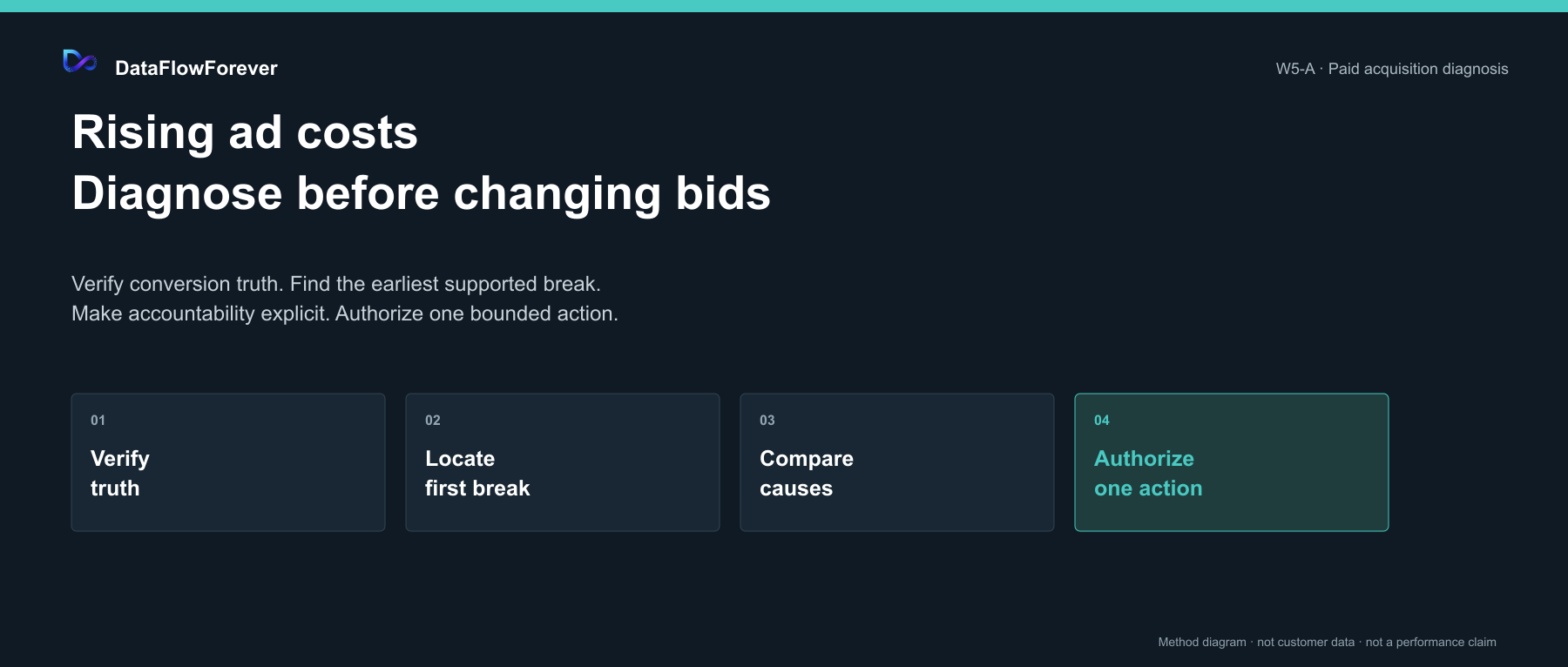
Verify conversion truth, locate the earliest supported break, make accountability explicit, and authorize one bounded action.
When paid acquisition deteriorates, an operating review can become a personnel review in minutes.
CPA is up and valid orders are down. The owner asks whether the media buyer has lost control of the account. The buyer points to auction pressure, platform volatility, or a learning period and proposes fresh creative or looser targets. The ecommerce team says clicks are still arriving, so the landing page must be failing. By the end of the meeting, bids, budgets, creative, offers, pages, and campaign structure may all be scheduled to change.
The immediate problem is not only that one of those changes may be wrong. Changing several adjacent systems at once destroys the team's ability to explain what happens next. A recovery produces an attribution argument. Continued decline produces another round of edits and another person to blame.
Here is the better operating answer: verify that the reported conversion represents the business outcome first. Then trace qualified demand, eligibility and delivery, clicks, real arrivals, useful behavior, checkout, and valid orders to find the earliest change supported by evidence. Keep competing explanations visible. Authorize one bounded action that can distinguish between them.
The media buyer is neither automatically guilty nor automatically exempt. They should be accountable for account goals, settings, queries, budgets, bids, creative decisions, change history, and evidence handoffs. Bidding cannot repair missing demand, an uncompetitive product, an ineligible Feed, an offer-to-page mismatch, a broken mobile experience, checkout failure, or an invalid conversion definition.
1. Verify conversion truth before reading efficiency
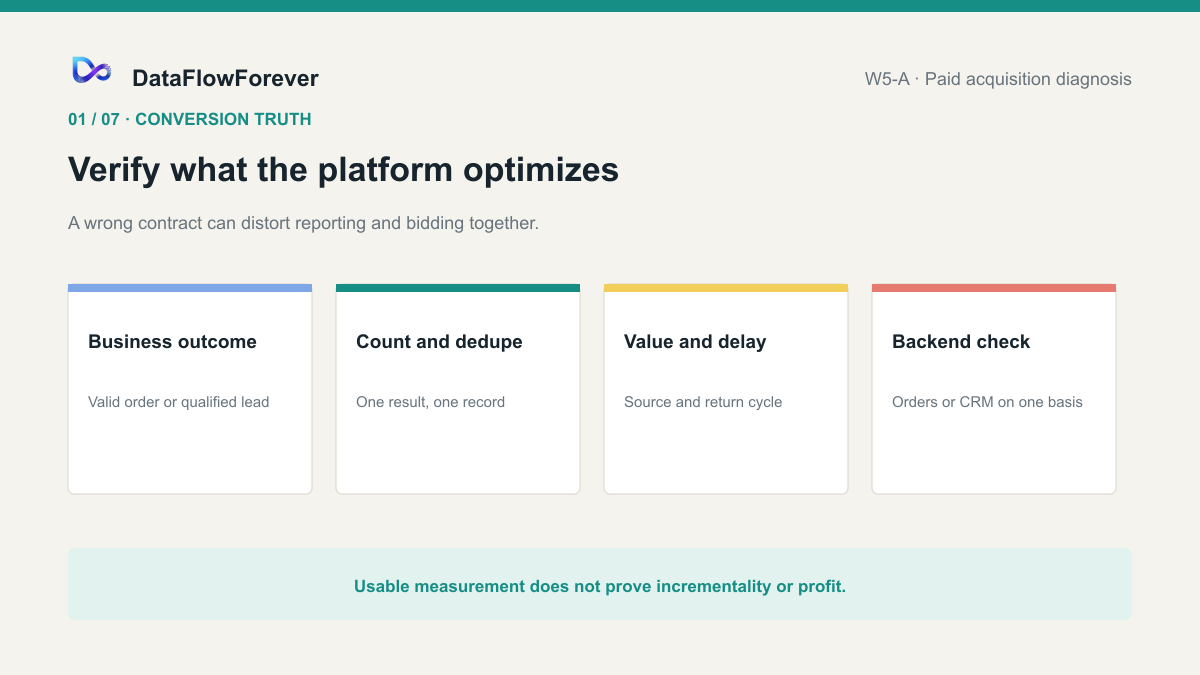
An account can display conversions without measuring the result the business actually wants.
A purchase and a checkout-start event may both be primary actions. A thank-you page may count again when refreshed. A lead may lack a stable identifier for deduplication. Reported order value may not match the commerce backend. Test orders, cancellations, refunds, or unqualified leads may remain in the success column. Conversely, a recent tracking repair can make platform conversions fall even when the underlying business did not suddenly deteriorate.
This is not a cosmetic reporting concern. Google's current description of conversion goals distinguishes primary actions used for bidding from secondary actions used mainly for observation. An incorrect primary outcome can distort the dashboard and the optimization signal at the same time.
A minimum conversion contract should answer six questions:
- What business result is the campaign expected to produce: a valid order, a qualified lead, or another confirmed outcome?
- Which action is primary, and which actions are diagnostic only?
- How is one result counted and deduplicated?
- Where does value come from, and how are discounts, cancellations, refunds, or invalid leads handled?
- How long do the customer decision, platform return, and backend confirmation normally take?
- How will platform results be reconciled with orders, CRM records, or another business system on the same basis?
Passing this check means the evidence is usable for the next decision. It does not establish incrementality or global profit. Advertising-measurement research repeatedly shows why observational exposure-and-purchase relationships can be distorted by selection, heterogeneous customers, and limited statistical power. W5-A needs a reliable operating fact base; W5-B will own the fuller allowable-CPA, contribution, incrementality, profit, and cash interpretation.
2. Find the earliest supported break
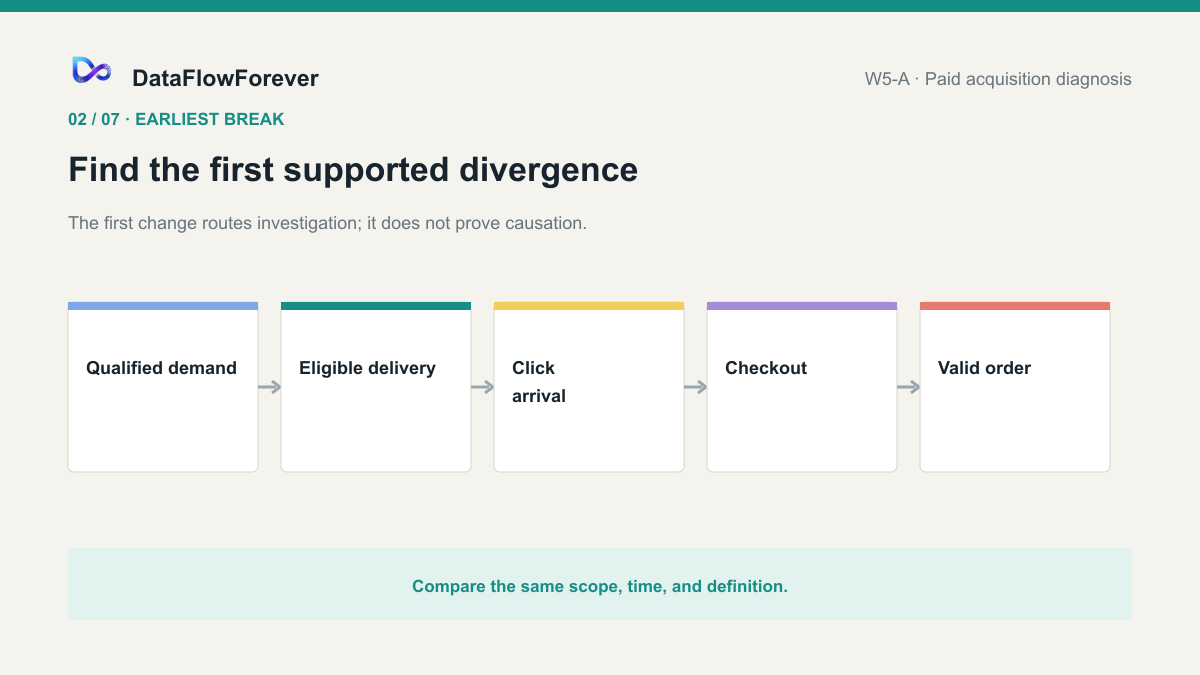
Once valid orders are confirmed to be worse, do not work through a generic optimization checklist. Lay out one comparable path:
Qualified demand → eligible delivery → impression → click → real page arrival → useful action → checkout → valid order → downstream value signal.
For the same market, campaign, product set, device, and comparison window, where does the first reproducible change appear?
If impressions decline first, the landing page is not the first investigation. If impressions and clicks remain comparable but real arrivals drop, inspect URLs, redirects, load behavior, consent, tracking, and device compatibility. If arrivals hold while product actions weaken, query intent, ad promise, price, availability, shipping, offer, and page experience enter the branch. If checkout starts hold while valid orders decline, payment, checkout errors, delivery promises, and order confirmation need attention. If platform conversions look steady while confirmed orders weaken, return to the conversion contract and reconciliation.
“Earliest” is a routing rule, not a causal claim. A mobile arrival drop could reflect site speed, an incorrect destination, browser behavior, consent changes, or broken measurement. Record evidence supporting the branch, evidence against it, and what remains unknown.
This is also why blended CPA is an alarm rather than an explanation. It combines markets, products, devices, campaigns, queries, audiences, placements, new and returning customers, and different time effects. Segment to find a common transition, not to hunt for the most flattering slice.
3. Keep eligibility, demand, budget, rank, and target pressure separate
Operator discussions often start with the same puzzle: impressions and conversions fell sharply even though nobody remembers changing the account. Replies quickly nominate seasonality, aggressive competitors, algorithm changes, policy, budget, bids, or lower search demand. Each may deserve a check. None is established without account evidence.
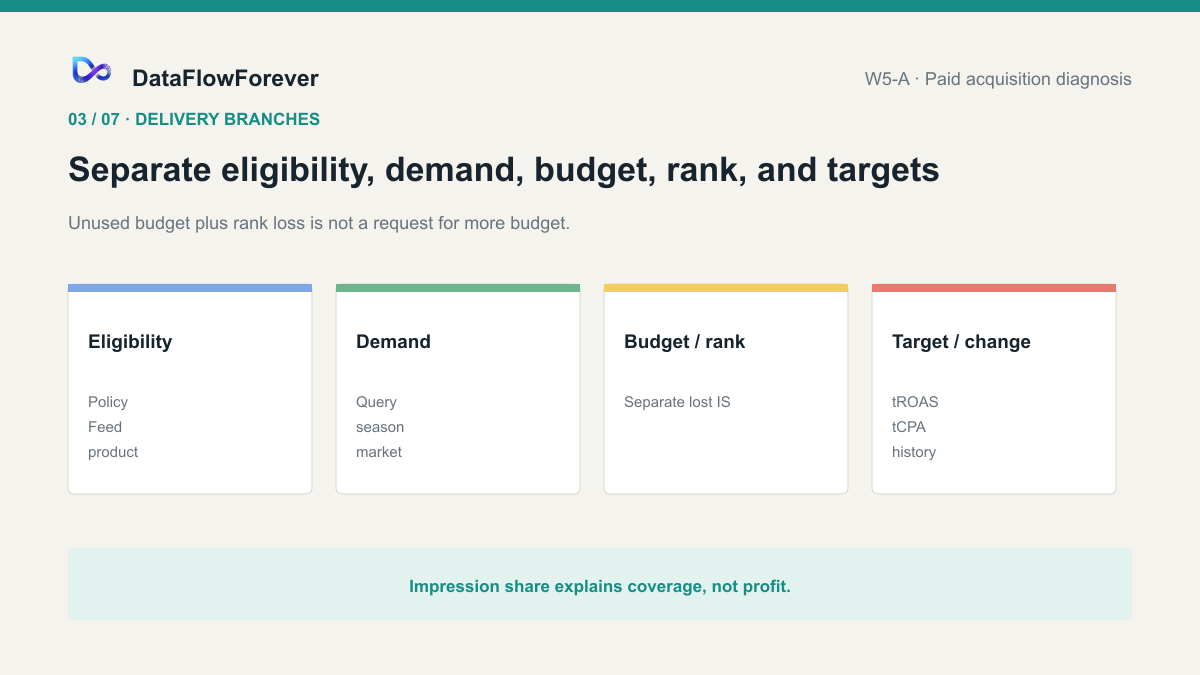
Start with eligibility. Are the account, ads, products, destination, geography, schedule, network, audiences, and product groups still eligible for the intended opportunity? In Shopping and Performance Max, Merchant product data connects identifiers, title, price, availability, destination, and other attributes. Correct data does not guarantee traffic or sales, but rejection or inconsistency can prevent the expected participation before a bidding diagnosis begins.
Then inspect demand on a like-for-like basis. Did query families or product interest change? Did brand and non-brand traffic shift? Did seasonality, promotions, or market events alter the opportunity? Auction Insights can show overlap and relative presence among advertisers participating in related auctions. A competitor's appearance or a position change does not prove that competitor caused the cost increase.
Finally, separate three account concepts:
- Lost impression share to budget describes eligible opportunities missed because of budget constraints.
- Lost impression share to rank describes eligible opportunities missed due to Ad Rank, which can involve bids, quality, relevance, landing experience, and competition.
- Target pressure describes tension between tROAS, tCPA, or another optimization target and the opportunities and signals currently available.
If a Shopping campaign is not spending its available budget while losing significant share to rank, more budget is unlikely to resolve the binding issue. The investigation must continue through targets, relevance, product scope, Feed, destination, and signal quality. The reverse also matters: budget loss is not an automatic instruction to add spend. The incremental opportunity still needs qualified intent, sellable products, and an acceptable business guardrail.
Impression share explains auction coverage. It is not contribution, incrementality, or cash.
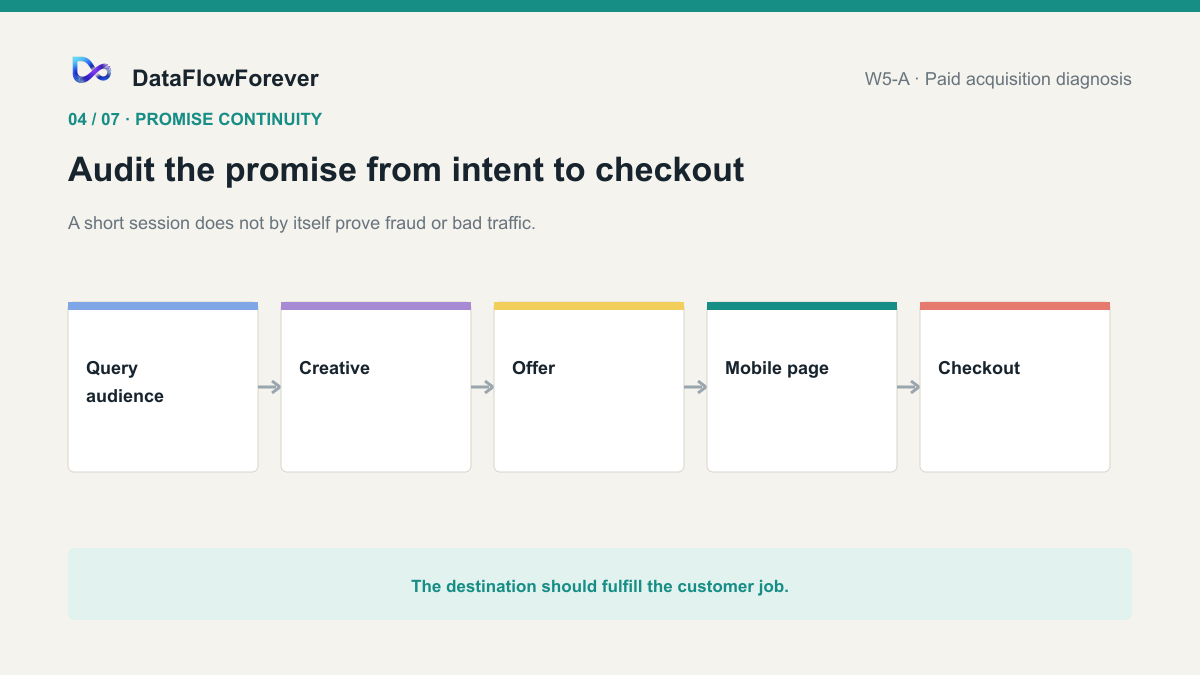
4. Audit the promise from intent to checkout
Another common complaint is that the ad platform records clicks while the site sees little useful engagement. That can feel like proof that the platform is wasting budget. A short session, one page view, or no purchase does not by itself prove bots, fraud, or invalid traffic.
Inspect the complete promise instead: what the customer searched for or responded to, what the creative promised, which URL received the click, whether the page delivered that promise quickly and clearly on mobile, whether price and availability remained consistent, and whether checkout could be completed.
For Search and Shopping, review search terms, match types, negatives, location mode, network, product scope, Feed, and destination together. Broad, phrase, and exact match do not have universal moral qualities. Small-budget accounts also need to distinguish keyword rows from independent intent hypotheses. Adding more intents expands the auction universe and can disperse limited evidence across more decision units. Organize the work around the customer task, the promise, the destination, the result that would qualify the intent, and the evidence that would retain or exclude it.
For paid social, rising CPA may travel through CPM, CTR, conversion rate, order value, audience mix, placement, frequency, creative, offer, page, or checkout. “Creative fatigue” is a hypothesis that requires evidence, not the default explanation whenever performance weakens. A creative test can be useful, but the team should identify the main variable, the conditions held stable, and the decision the result can support.
A landing-platform migration deserves similar discipline. Temporal order makes the change important, not causal by itself. Compare URLs, redirects, tracking, loading, mobile rendering, content, variants, price, availability, shipping, payment, and any concurrent campaign or market change. Preserve a version or rollback path when possible.
The customer has a simpler standard than the dashboard: the ad should make a relevant promise; the destination should fulfill it without surprise; the mobile page should be readable and operable; price, shipping, and availability should remain coherent; checkout should work.
5. Treat symptoms as questions, not verdicts
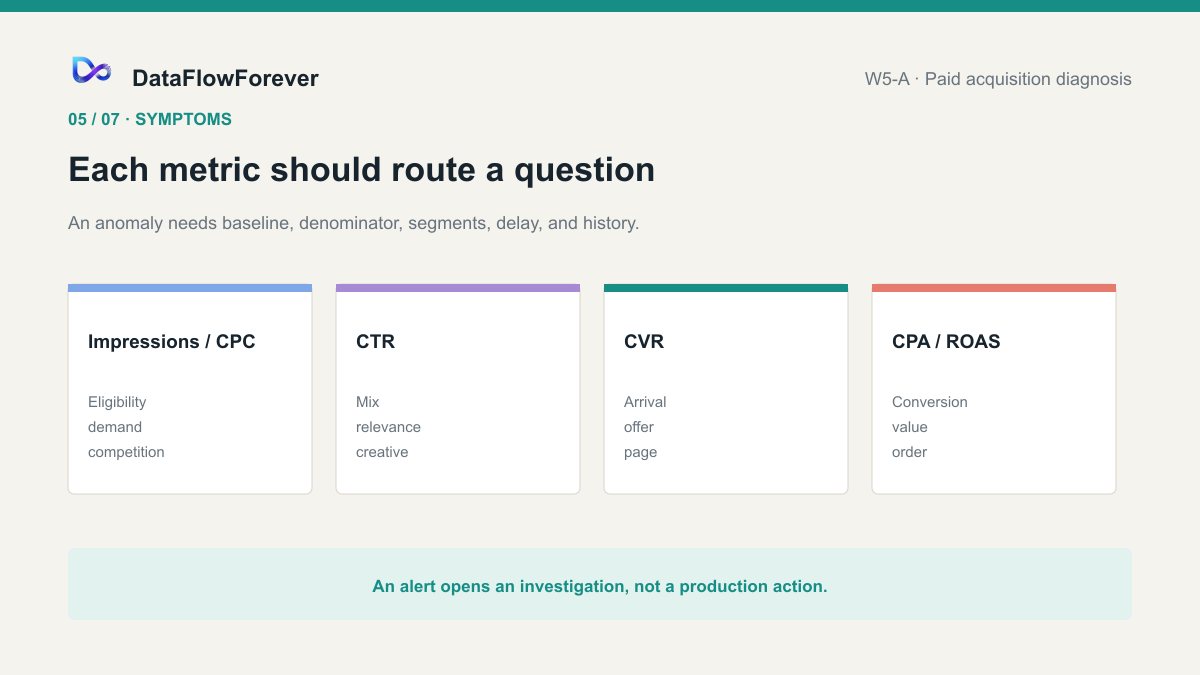
Impressions and conversions decline together. Check measurement, eligibility, Merchant issues, product scope, demand, geography, scheduling, budget and rank loss, target pressure, and change history. “No intentional account change” is useful context, not proof that nothing changed.
CPC rises. Competition, query mix, rank, quality, audience, placement, or product composition may be involved. CPC is not customer value. If valid orders and marginal economics remain acceptable, reducing CPC by acquiring worse traffic is not an improvement.
CTR falls. Creative or ad relevance may have changed, but so may the denominator: devices, positions, queries, audiences, or placements. Segment the exposure before assigning cause.
Clicks hold while conversion rate falls. Confirm real arrivals, then inspect intent, offer, price, inventory, page version, mobile experience, checkout, payment, and tracking. Do not hand every post-click issue to CRO, and do not ask bidding to compensate for a reproducible destination failure.
CPA rises while platform ROAS still looks healthy. Verify the conversion value and backend outcome. Platform attribution can help compare a channel with itself under a stable definition; it is not a cross-channel causal or global-profit truth.
Auction position is modest while CPA remains good. Low position is not automatically a defect. Chasing top impression share may buy more coverage at a different marginal cost. Scale only if the additional valid outcomes remain inside the business guardrail.
Monitoring these indicators is valuable. A useful alert carries the account's baseline, denominator, segmentation, expected delay, and relevant change history. The alert opens an investigation. It does not automatically add budget, loosen a target, exclude a placement, add negatives, duplicate a campaign, or rebuild the account.
6. Define media-buyer accountability without making them the universal owner
“Do not blame the buyer first” should not become “the buyer cannot be held accountable.” Professional responsibility becomes clearer when it is specific.
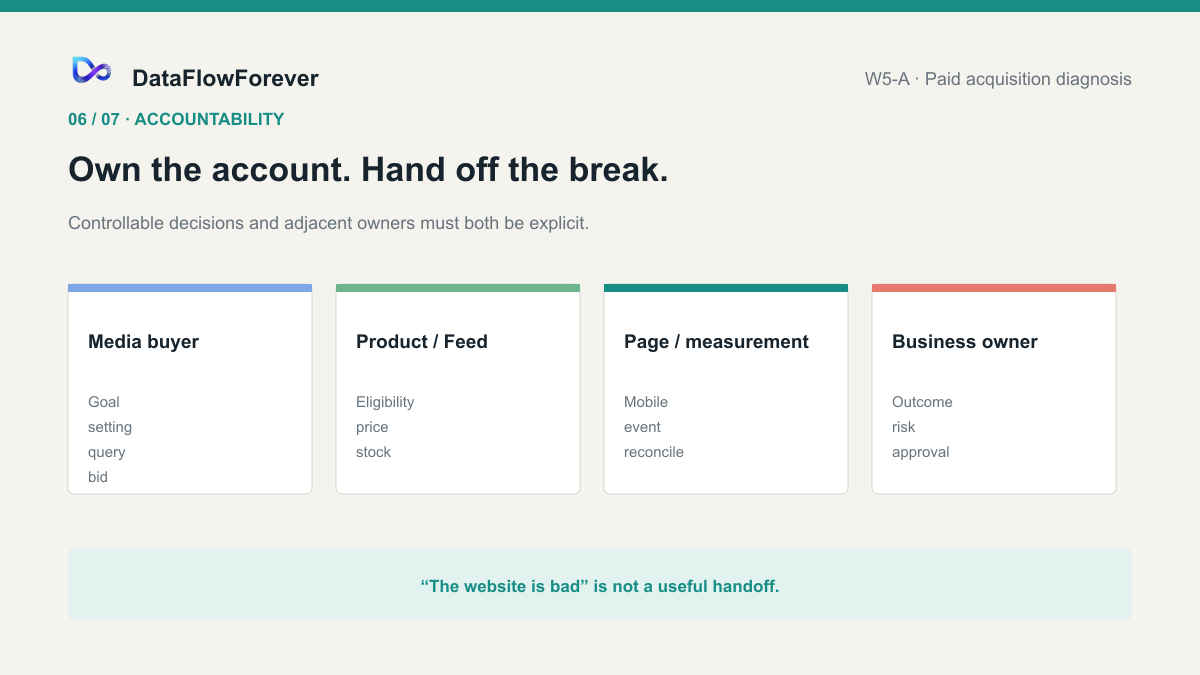
The paid-media owner should be able to explain whether the business goal and primary conversion align; whether campaign settings, geography, network, product scope, and destinations match the job; how queries, match types, negatives, audiences, and placements changed; how budget loss, rank loss, bid targets, and actual spend relate; what creative promise is being tested; what changed and when; and which competing explanations a proposed action is designed to distinguish.
Adjacent breaks need a real handoff. Product and Feed eligibility go to their accountable owner. Demand, price, and offer require merchandising and operating judgment. Page, mobile, and checkout defects need ecommerce or CRO ownership. Event definitions, value, deduplication, and reconciliation need measurement ownership. Valid orders, cancellations, refunds, contribution, and cash require the business owner.
“The website is bad” is not a handoff. A useful handoff records the affected scope, the observed fact, a reproduction method, counterevidence, the decision at risk, and the question the next owner must answer.
The business owner decides which outcome is protected, who may change production, how much risk is permitted, and whether uncertainty calls for observation, a small test, rollback, handoff, or stop. An Ads Agent can support checks, alerts, evidence assembly, and recommendations. Critical budget, structure, target, query-control, or production actions remain approval-bound.
7. End with one bounded action
A diagnosis is useful when the next action can teach the team something, not when it produces the longest list of possible causes.
Use a Paid Acquisition Diagnosis Record with these fields:
- business outcome and valid success definition;
- primary conversion, counting, deduplication, value, delay, and backend check;
- affected market, campaign, product, intent or audience, device, page version, and time scope;
- earliest observed change, supporting evidence, and counterevidence;
- competing hypotheses and important unknowns;
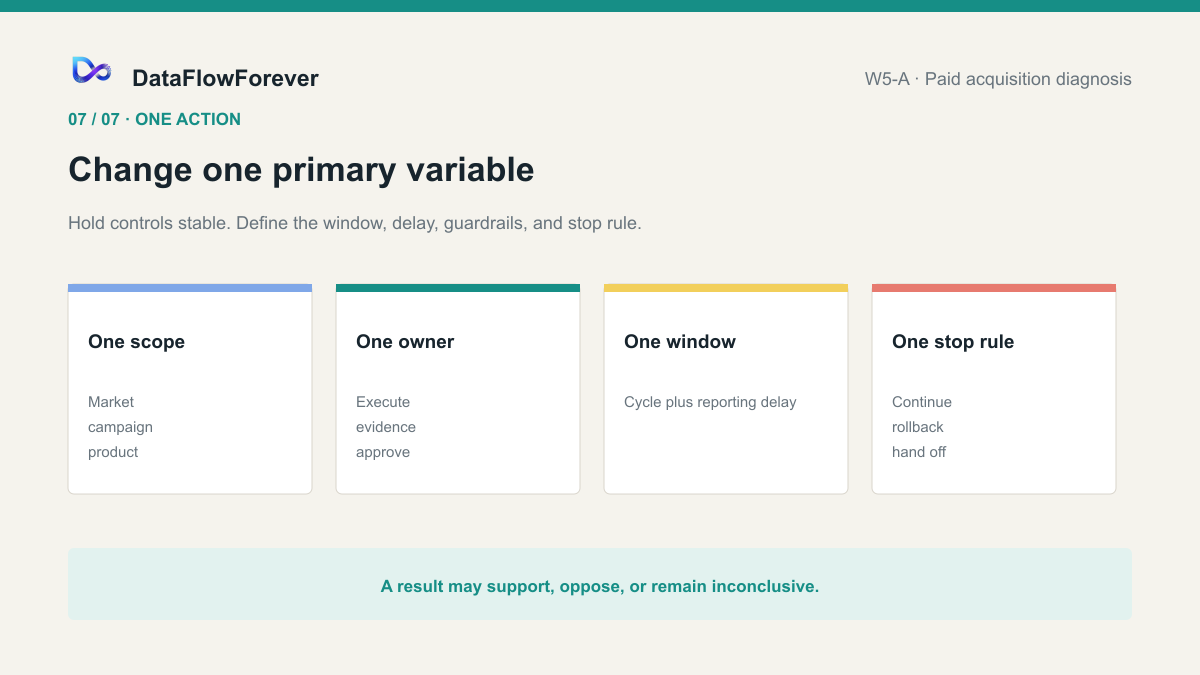
- one approved variable and the controls intentionally left unchanged;
- execution owner, adjacent evidence owners, and production approver;
- observation window that covers the natural conversion cycle and reporting delay;
- one primary outcome and necessary spend, quality, customer, inventory, or other guardrails;
- continue, repair, rollback, handoff, stop, or inconclusive condition;
- review date and evidence receipt.
For a campaign with unused budget and high rank loss, the action might test one target-pressure adjustment or repair one product-eligibility issue while other settings remain stable, not simply add budget. After a landing migration, the action might restore a comparable version or fix a reproducible defect before changing creative and audiences. When query intent drifts, a validated negative proposal can protect converted and strategically relevant terms, require human approval, and monitor query leakage and downstream results after the change.
Independent research offers a useful warning here. Advertising effects can be difficult to identify from observational reports, especially with natural purchasers, heterogeneous customers, selection bias, and limited power. A completed window may honestly support the hypothesis, oppose it, or remain inconclusive. The third state is not failure if it clarifies what evidence or design is needed next.
Change the quality of the decision before changing everything else
The media buyer may have misconfigured a goal, ignored query drift, changed too frequently, or recommended a lever without evidence. The account may also be competently managed while demand, competition, product, Feed, offer, page, checkout, or order quality changes elsewhere.
A serious team does not need to protect a person from accountability or find a convenient person to blame. Verify the outcome. Locate the earliest supported break. Separate facts, hypotheses, counterevidence, and unknowns. Assign account responsibility and cross-functional handoffs. Authorize one observable, reversible action.
DataFlowForever's One-Time Advertising Diagnosis is a read-only-first review of Search, Shopping, Performance Max, Feed, product, destination, measurement, attribution, and operating handoffs. It produces prioritized findings and bounded action or experiment directions. A client's internal team or existing agency can execute them; production changes require separate authorization. Ongoing consulting, paid-media management, an Ads Agent, and system co-building remain distinct services rather than a forced continuation.
Bring one real deterioration with its affected outcome, start date, campaign or product scope, known changes, and backend order movement. We will first determine whether the evidence can support a next decision. We will not infer a root cause from one screenshot, promise a ROAS recovery, or treat platform-attributed revenue as the whole business truth.
Sources and boundaries
Platform mechanisms are calibrated against Google's current documentation for conversion goals, performance fluctuations, impression share, Auction Insights, and Merchant Center product data. Independent studies are used to limit claims about observational measurement, incrementality, customer heterogeneity, and statistical power; their platforms, samples, and dates do not become current-account prescriptions. Community discussions supply problems, counterexamples, and diagnostic hypotheses only. No anonymous benchmark, fixed threshold, username, or claimed result is reproduced here.