
ROAS Looks Strong. Why Is There Still No Cash?
Advertising and finance can both be accurate: they describe different layers on different clocks. Reconcile platform credit to mature contribution and cash before approving the next spend band.
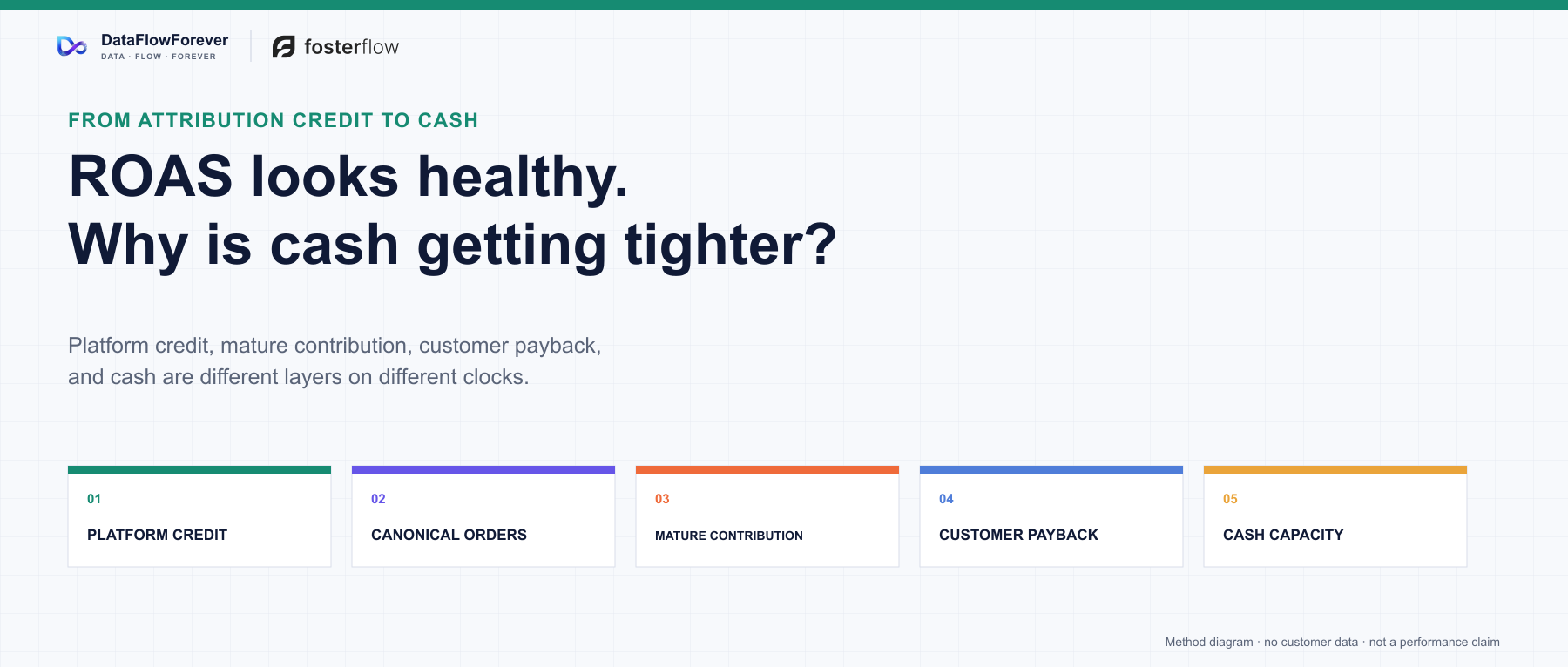
The advertising dashboard is green. The weekly ROAS is above the target. The agency says the campaign is ready to scale.
Then the founder opens the bank balance. A supplier deposit is due, the next inventory order cannot wait, refunds are still arriving, and yesterday's sales have not all reached the bank. The finance view does not feel like the media view at all.
Nobody has to be lying for both screens to be accurate. They are describing different parts of the business on different clocks.
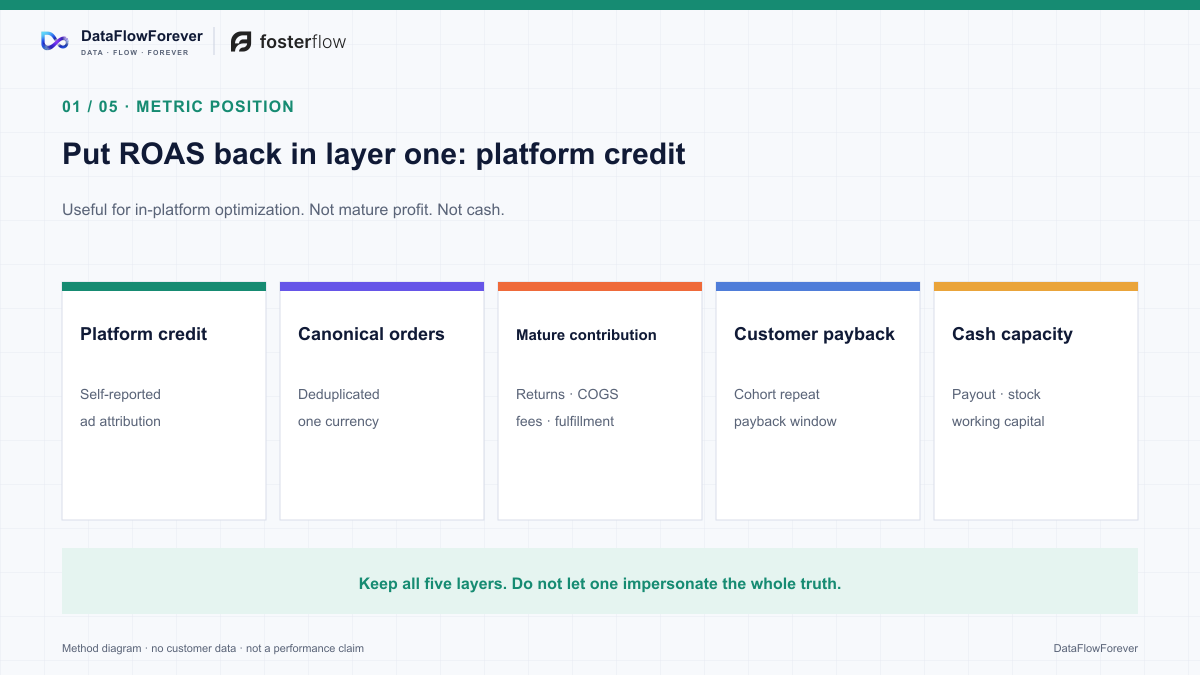
ROAS is useful when it is given one job: describe how much reported conversion value an advertising platform credits to a defined amount of media cost under a stated conversion, attribution, and time contract. It does not subtract every cost required to fulfill the order. It does not know whether the customer will return an item. It does not establish that the ad caused the sale. It does not show whether cash arrived before the next obligation.
The operating answer is not to abandon ROAS. It is to put it back in its proper place and build an evidence bridge:
platform credit → canonical conversion → global white-box credit → mature order and SKU contribution → like-aged cohort payback → payout, inventory, working-capital, and dated cash.
Only then can the team decide whether the next spend band should be scaled, tested, held, measured, or rejected for insufficient evidence.
Start by asking what the ROAS numerator contains
A ratio can look precise while its inputs remain surprisingly flexible.
In Google Ads, conversion value is configured by the advertiser, and reported value can depend on the selected conversion actions, counting rules, attribution model, conversion window, and modeled or adjusted records. Google's own guidance describes value divided by cost as an advertising measure. It does not call that value net contribution or bank cash. See Understand your conversion tracking data and About attribution models.
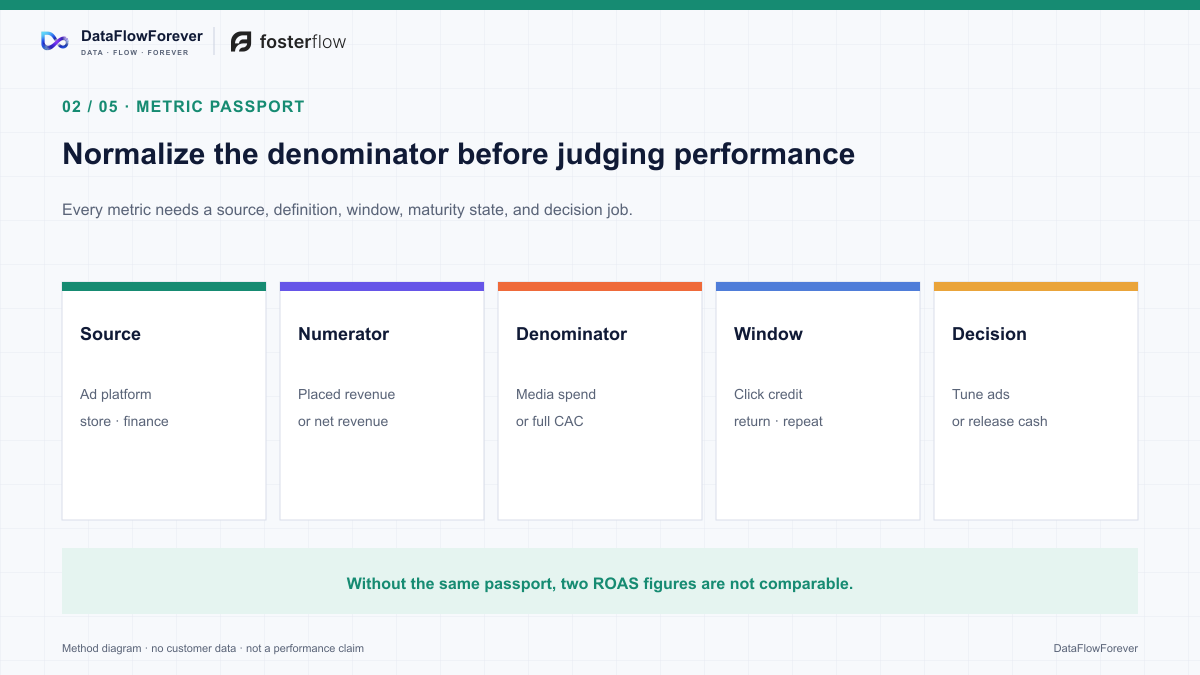
Before comparing a platform ROAS with a business threshold, write a metric passport:
- Field: Conversion · Question: Which event is counted: purchase, lead, subscription, or another action?
- Field: Value · Question: Is it gross order value, discounted value, estimated value, or a later adjustment?
- Field: Population · Question: New customers, all customers, one market, one product set, or a mixture?
- Field: Credit rule · Question: Which attribution model, window, identity rule, and included touchpoints apply?
- Field: Cost · Question: Media cost only, or a broader acquisition-program cost?
- Field: Time · Question: Click date, conversion date, order date, refund date, or reporting date?
- Field: Maturity · Question: Are cancellations, returns, disputes, and late conversions still open?
This passport keeps a channel trend useful. If the contract stays stable, a change in platform ROAS can tell the media owner where to investigate. If the conversion set, value rule, or attribution policy changes, the series has a break. A higher number after that break is not automatically a like-for-like improvement.
It also prevents a common category error: adding the full self-attributed revenue from several platforms. Each platform can claim the same conversion under its own evidence and rules. Those claims are diagnostic views, not additive company revenue.
Put the order fact before channel credit
A cross-channel decision needs one canonical conversion record before it needs a winner.
For an ecommerce purchase, that record should identify the order, time, currency, customer or permitted identity evidence, order state, line items, discounts, taxes, shipping, cancellations, refunds, disputes, and any value restatement relevant to the decision. Duplicate, test, reversed, unresolved, and missing-source states should remain visible rather than being forced into a successful channel row.
Then apply one disclosed attribution policy to the covered touchpoints. A reviewable conversion record should show which touches were present, which were eligible or excluded, how identity was matched, which window and model version applied, how credit was calculated, what each platform claimed, and what remains unknown.
This is what global white-box attribution adds. It does not promise that every touchpoint is observable. It does not turn a chosen model into causal truth. It creates a channel-neutral, reproducible company view in which one conversion receives one explainable treatment under the selected policy. An order may be attributed, fractionally attributed, unattributed, excluded, reversed, identity-unresolved, source-missing, outside the window, or insufficient for a conclusion.
That last group matters. A trustworthy attribution system does not improve its appearance by inventing certainty.
The order fact and the credit view should also be versioned separately. A late event, identity merge, refund, mapping correction, or model change may restate credit. It should not silently rewrite what the underlying order was.
Walk from net sales to contribution, one cost layer at a time
Even perfectly reconciled advertising credit is still revenue credit. It needs an economic bridge.
Shopify defines net sales as gross sales less discounts and sales reversals. Its gross-profit reporting subtracts recorded product cost, and its documentation warns that missing product cost limits the result. That is a useful reporting layer, but it is not automatically contribution after fulfillment, payment processing, shipping subsidy, returns, support, and acquisition. See Shopify sales reports and finance reports.
For the decision in front of you, build the waterfall with merchant-specific inputs:
- mature net order value
- - landed product cost for the actual SKU mix
- - variable pick, pack, fulfillment, and merchant-funded shipping
- - payment and marketplace fees that vary with the order
- - expected or realized return, dispute, reverse-logistics, and support cost
- = advertising-before contribution
- - acquisition cost on the same customer and attribution basis
- = advertising-after contribution
Use actual order lines and an explicit allocation rule when products share a shipment or another joint cost. Show missing cost coverage. Do not let an absent cost field behave like a zero.
Fixed and step costs require a second view. Rent, core payroll, retainers, software commitments, and warehouse capacity do not always change with one more order. Mechanically dividing every period cost by the current order count can make the next order look more expensive than its causal cost. Ignoring those commitments can make a positive per-order contribution look like a profitable company. Keep marginal contribution and declared-period cost coverage beside each other.
This resolves an apparent contradiction. Cutting spend can raise average ROAS while reducing total contribution available to cover committed costs. Increasing spend can lower average ROAS while adding contribution dollars. Neither observation authorizes the next dollar on its own. The next spend band still needs positive downside economics and a cash-safe boundary; sunk fixed cost never justifies buying negative marginal contribution.
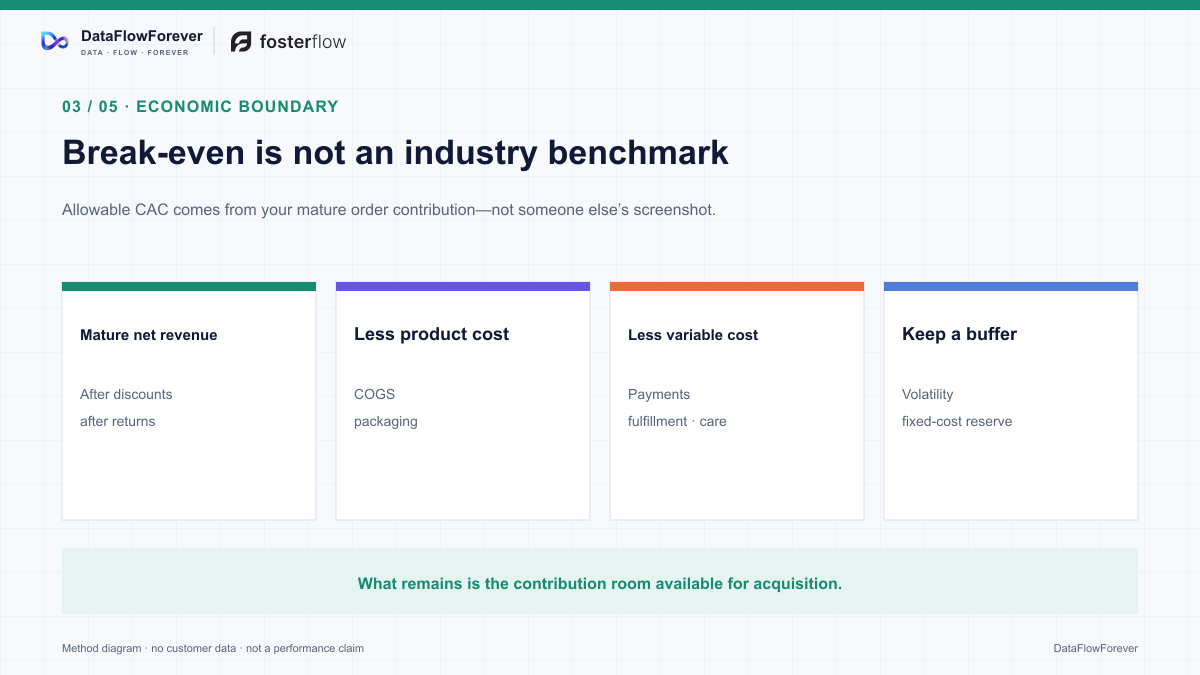
Derive break-even from your economics, not a community benchmark
There is no universally good ROAS for ecommerce.
First define the contribution layer the decision must preserve. For a first-order acquisition decision, a simplified planning structure is:
- first-order allowable CAC
- = mature first-order net value
- - complete first-order variable costs
- - required contribution reserve
If that allowance is positive, it can be translated into a planning ROAS only when the numerator and denominator refer to the same customer population, orders, attribution policy, currency, maturity window, and media-cost scope:
- planning ROAS boundary
- = aligned mature net value / aligned allowable media CAC
A break-even boundary reserves no target contribution. A target-reserve boundary does. An operating-profit boundary also has to consider the declared period's fixed and step commitments. A cash boundary includes payment timing, inventory commitments, financing, taxes, and minimum liquidity. Calling all four “break-even ROAS” hides the decision.
If the complete advertising-before contribution is non-positive, more traffic is not a margin repair. The state is not-feasible or measure-only until product, price, landed cost, fulfillment, order design, returns, or another relevant owner changes the economics. If the allowance is positive but observed acquisition evidence is sparse, the business may buy a bounded learning test. Economic possibility is not evidence of scalable delivery.
Price, bundle, organic distribution, retargeting, lifecycle messaging, and subscription are candidate interventions, not automatic rescue plans. Each changes a different part of the system and needs its own owner, customer guardrails, secondary effects, and proof.
Do not spend predicted LTV before the cohort earns it
A first order and a customer relationship are different evidence windows.
Some products can reasonably tolerate a first-order deficit because repeat contribution later repays it. That permission should come from like-aged, realized cohorts—not a blended average containing older organic customers, a platform forecast, or an aspirational LTV field.
Compare customers acquired through the same source, first product, Offer, discount condition, market, and age where the decision requires it. Track mature first-order contribution, realized repeat net contribution, cumulative acquisition cost, and the date at which cumulative contribution repays that cost. Keep selection effects visible: a first product or channel can be associated with a stronger cohort without causing its later value.
The cohort decision has three honest outcomes:
- ranking retained: the apparent acquisition winner remains stronger after equal maturity;
- ranking reversed: returns, repeat behavior, cost, or timing changes the order;
- insufficient evidence: the cohort is too young, small, incomplete, or incomparable.
Google's guidance on estimating conversion value explicitly recognizes that repeat and lifetime value can be difficult to estimate. A conservative range is a planning input. It is not realized contribution or cash.
Email and other lifecycle work can support a qualified next-value opportunity. They cannot create a natural repeat need, guarantee recovery of a first-order loss, or turn observed attributed revenue into incremental profit.
Add the return, payout, inventory, and cash clocks
Purchase-time ROAS is often provisional.
An order can be canceled, partially returned, refunded on another date, disputed, exchanged, replaced, restocked, written down, or disposed of. The product, shipment, payment, and inventory records may mature at different times. Google supports conversion retractions and value restatements for cancellations, refunds, and changed values, but that capability does not prove every merchant has sent every adjustment correctly. See About conversion adjustments.
Shopify likewise separates sales, returns, refunds, payment balance activity, and payouts. Its payout reconciliation report can connect covered Shopify Payments activity, fees, refunds, disputes, reserves, holds, and payouts. It is not a P&L or a universal cash forecast, and third-party processors may sit outside its coverage.
Inventory creates another gap between profit and cash. Buying stock converts cash into an asset before the related cost reaches the income statement. A profitable order can still increase cash pressure if replenishment, minimum order quantities, long lead times, deposits, or growth inventory require payment before customer cash arrives. Current ROAS may reflect an older landed-cost layer while the next purchase order carries a new cost.
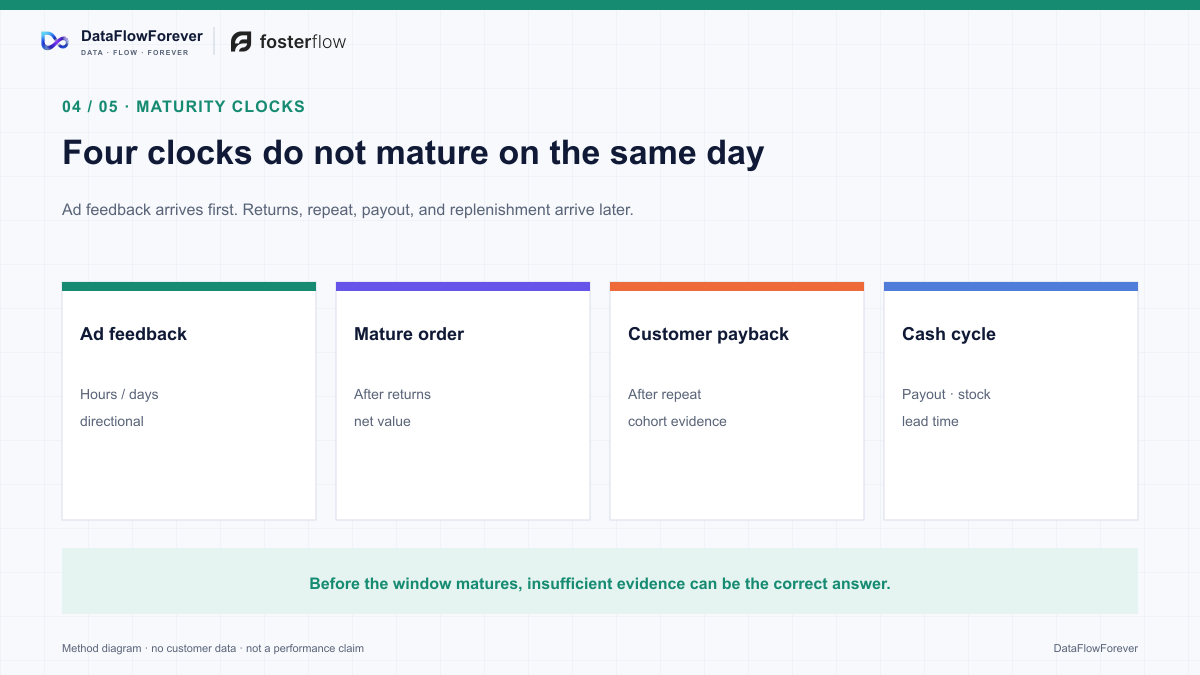
Put the major clocks on one dated line:
- media charge and platform credit;
- order, cancellation, delivery, return, refund, and dispute maturity;
- processor balance activity, payout, and bank receipt;
- supplier deposit, production, freight, duty, warehousing, and replenishment;
- cohort repeat contribution and payback;
- payroll, tax, debt, and other committed obligations.
The question “Are we profitable?” belongs to a defined contribution or accounting period. “Can we safely place the next order and fund the next ad band?” belongs to a dated base and downside cash forecast. They connect, but they are not interchangeable.
Judge the next spend band, not the historical campaign label
A campaign can have acceptable historical averages and an unattractive next dollar. It can also have a modest average while a carefully defined additional band remains valuable.
Scaling changes the opportunity set. The next impressions may come from different auctions, customers, products, placements, or intent. Product mix can change shipping and return economics. Inventory or support capacity can become binding. That is why average ROAS is evidence about the past range, not a contract for the next one.
For the proposed increment, record:
- the stable conversion and attribution contract;
- canonical new-customer and order denominators;
- mature net value and SKU or Offer contribution;
- observed versus predicted cohort value and payback;
- incremental evidence, if any, with uncertainty kept separate from attribution;
- inventory availability, replenishment exposure, fulfillment, and service capacity;
- dated payout, supplier, operating-obligation, and minimum-cash effects;
- scope, owner, approval rights, review window, stop, and rollback.
Attribution answers how observed conversion credit is allocated. Incrementality asks what would have happened without the treatment. Google's Conversion Lift uses treatment and holdback groups for that different question, while also exposing uncertainty and possible modeled delayed outcomes. A holdout can still be too small, contaminated, or imprecise. Revenue lift can still diverge from profit lift after discounts, refunds, fulfillment, and other incremental costs.
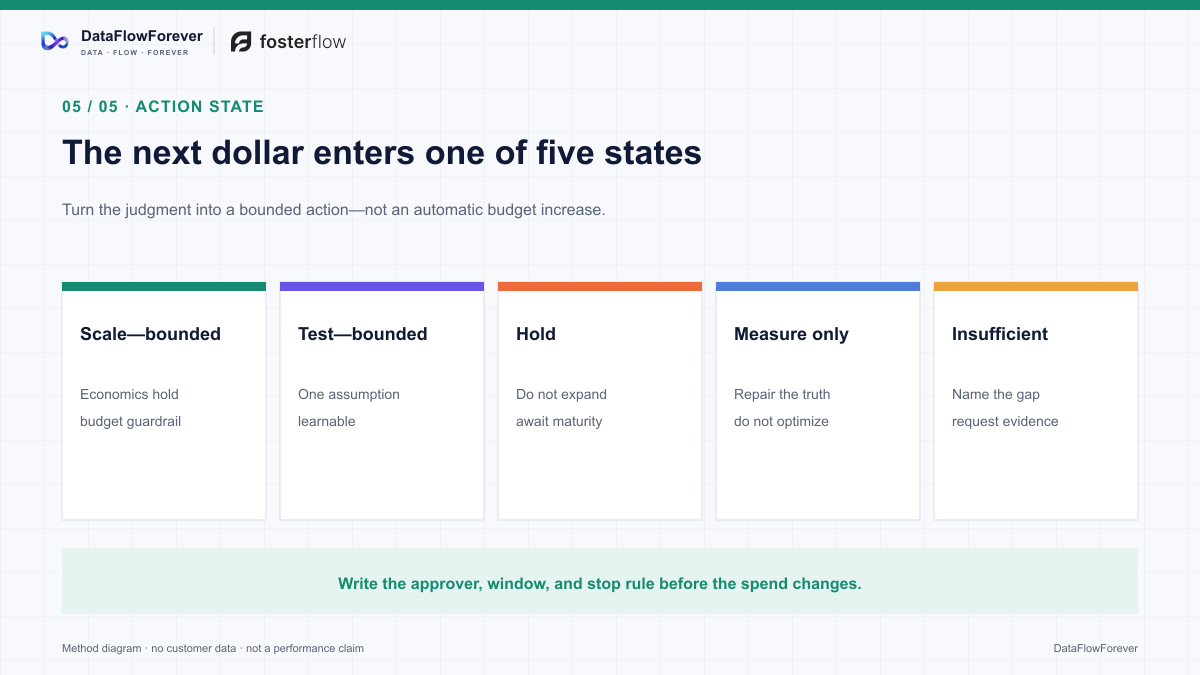
Return one of five decision states:
- scale-bounded: the next defined band passes contribution, uncertainty, cash, capacity, and approval gates;
- test-bounded: the economics are plausible, but only a capped learning purchase is supported;
- hold: a known risk, dependency, or downside prevents the increment;
- measure-only: the earliest gap is a conversion, cost, return, cohort, payout, or cash fact;
- insufficient-evidence: the current data cannot support the decision without pretending.
Use one Attribution-to-Cash Decision Record
The next review should not end with “ROAS is good” or “cash is bad.” Put the bridge on one record.
- Record section: Platform view · Minimum decision evidence: Conversion actions, reported value, cost, model, window, settings, and maturity
- Record section: Canonical fact · Minimum decision evidence: Orders, customers, currencies, states, line items, duplicates, reversals, and missing identities
- Record section: Global credit · Minimum decision evidence: Covered touchpoints, policy version, assigned or no-credit reason, platform delta, and unknowns
- Record section: Contribution · Minimum decision evidence: Mature net value, cost coverage, SKU and joint-cost rules, first-order and period views
- Record section: Cohort · Minimum decision evidence: Like-aged realized contribution, predicted range kept separate, payback, and selection limits
- Record section: Cash · Minimum decision evidence: Payout timing, inventory commitments, obligations, forecast scenarios, and minimum cash
- Record section: Decision · Minimum decision evidence: Spend band, owner, window, guardrails, stop, rollback, and human approval
DataFlowForever's attribution work can organize covered touchpoints and conversions into a reviewable global credit view, reconcile platform claims, and connect the observed result to declared business-value fields when those sources and permissions are in scope. Attribution Analysis can be a bounded engagement; cross-functional economics and prioritization may belong in Growth Strategy Consulting or the One-Year Growth Partnership.
The boundary is as important as the capability. A company-wide white-box view is not “all truth.” It does not observe every touch, choose the merchant's risk appetite, replace financial close, or prove causal lift. Data and account access vary by project. Budget, bid, inventory, pricing, and customer-treatment changes remain human decisions.
ROAS should remain on the screen. It is a useful local media ratio. Just do not ask it to answer a question it was never designed to answer.
When the dashboard looks strong and cash still feels tight, do not choose between marketing and finance. Reconcile the two. Follow the credited conversion into the order, the SKU, the return window, the cohort, the payout, the inventory commitment, and the dated cash forecast. Then decide what the next dollar is allowed to do.