
More Emails, Still No Orders: Find the First Broken Step
Make the traffic decision-usable, locate the earliest supported break, and qualify Email or CRO only when the path gives them a real job.

The weekly report can look active while the business stays still. Ads brought clicks. The store recorded sessions. Email earned opens. The team changed the hero, added reviews, tightened the call to action and launched Welcome, cart and winback Flows. Orders did not follow.
Paid Media blames the page, the site team questions the traffic, and Lifecycle proposes another offer. Any of those ideas could become useful. None identifies where a buyer first stopped moving.
Traffic without sales is a symptom shared by bad measurement, weak demand, irrelevant traffic, an unsupported offer, broken promise continuity, page friction, checkout failure and incomplete sales follow-up. When several teams change their layer at once, the evidence gets worse.
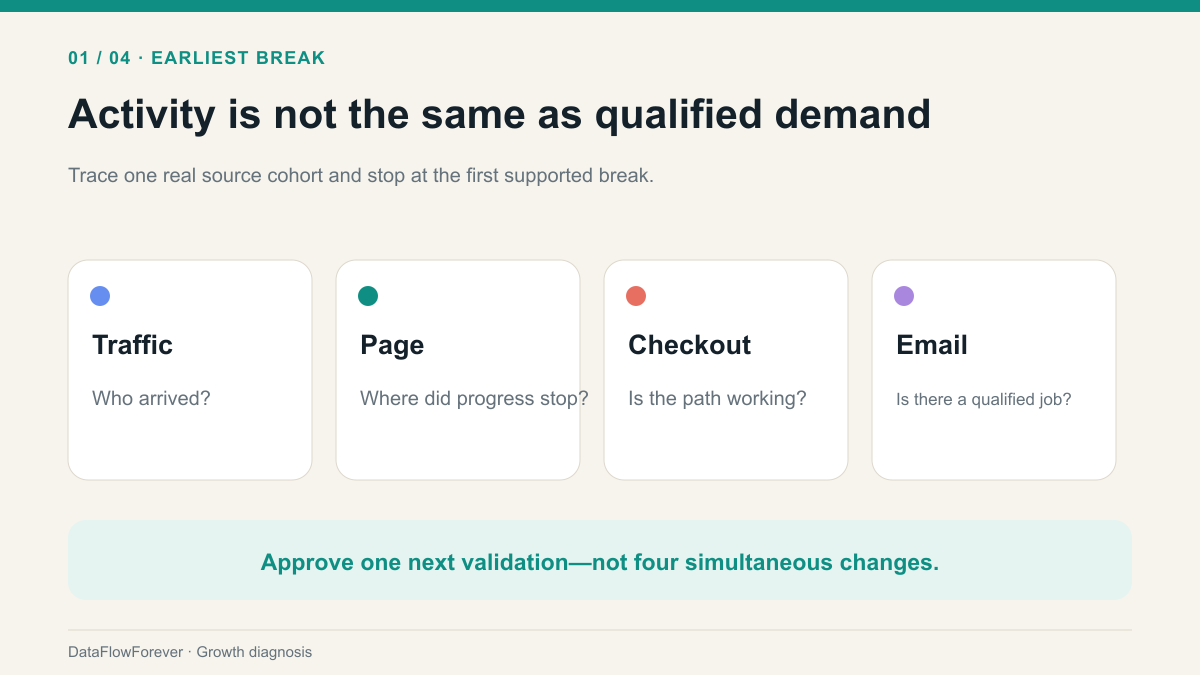
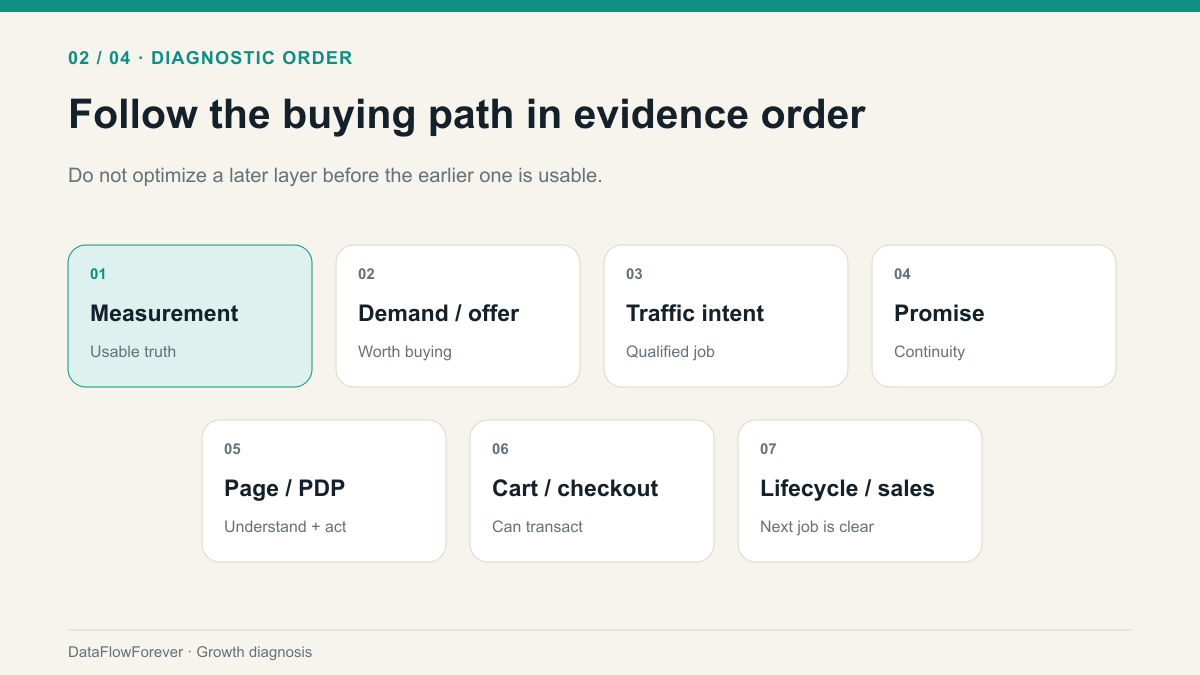
Start with one real cohort, follow the buyer's path in order, and stop at the earliest break supported by evidence. Assign one primary owner to the next validation. Email and conversion rate optimization remain in the path, but they must qualify for the job.
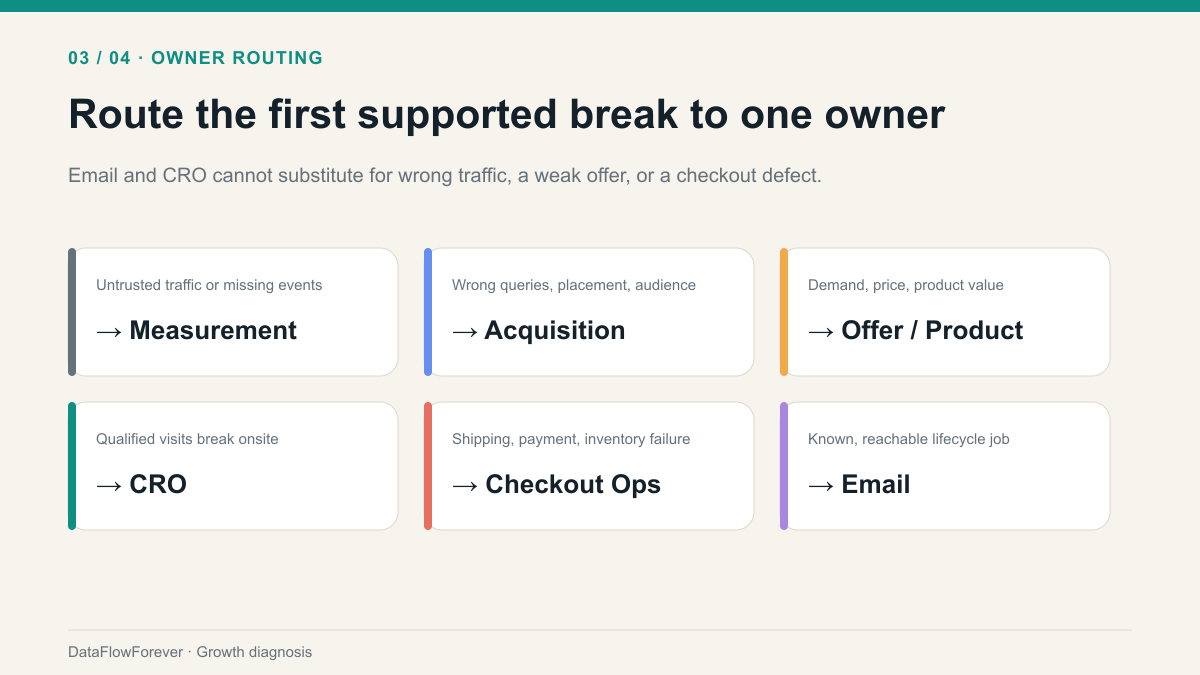
Make traffic decision-usable before calling it demand
A session count is not a count of prospective buyers. Session boundaries, consent, cross-device behavior, referral classification and automated traffic can all change the denominator.
Shopify documents acquisition reporting and bot filtering; GA4 distinguishes user acquisition from traffic acquisition. Those mechanisms help an operator inspect the data. They do not decide whether a particular spike represents people, intent, spam, attribution differences or missing events.
If one referrer, geography or device suddenly produces thousands of sessions without corresponding media exposure, spend, product events, checkout attempts or orders, preserve the raw count and compare it with approved classifications. Reconcile the spike against upstream exposure and downstream events. If the systems do not line up, Measurement owns the next check.
Session duration is also a clue, not a universal filter. A short visit can result from an accidental click, an irrelevant page, fast answer retrieval, slow loading or automation. A long visit can reflect confusion or a session boundary problem.
- Record the decision question and merchant type.
- Name the primary conversion unit and realistic observation window.
- Lock event definitions and cohort filters.
- Rate measurement confidence as trusted, partially trusted or untrusted for this decision.
- Use measure-only or insufficient-evidence when the data cannot support an owner.
Ask why the click happened
An advertising system can complete its click objective while the merchant still needs a purchase. For paid search, actual queries matter. Google's Search terms report exists because configured keywords and campaign labels do not fully describe what people typed.
For paid social, inspect the optimization objective, placement, geography, device, creative promise and destination. A creative can generate curiosity while filtering poorly for product, price or eligibility. A healthy click-through rate proves a response to the ad; it does not prove qualified purchase intent.
- What job was the person trying to complete?
- What product, outcome, condition or next step did the source promise?
- Did the first visible page continue that promise?
- Did the cohort show credible purchase progress rather than visits alone?
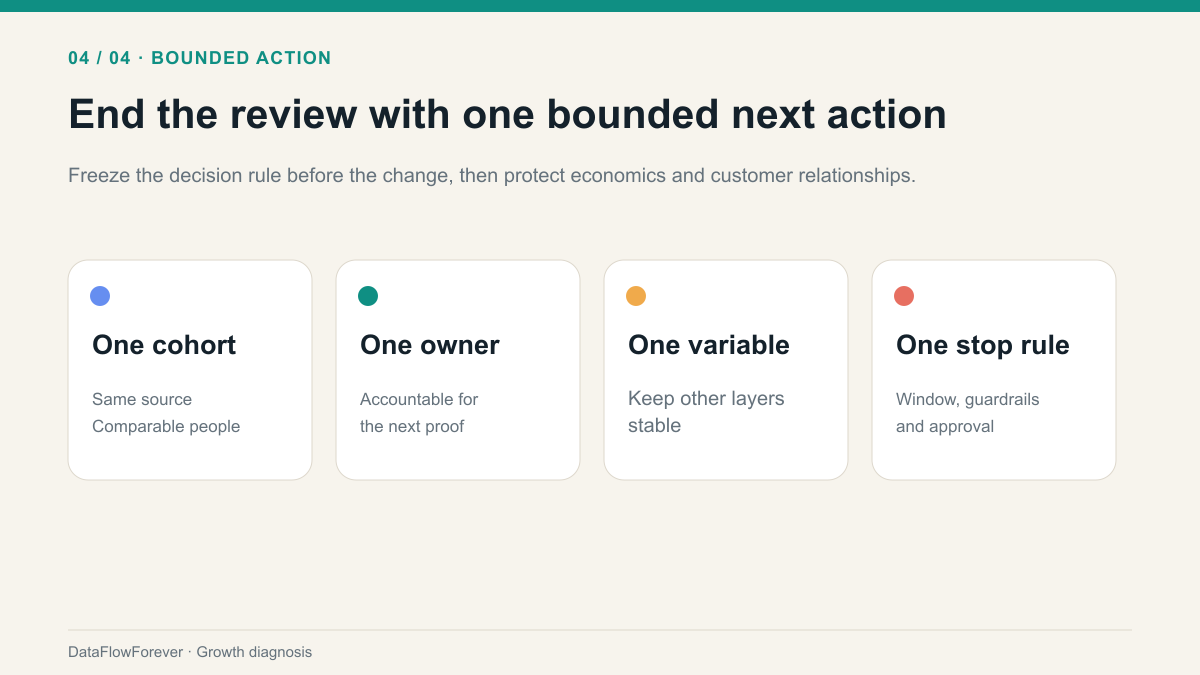
If queries, placements, objectives or audiences are demonstrably irrelevant, Acquisition owns the next correction. Media changes still require the appropriate approval. CRO should not optimize the experience around the wrong audience, and Email cannot convert anonymous or ineligible traffic into a legitimate sending population.
Separate offer substance from page expression
Some merchants have already added videos, reviews, FAQs, guarantees and calls to action. The store still struggles. The next discussion often focuses on button color while the buyer's reason to purchase remains uncertain.
What use case does the product serve? Who values it in that context? How does price compare with a credible alternative? What do the bundle, delivery promise and return conditions change? Why act now instead of using a familiar marketplace, selecting a substitute or doing nothing? Those are Offer/Product questions. A page can make the answers understandable; layout cannot manufacture demand.
Sales on Etsy show that a product can sell within Etsy's search, review, trust and transaction context. They do not prove the same offer should convert from cold traffic on a direct store. The channel difference is useful evidence, but it is neither cross-channel product-market-fit proof nor proof that the Shopify page caused the failure.
Write two hypotheses when the evidence crosses this boundary. One addresses product, use case, price, bundle, objections and economics. The second addresses whether qualified visitors can understand, trust and act on that otherwise plausible offer.
Let CRO own a localizable transition
Once measurement is usable, traffic is basically qualified and the offer is explicit, CRO has a defined object. Promise continuity is one candidate: a visitor clicks for a particular model, availability claim, delivery condition or service inclusion, then lands on a generic page or sees different terms.
Understanding and trust form another candidate. Can a qualified visitor identify the product, fit, included items, price, delivery terms and risk? Are essential details visible on mobile? Do reviews, return statements and shipping terms agree across the path?
Action is the third candidate. Does the variant selector work? Does Add to Cart create a real cart? Is state preserved when the buyer returns? Are error messages understandable? Heatmaps, recordings and segment differences can help locate a problem, but remain observational evidence.
Use fix-now for a verified defect such as a dead control, mobile obstruction, missing required information or confirmed tracking error. Use test for an uncertain behavioral hypothesis. Before exposure, freeze the eligible population, allocation, primary variable, outcome window, signed direction, minimum business-material effect, numeric decision threshold, guardrails, stop conditions and approval owner.
High-ticket and low-volume journeys need particular care. Replace purchase with the actual qualified outcome when appropriate, include the realistic buying and follow-up cycle, and wait for mature cohorts. When the cycle is incomplete, insufficient-evidence is a valid operating decision.
Repair checkout before asking Email to recover it
Normal product views and cart creation followed by a break after checkout start move the earliest observable problem downstream. Inspect shipping methods, taxes, currency, inventory, discount rules, address restrictions, payment options, 3DS, gateway responses and visible errors. Reconcile attempts with orders.
A reproducible payment, shipping or configuration failure belongs to checkout-operations. CRO may inspect interaction and clarity, but it should not relabel an operational defect as a behavioral experiment.
Cart and checkout recovery Email can be useful after the defect is fixed or bounded. The customer must be identified and eligible for the message. Recovery can preserve the path, remind the customer of an unfinished task and address an evidence-backed objection. It should not assume that every abandonment requires a discount or send a customer back into the same failure.
Give Email a qualified lifecycle job
Email starts with a known, legally and operationally reachable person, not with anonymous traffic. That person is in a defined lifecycle state, and a message has a useful job.
Welcome communication fulfils the signup promise and supports a first decision. Education answers a supported objection. Recovery reminds a person with continuing intent. Post-purchase communication helps delivery and product use. Replenishment, repeat purchase, retention and reactivation serve established relationships. Each path needs eligibility, suppression, entry, exit, frequency and outcome boundaries.
When Email clicks look healthy but the landing action is weak, validate click-to-landing event truth first. If the message promises the wrong next step, email-lifecycle owns the correction. If the product or price cannot support the promise, hand off to offer-product. If the event path is not observable, return to measurement. If the same qualified cohort meets a clear page break, cro-onsite takes the next validation.
Email and CRO may share campaign version, eligibility, destination, device, page action, order, refund, unsubscribe and complaint evidence. Shared evidence does not require shared ownership. One team remains accountable for the next proof.
End the review with one bounded action
A useful diagnostic record contains:
- the decision question, merchant type, primary conversion unit and window;
- measurement confidence and the earliest observable break;
- one primary owner;
- evidence, counterevidence, hypothesis state, confidence and missing data;
- fix-now, test, measure-only, hold or insufficient-evidence;
- the next action, metric, window, stop condition and approval requirement.
Irrelevant search terms can produce an approval-gated Acquisition correction. A reproduced mobile cart defect can be repaired. Unreconciled payment errors need measurement before a fix. A small high-ticket cohort with unfinished cycles needs more evidence. When media, page, price and Email changes would contaminate the most important diagnosis, place lower-priority actions on hold.
Arbitrate conflicting evidence without creating joint root causes
Real cases rarely arrive with one clean explanation. Split candidate explanations into separate hypotheses. Record supporting evidence, counterevidence and missing data for each. Give one primary owner to the earliest supported break. That assignment makes the owner accountable for the next proof; it is not a causal verdict.
A winner needs the frozen directional rule and a valid design. no-material-difference requires enough precision to rule out a business-material difference. contradictory records conflict between the primary outcome, cohorts or guardrails. insufficient-evidence covers inadequate volume, time, allocation, instrumentation or completed buying cycles.
Queries and budgets, prices and discounts, checkout and payment, sending and contact can create operating risk. Diagnosis does not grant production-change authority. Verify read-only evidence first, then have the accountable owner approve the action.
Research boundary
This article reviewed 22 Reddit question-and-answer threads, 20 X discussions, six official sources and three independent studies. Community material supplied vocabulary, hypotheses, conflicts and counterexamples. It did not supply universal benchmarks, causal conclusions or performance promises. No usernames, copied comments, popularity signals, fixed conversion rates, fixed session-duration rules or unverified lift figures were used.
These sources explain current mechanisms. They do not diagnose a specific merchant or guarantee an outcome.