
Email Open Rates Look Healthy. Why Aren't Orders Following?
Freeze one comparable cohort, message job, version, and window. Then find the first observable transition that materially failed.
A strong email open rate and weak sales do not point to one automatic fix. The audience may have changed. Some eligible profiles may never have reached the send. Privacy or security systems may have generated part of the measured engagement. The email may have earned a real visit while the offer, product page, checkout, inventory, or payment step failed. Orders may even have increased while discount cost, returns, or margin made the treatment unattractive.
The useful first move is to freeze one comparable cohort, message job, version, and observation window, then find the earliest observable transition that materially failed.
That approach keeps the team from changing the subject line, body, incentive, landing page, cadence, and entire Flow at the same time. It also gives every metric a defined job instead of asking one attractive percentage to represent the whole program.
Freeze the comparison contract before reading the dashboard
Write these four items at the top of the review.
Cohort
Who was eligible, and why? Record acquisition source, consent and reachability, lifecycle stage, prior purchase, relevant product or account state, geography, and any exclusions that materially change the mix. A new lead-magnet cohort and a returning-customer cohort can produce different orders behind the same open rate.
Message job
What customer or business step was this message meant to support? A Welcome message might need to deliver the signup promise. Recovery might need to preserve the path back to a valid cart. Post-purchase education may need to reduce setup failure. A B2B message may need a qualified reply or a held meeting rather than an immediate sale.
Choose one primary outcome that matches that job. Keep upstream activity as diagnostic evidence.
Version
Record changes to the subject, body, offer, product selection, CTA, destination page, Flow eligibility, send policy, and attribution settings. If several changed together, a better result cannot identify which treatment deserves to be retained.
Window
Define the send period, event window, conversion window, timezone, expected data delay, and treatment of refunds, returns, offline outcomes, and late conversions. A campaign observed for two days is not comparable with one that has completed its full purchase and return cycle.
Without this contract, “opens increased” and “orders decreased” may be accurate statements about different populations, policies, and time horizons.
Use six evidence layers instead of one KPI hierarchy
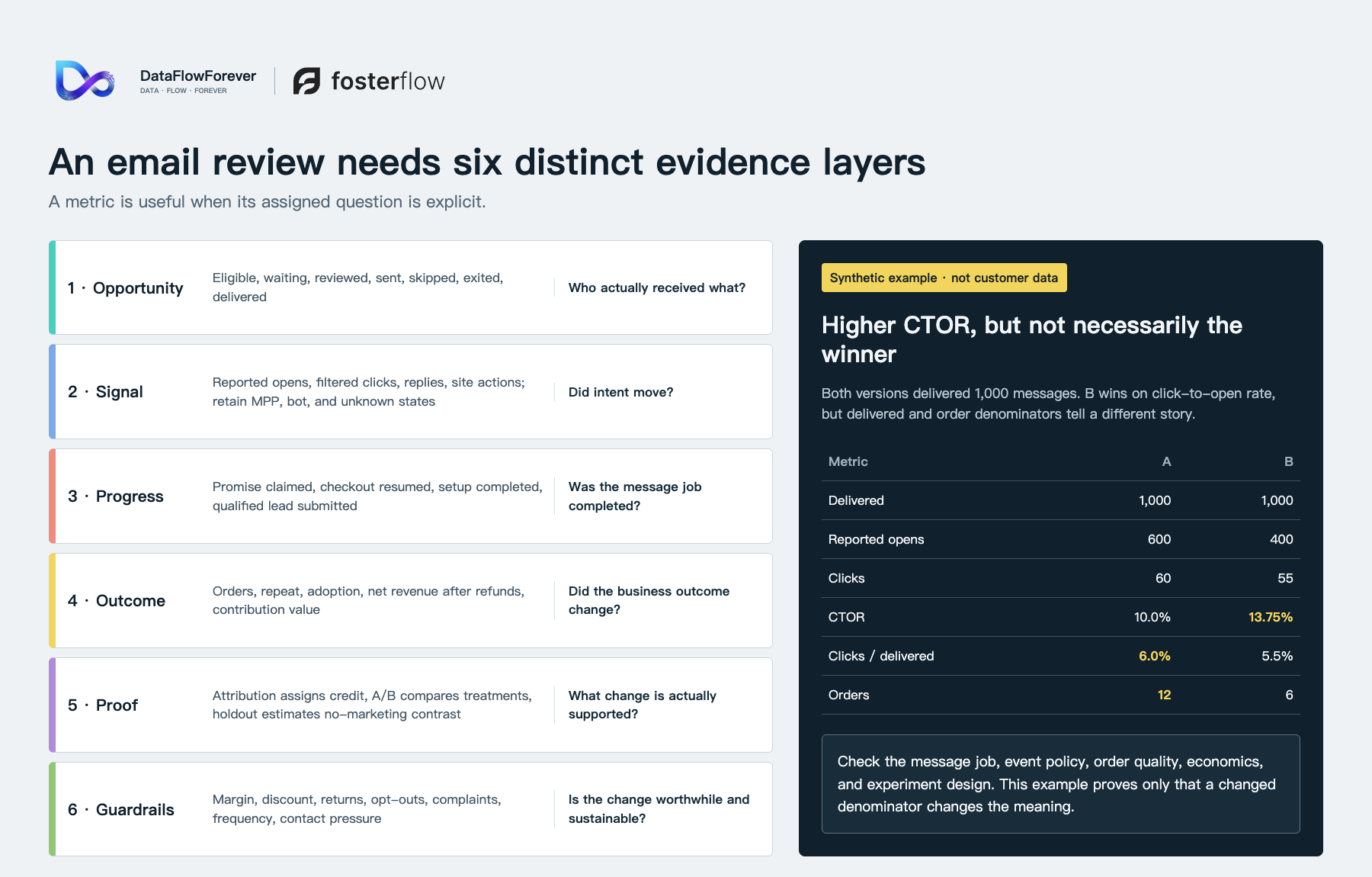
There is no universal ladder in which every click is more important than every open, or every attributed order is more important than every customer-progress event. Use six layers, each with a narrower responsibility.
- Opportunity and runtime: Who was eligible, waiting, sent, skipped, exited, or delivered? What it cannot prove alone: Attention, inbox placement, or value
- Signal: Which opens, clicks, replies, or site events were observed under the declared policy? What it cannot prove alone: Human intent or business impact
- Customer progress: Did the message help the person complete its intended next step? What it cannot prove alone: A profitable or incremental outcome
- Business outcome: Did orders, qualified leads, adoption, repeat purchase, or net revenue change? What it cannot prove alone: Which touch caused the change
- Proof method: Is this attribution, a historical trend, an A/B comparison, or a no-marketing contrast? What it cannot prove alone: Answers belonging to another proof design
- Guardrails: What happened to margin, refunds, returns, complaints, unsubscribes, and pressure? What it cannot prove alone: The primary outcome by itself
The layers are connected, but they are not interchangeable. A configured Flow does not prove runtime. A delivered message does not prove attention. An attributed order does not recover the unobserved counterfactual. A randomized comparison can reduce selection bias and still be too imprecise for the decision.
Treat opens as a classified signal, not proof of reading
Apple Mail Privacy Protection can load remote content through proxy infrastructure before or without the recipient reading a message. Security scanners, previews, and automated systems can also affect click records. The measured event is therefore not automatically a person-level statement of attention or intent.
Where the provider supports it, retain the raw event and record MPP: true / false / unknown, bot classification, the deduplication rule, policy version, and evidence time. State whether each reported metric includes or excludes classified events. An MPP value of false still does not guarantee human attention, and an unknown historical event should not be silently rewritten.
Open data remains useful for bounded directional diagnosis when the population, event policy, and window remain stable. A sudden change can justify checking sender identity, audience composition, subject treatment, or measurement settings. It cannot independently establish:
- primary-inbox placement;
- actual reading;
- healthy list quality;
- present purchase intent;
- future orders.
Use clicks, replies, current site behavior, purchases, and customer state as stronger downstream evidence for consequential decisions.
Check the numerator and denominator before selecting a winner
Consider a synthetic example. These figures are not customer or FosterFlow data.
Both versions deliver 1,000 messages:
- Version A records 600 reported opens, 60 clicks, and 12 orders. Its click-to-open rate is 10%.
- Version B records 400 reported opens, 55 clicks, and 6 orders. Its click-to-open rate is 13.75%.
If the review ranks only click-to-open rate, B wins. Measured against delivered messages, A produces a 6% click rate and B produces 5.5%. The order counts are 12 and 6.
That still does not make A a proven winner. We do not know whether assignment was comparable, whether the orders had similar value, whether refunds or discounts differed, or whether the observed gap is distinguishable from random variation.
The durable lesson is simpler: changing the denominator changes the question. Every rate should retain its raw numerator, denominator, population, event policy, window, and decision role. For small audiences, show the counts. A move from ten clicks to seven and a move from 10,000 to 7,000 should not produce equally confident recommendations.
Find the first broken transition
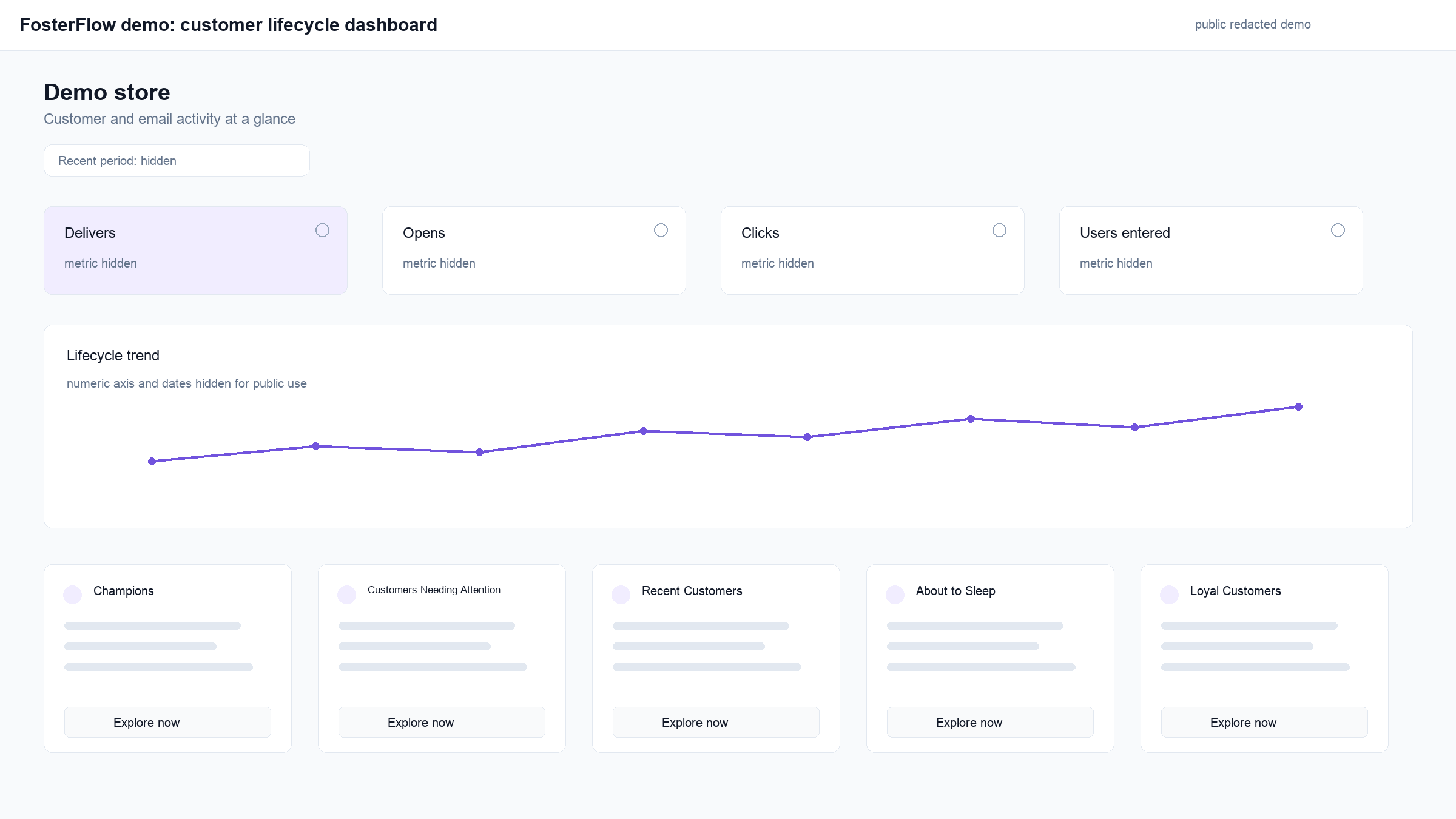
Take one Campaign or Flow and trace the same eligible population in order.
Eligibility to send and delivery
Review consent, reachability, suppression, purchase exits, contact pressure, inventory, conflicting journeys, and send-time eligibility. If a large share never had a valid opportunity to receive the message, fix execution before rewriting copy.
Delivery to credible action
If delivery is stable but reported opens move, inspect sender and audience changes, subject treatment, MPP policy, and the comparison window. If opens look similar while filtered clicks, replies, or attributable site activity fall, inspect promise continuity, customer-stage fit, primary CTA, link operation, product mix, and mobile experience.
Action to page or checkout progress
Credible visits with weak progression move the diagnosis downstream. Review offer fit, page-message match, product evidence, price, shipping, inventory, trust, speed, forms, payment, and checkout friction. Another subject-line test will not repair a destination that fails to continue the promise.
Progress to the selected outcome
Verify the event, deduplication, identity association, order or lead state, and outcome quality. For a considered B2B journey, keep reply, booking intent, booked meeting, held meeting, qualified opportunity, pipeline, and realized business value separate.
Outcome to net value
Reconcile net revenue, refunds, returns, discount cost, product margin, fulfillment, support, and other variable costs. When a complete profit view is unavailable, record the economic evidence gap rather than renaming attributed revenue as profit.
Stop at the first materially weak transition that has enough evidence to support a local test. Assign one owner, one proposed change, one primary result, guardrails, and a review date. “Insufficient evidence” is a valid state when the data cannot distinguish the competing explanations.
Reconcile revenue at the conversion level
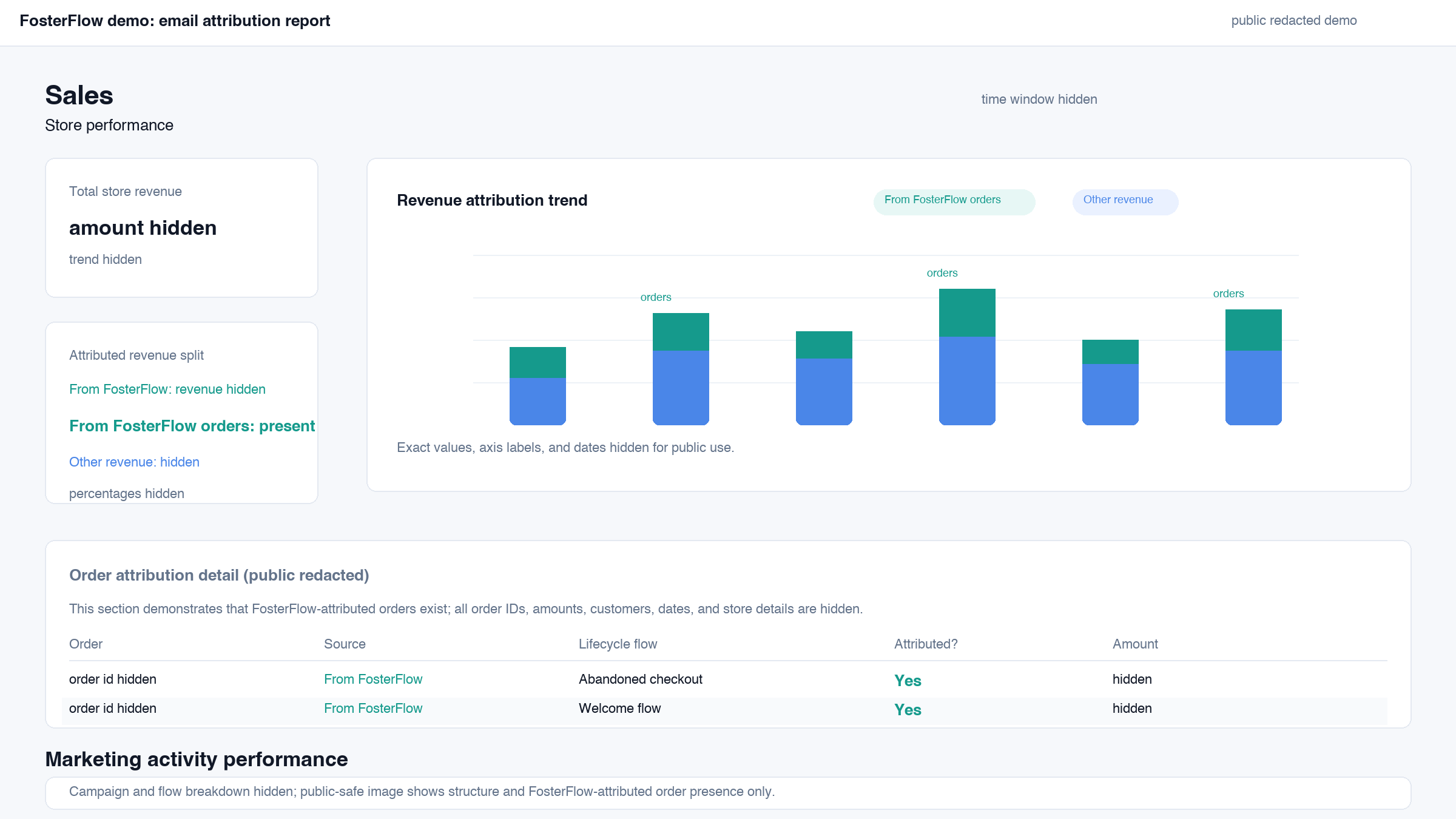
An email platform, Shopify, GA4, and the order backend can report different revenue without any one table being arithmetically broken. They may use different identity evidence, interaction windows, order times, refund treatment, cross-device logic, attribution models, or historical recalculation.
For company-wide decisions, DataFlowForever starts with a canonical conversion fact and applies one disclosed, versioned, channel-neutral policy across the sources inside the agreed coverage. Each in-scope conversion should expose:
- ID, type, time, amount, currency, and current order state;
- associated identity, device, session, and covered touchpoints;
- missing, duplicate, late, conflicting, or excluded evidence;
- model, window, mapping, identity rule, and policy version;
- assigned credit or a reasoned no-credit state;
- platform claims, reconciliation differences, and remaining uncertainty.
White-box attribution does not mean forcing every conversion into a positive channel bucket. Unattributed, excluded, reversed, identity unresolved, and insufficient data can be honest outcomes when the evidence does not support credit.
This approach is global within declared coverage, not a promise to observe every possible influence. Channel-platform attribution remains useful for comparing that channel with itself when conversion definitions, windows, signal policies, identity rules, and value treatment remain stable. Self-attributed revenue from several platforms should not be added together and presented as cross-channel incremental value.
Ask attribution, A/B, and holdout the right questions
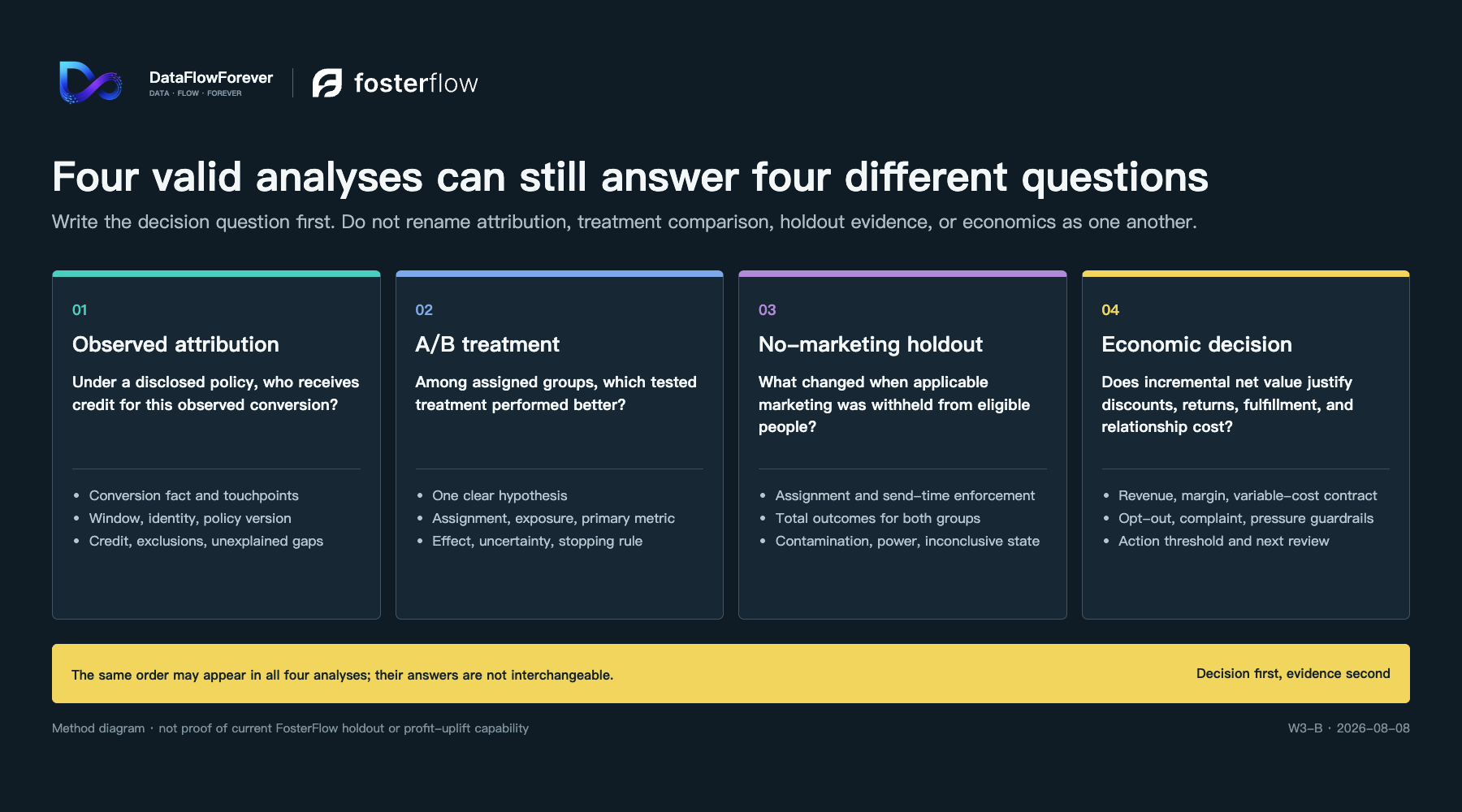
Observed attribution asks which covered touch receives credit for a conversion that occurred under a disclosed policy.
A/B treatment comparison asks which eligible treatment performed differently on a predeclared outcome. A useful test defines the decision, hypothesis, eligible population, assignment, one reviewable treatment difference, primary outcome, minimum useful effect, window, stopping rule, signal policy, and guardrails before results are visible.
No-marketing holdout asks what changes when an eligible group does not receive the applicable marketing. It requires durable assignment, actual send-time enforcement across in-scope Campaigns and Flows, governed service-message exceptions, total outcomes for both groups, and reporting of contamination and uncertainty.
Lewis and Rao studied 25 large randomized digital-display experiments, each with more than 500,000 users, and still found that return-on-investment estimates could remain highly imprecise. This is not an email sample-size rule. It shows why randomization addresses selection bias without automatically providing enough precision for a business decision.
Current FosterFlow evidence does not verify a complete global-holdout runtime, governed MPP classification controls, normalized profile-level skip-reason audit, arbitrary conversion-property drilldown, or profit-uplift targeting. Those remain explicit product and research directions, not capabilities that can be inferred from a static concept or another vendor's feature.
Add profit and relationship costs before scaling
Baier and Stoecker report an online-shop randomized experiment with approximately 155,000 customers. Under the paper's simplified 20% discount and 30% margin assumptions, the treatment increased purchase response and revenue per customer while reducing profit per customer.
The figures are not ecommerce benchmarks, and the paper's equation is not a merchant's complete ledger. The useful boundary is that response, revenue, and profit are different objectives.
Define the intended net-value outcome before reading the test: net revenue, refunds or returns, product margin, incentive cost, variable fulfillment, and any decision-relevant contact cost. Keep unsubscribes, complaints, repeated exposure, and contact pressure visible by acquisition source, lifecycle job, delivered recipients, and exposures per person. An unsubscribe can be a healthy exit or evidence that the signup promise and ongoing program do not match; a universal threshold removes that context.
Turn the report into a seven-field decision record
A weekly or monthly email review is complete when it produces a decision, not when it adds another dashboard tile. Record:
- 1. Message job: What did this population need to complete?
- 2. Comparison contract: Which cohort, version, window, event, and value definitions apply?
- 3. Population lineage: How many were eligible, waiting, sent, skipped, exited, and delivered?
- 4. First broken transition: Which step weakened first?
- 5. Evidence state: Observed fact, hypothesis, contrary evidence, unknown, or insufficient evidence?
- 6. One action: Who changes what, judged by which primary outcome and guardrails?
- 7. Review condition: When will the team keep, stop, revise, or expand the change?
Start with one high-volume, disputed, or economically important Campaign or Flow. Bring the raw population counts, order or lead facts, attribution settings, refunds, and available economics into one review. That bounded exercise usually creates more reusable learning than a larger composite score.
Frequently asked questions
Does a high open rate prove good deliverability?
No. Authentication, bounces, complaints, provider diagnostics, sender identity, and stable downstream behavior are needed for a delivery diagnosis. Opens are affected by remote-content loading and audience composition and do not identify inbox placement on their own.
Which revenue number should the business trust?
Start with the agreed conversion fact and order state, then reconcile each conversion against covered identities, touchpoints, windows, refunds, and policy rules. Use one reproducible cross-channel view for company decisions and retain channel-platform views for stable-definition self-comparison. No dashboard is automatically complete or causal truth.
Are clicks always more important than opens?
No. A declared open metric can diagnose a subject treatment. Filtered clicks, replies, or site activity can diagnose content and CTA. Orders, qualified leads, adoption, net value, or another downstream outcome should govern the job they actually represent. Metric authority comes from the decision it supports.
Can a small list support testing?
It can support a bounded test or next hypothesis when raw counts, minimum useful effect, window, and uncertainty are visible. If the sample cannot distinguish a decision-relevant difference, report insufficient evidence. Do not pool unrelated audiences and message jobs solely to create a larger number.
Review one real path next
Start with the customer job, comparable population, and first weak transition. Route the next action to the message, Flow, page, checkout, measurement, or economic owner supported by the evidence.
Attribution Analysis is available only to customers actively using our CDP when payment is accepted and after the agreed pre-payment coverage check passes. Standard delivery is one PDF and one Excel evidence ledger through WeChat, without an included interpretation meeting. Ongoing model policy or operating-review design requires a separately written consulting scope.
Sources and boundaries
- Apple, Klaviyo, Shopify, and GA4 links calibrate their respective current platform mechanisms.
- Lewis and Rao support the precision boundary for randomized measurement, not an email sample-size threshold.
- Baier and Stoecker support the distinction between response, revenue, and profit, not a merchant benchmark.
- Community discussions provide operator problems and hypotheses. Synthetic figures and product-structure screenshots do not represent customer results.