
Acquisition, Conversion, or Retention: What Should You Fix First?
Contain material harm, establish decision-grade facts, find the current constraint, and authorize one bounded action with an owner and stop rule.
The weekly growth meeting can produce several accurate warnings at once.
Paid acquisition is getting more expensive. Store conversion is not improving. Repeat purchase is below the team's expectation. The advertising lead wants new creative and more testing budget. The ecommerce lead wants to rebuild the product page. The lifecycle team wants another Flow. Operations is still dealing with inventory, shipping, payment, or service issues.
Each proposal may be sensible. The list still does not tell the owner which problem deserves the next scarce week, budget increment, or accountable person.
Spreading resources across every request creates movement without clean learning. Changing traffic, pages, offers, prices, and messages together makes the next result hard to explain. Choosing one familiar metric is not much better. A team can improve platform ROAS while contribution deteriorates, raise conversion by discounting too deeply, or lift repeat revenue by contacting customers who would have purchased anyway.
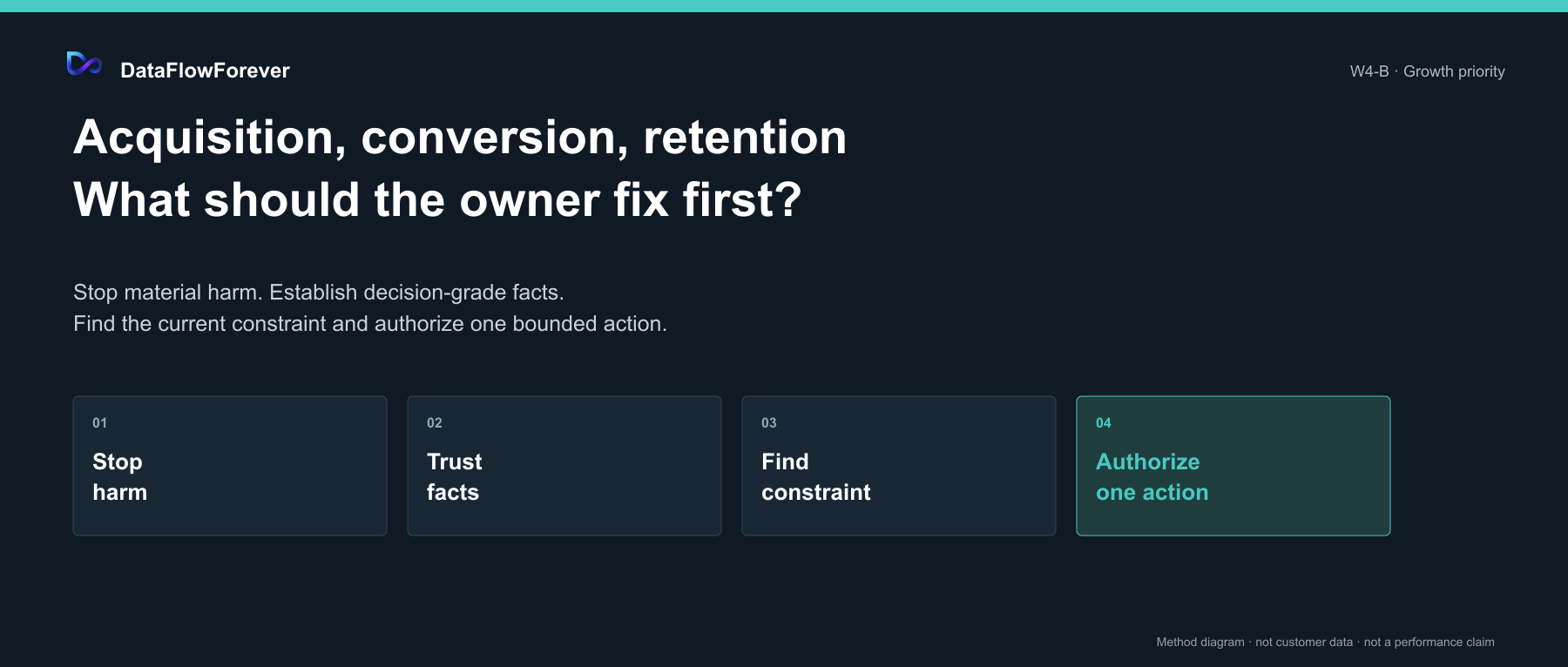
When acquisition, conversion, and retention all look weak, use this order: contain any material harm; make the facts usable for the current decision; identify the constraint most directly limiting customer and business outcomes; then authorize one bounded action with a named owner, observation window, guardrails, and a stop or handoff rule.
This is not a permanent ranking of departments. Constraints move. A business that repairs acquisition quality may expose a conversion problem. A better checkout may reveal poor product economics. A successful first order may expose weak delivery or the absence of a natural next-value opportunity. Priority has to be reviewed when the evidence window closes.
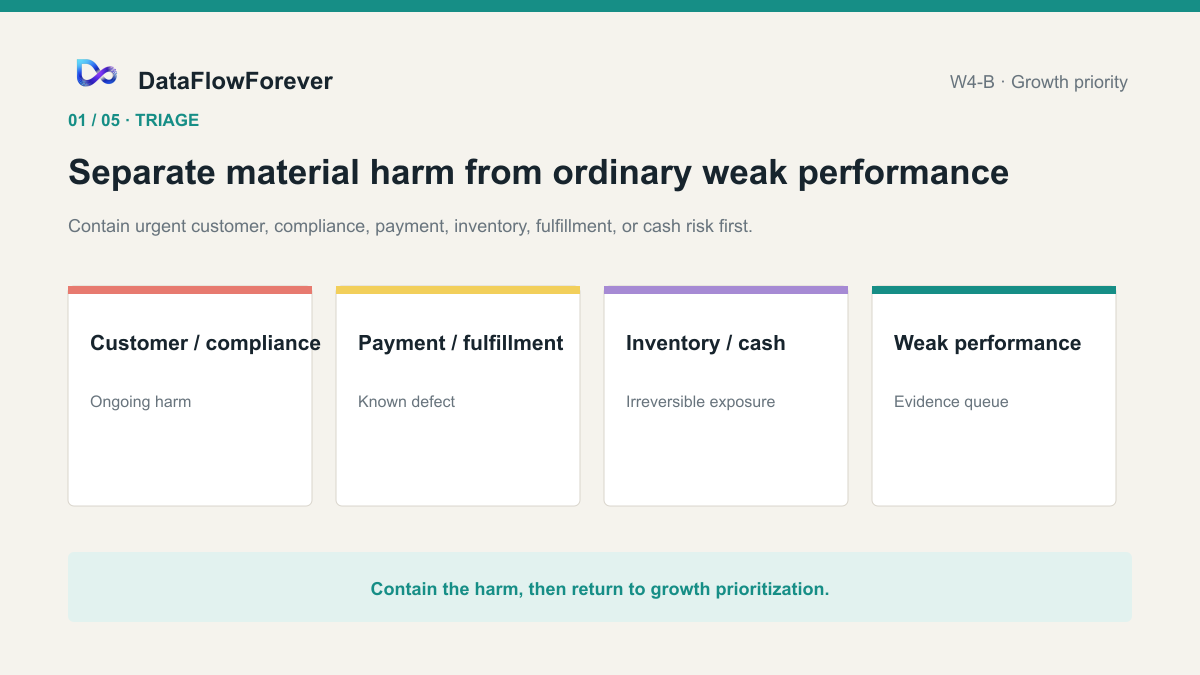
Put material harm in a separate queue
Some facts should not wait for an ordinary growth experiment.
A reproducible payment defect, an inventory promise the business cannot fulfill, a compliance exposure, repeated customer harm, or a cash commitment that threatens existing obligations needs containment. The owner should define what is known, which markets, products, devices, or customers are affected, how the impact will be limited, who owns repair, and what evidence is required before normal operation resumes.
Containment is not a reason to call every weak metric an emergency. A weekly ROAS decline, a disappointing aggregate conversion rate, or a repeat-purchase rate below an internal target may be important without being urgent. They still need a valid denominator, a relevant natural window, and a clear business consequence.
Physical products add irreversible decisions to this check. A larger minimum order may reduce unit cost while increasing inventory exposure, storage, obsolescence, markdowns, returns, and cash tied up before demand is known. The lower supplier quote is only one input. Sell-through scenarios, lead time, shelf life, fulfillment capacity, and total downside determine whether the commitment is safe enough to make.
Once known harm is contained, return the issue to the same evidence-based priority process as every other initiative. Otherwise, emergency action becomes an unreviewed permanent plan.
Build a fact base for the decision, not an infinite data project
Cross-functional reviews often compare metrics that were never designed to answer the same question. Advertising brings platform revenue or ROAS. Ecommerce brings conversion rate. Lifecycle brings attributed revenue, repeat rate, or engagement. Finance brings recognized revenue and cash. Their windows, denominators, attribution rules, exclusions, and cost coverage may differ.
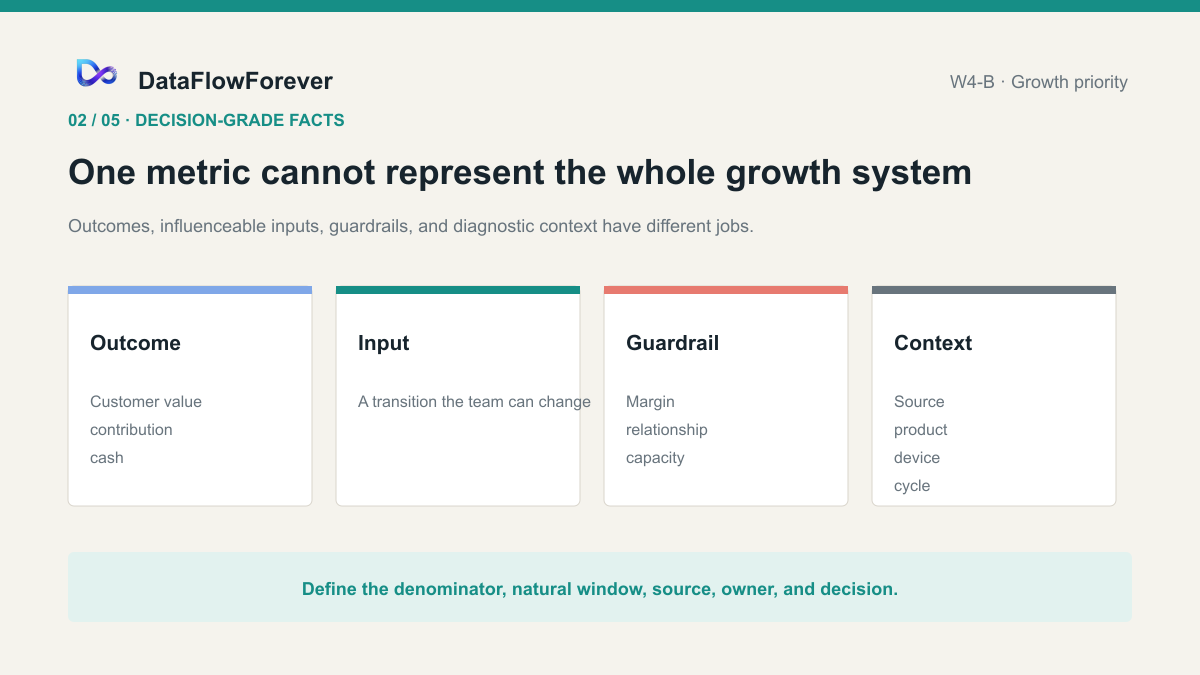
Keep four metric jobs visible:
- Customer and business outcomes. What useful state did the customer reach, and what net contribution or cash result matters to the business?
- Influenceable inputs. Which transition or operating condition can the team change and plausibly connect to the outcome?
- Guardrails. Which margin, relationship, consent, refund, inventory, fulfillment, support, risk, or capacity limits must not be damaged?
- Diagnostic context. Which source, market, product, device, offer, promotion, customer age, and natural cycle explain the result without becoming targets by default?
For every promoted metric, define the value unit, qualification rule, numerator, denominator, cohort, exclusions, source, freshness, natural window, owner, and the decision it can change. An aggregate conversion rate can fall because low-intent traffic grew faster than qualified traffic. Repeat purchase can look weak because most customers have not reached the next natural use or replenishment interval. A platform conversion value can omit refunds, fulfillment, service, inventory, or other operating costs.
Google Analytics Funnel exploration supports ordered steps, segments, time constraints, and open or closed funnels. Path exploration can help an operator work backward from an outcome and inspect earlier branches. Those are useful observation mechanisms. A drop between two steps does not identify its cause.
Shopify customer and cohort reports connect first-order groups with later behavior and explicitly separate projections from guaranteed future sales. Shopify's marketing reports also disclose data delays and model differences. These facts make the reports more useful, not omniscient.
If sessions, events, orders, costs, or customer identities cannot be reconciled for the decision at hand, the first initiative can be a small measurement repair. Limit it to one market, source group, product cluster, and outcome window. The goal is decision-grade evidence, not perfect historical reconstruction. “Insufficient evidence” is a valid operating state when it prevents a large, poorly supported allocation.
Check whether the business is ready to amplify
Teams frequently debate advertising versus CRO while leaving an earlier question unanswered: does the offer create enough customer value, at a supportable price and cost structure, for either tactic to scale?
An early business can begin with a small, reachable customer group. The purpose is not to hit a universal interview count. It is to learn what progress those people seek, which alternatives they use, what makes them hesitate, what they will pay for, and whether the business can reach them again. An interview, waitlist, trial, preorder, first order, and repeat order are different evidence states. Early interest supports the next learning step; it does not prove product-market fit at scale.
Price also has three distinct questions. What price is achievable with the intended customer and alternatives? Does net order revenue cover the costs that truly vary with the order and acquisition? Can the business carry inventory, settlement timing, refunds, tax, operations, and the downside while it learns?
The U.S. Small Business Administration's market research guide asks about demand, market size, location, saturation, alternatives, and price. It is a useful scope check, not a substitute for customer evidence in another market. Shopify profit reports connect product cost, discounts, refunds, shipping, duties, and margin while warning that cost fields can reflect a point-in-time value. A platform profit report still does not contain every company cost.
If the achievable price cannot support contribution and cash requirements, the next work may belong to product, sourcing, packaging, assortment, fulfillment, order value, route to market, or a stop decision. A page can explain a viable offer. It cannot make an unviable order economically sound.
Distribution should also have a declared job. A small campaign may be designed to learn about an audience or offer. A mature channel may be designed to scale a repeatable mechanism. Those jobs need different budgets, evidence, and stop conditions. More reach is not the only definition of progress.
Trace the current constraint across the operating path
After urgent risk and decision-grade facts are handled, inspect the connected path from market and offer through acquisition, conversion, transaction, delivery, and retention.
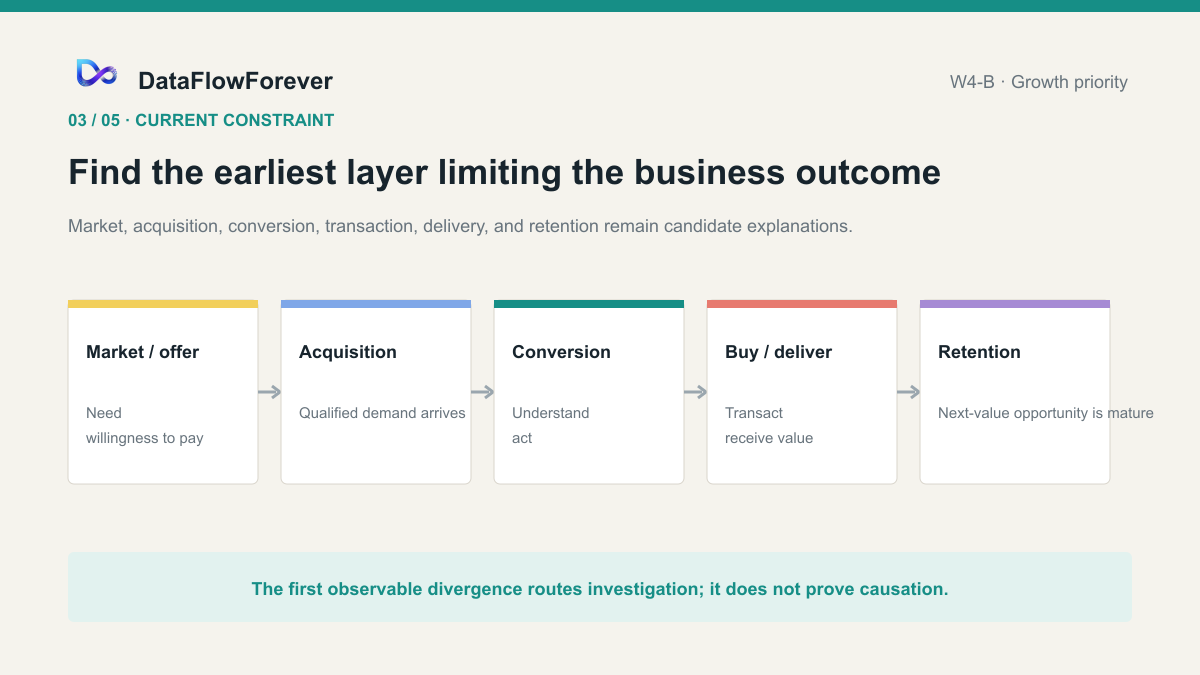
Market and offer. Is there a clear customer problem, a credible reason to choose this product, evidence for willingness to pay, and a route that can reach the intended customer? Weak evidence here makes downstream optimization fragile.
Acquisition. What job did actual queries, placements, objectives, markets, and creative bring? Clicks and sessions show entry, not qualified demand. Compare like-for-like source cohorts rather than letting a channel label stand in for intent.
Conversion. Can qualified visitors understand the product, confirm fit, trust the offer, choose, and act on desktop and mobile? Break aggregate conversion down by source, product, market, device, and step. CRO earns the next task when a local onsite or transaction break can be located.
Transaction and delivery. Can the customer see the correct price, shipping, tax, inventory, address restrictions, payment options, and delivery commitment? Repair reproducible operational defects before asking recovery messaging to return people to the same failure.
Retention and next value. Did the customer receive and use the first value? Has the natural replenishment, renewal, expansion, cross-sell, or advocacy opportunity matured? More lifecycle messaging cannot create a repeat need that does not exist.
This page is deliberately different from More Emails, Still No Orders: Find the First Broken Step. That article traces one traffic-to-order path and routes its earliest supported break. This one addresses the owner's portfolio decision when several systems and teams compete for resources. An observable divergence directs investigation; it does not by itself prove causation.
Make acquisition and retention prove investability
“Traffic is more expensive, so move budget to retention” may be a good hypothesis. It is not yet an allocation rule.
Retention is a cross-functional outcome. Product value, onboarding, delivery, service, the natural use cycle, and an available next action influence whether a customer returns. Before increasing retention resources, define an eligible opportunity denominator. Customers should have reached the relevant interval, received or been able to receive value, have a fulfillable next action, remain eligible for the treatment, and not already have converted or entered a conflicting path.
Then diagnose whether weak repeat behavior reflects customers who are not due yet, an inherently low-frequency product, no next need, a product or service failure, or a constraint the proposed action can influence. Existing repeat revenue does not prove that email, loyalty, incentives, or another retention treatment caused it. A defensible holdout is useful where feasible; a weaker comparison should be labeled as such.
Acquisition quality extends beyond the first order. Compare like-aged source-and-offer cohorts on net contribution, discounts, refunds, service burden, mature next-value opportunities, and payback. A lower first-order CAC can be a false economy. A cohort with higher projected lifetime value also does not automatically justify higher acquisition spend. Product mix, audience, geography, promotion, season, fulfillment, and selection can explain observed differences.
Research on acquisition and retention allocation has treated the problem as customer-profit optimization rather than a slogan. It supports attention to customer heterogeneity and marginal value, but historical model parameters are not a current ecommerce budget formula. Channel-platform attribution is more useful for self-comparison under stable rules. Cross-channel allocation still requires an explainable path from conversion to contribution and cash, with coverage and uncertainty visible.
For a deeper Email measurement treatment, see Open Rates Look Healthy. Why Aren't Orders Following?. It separates delivery, attention, action, purchase, attribution, and business outcomes. This article keeps Email inside the broader company priority decision instead of turning it into the default owner of retention.
Compare candidate work without hiding uncertainty in a score
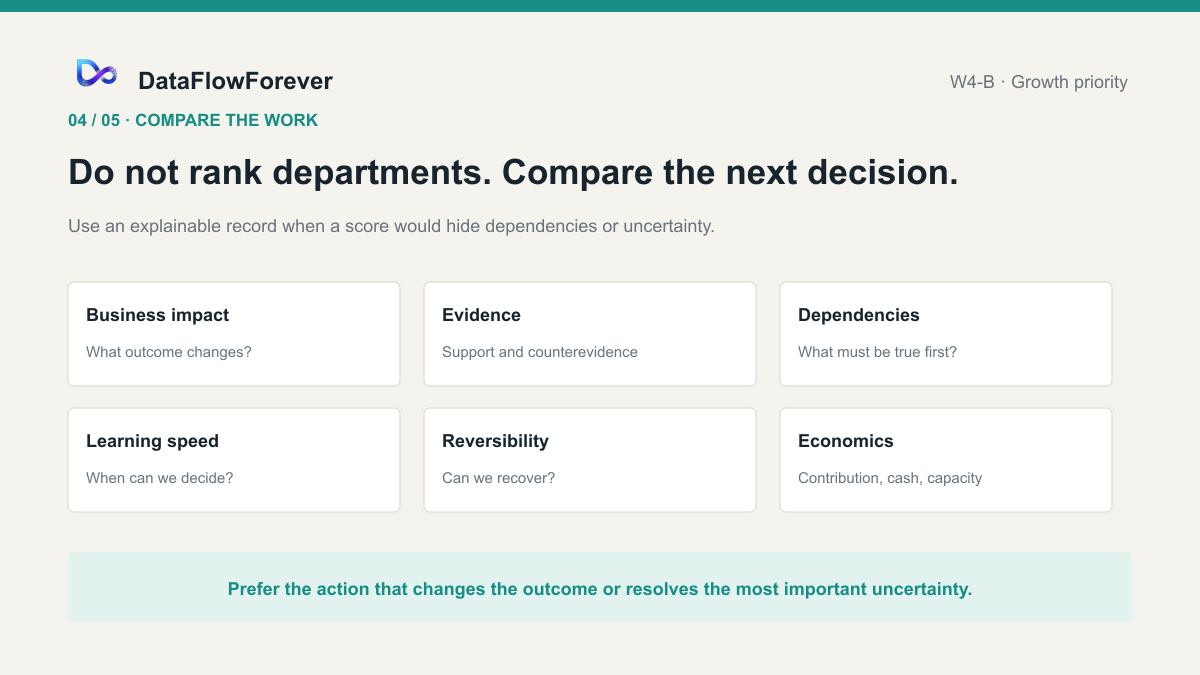
Once the current constraint is stated as a hypothesis, compare the next initiatives on the same record. A weighted score can help when inputs are genuinely comparable. It becomes dangerous when precise-looking totals hide missing evidence and hard dependencies.
Ask six questions for each candidate:
- Business impact: Which customer and economic outcome could change, and how large is the eligible denominator?
- Evidence: What supports the mechanism, what contradicts it, and what remains unknown? Is the evidence a document, configuration, observation, test, or operating result?
- Dependencies: Which market, data, inventory, product, permission, or team conditions must be true first?
- Learning speed: When can the business obtain evidence strong enough to change a decision, given the natural buying or repeat cycle?
- Reversibility: Can the team recover if the action is wrong? What customer, brand, legal, cash, or measurement damage could remain?
- Economics and capacity: What resources are required, and how might the action affect contribution, cash, inventory, service, and team workload?
Also name the primary role of the work. Does it build a repeatable mechanism, create a temporary acceleration, improve the efficiency of qualified flow, or provide a required input such as data, content, inventory, trust, or capacity? A campaign spike is not automatically a durable mechanism. A high rate on a tiny eligible denominator may not deserve company-wide focus.
The best next action often creates one of two forms of value. It can improve the most important current outcome, or it can cheaply resolve an uncertainty that controls a much larger later decision. A bounded measurement repair, customer study, or offer test can therefore outrank a larger channel or redesign initiative.
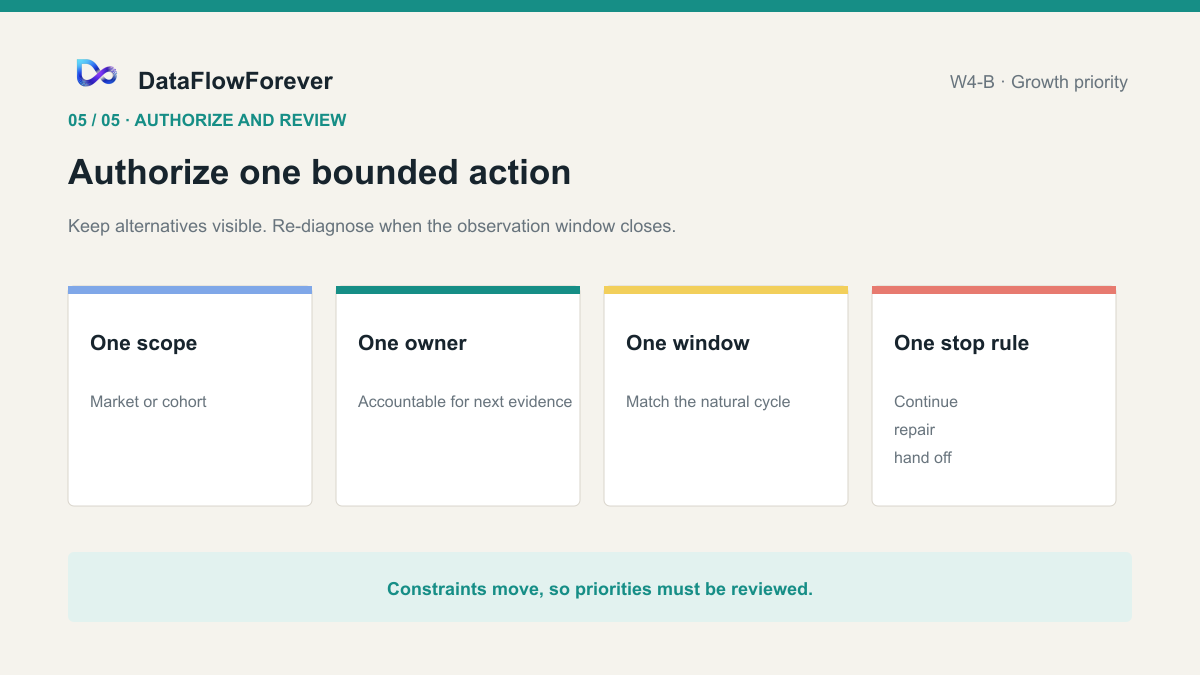
Authorize one bounded action, then re-diagnose
A useful growth review ends with an owner and a decision rule.
Use a Growth Priority Decision Record with at least these fields:
- Decision: Which next week, budget increment, or accountable owner is being allocated?
- Outcome: Which customer value and contribution or cash result matter?
- Material risk: Is containment required, for whom, and what restores normal operation?
- Fact state: Trusted, partially trusted, insufficient, or measurement required
- Constraint hypothesis: Evidence, counterevidence, unknowns, and the first observable divergence
- Candidate action: Expected mechanism, primary role, dependencies, and deferred alternatives
- Execution boundary: One scope, primary owner, resource envelope, and approval rights
- Observation: Outcome, guardrails, source, natural window, and review date
- Exit: Continue, scale, repair, pause, stop, or hand off
A known reproducible defect may be fixed immediately with before-and-after evidence. An uncertain behavior hypothesis needs a controlled test. Incomparable facts require measurement or research. Other simultaneous changes that would contaminate the primary decision should be held deliberately rather than forgotten.
DataFlowForever can enter through a bounded module such as advertising diagnosis, market and competitive analysis, attribution analysis, or Growth Strategy Consulting. When market, advertising, storefront, transaction, customer, and operating-capability decisions remain connected throughout the year, the One-Year Growth Partnership maintains a client-owned Growth Matrix across those decisions. The complete Matrix belongs to that nineteenth service; it is not a twentieth service, a zero-configuration product, or an autonomous priority engine.
If acquisition, conversion, and retention are all requesting resources, do not begin by choosing the most persuasive department. Put one customer and business outcome, the material risks, the fact state, the constraint hypothesis, and the candidate actions on one record. Authorize one bounded next step. When its evidence window closes, allow the priority to change.